




During the last 24 Hours of Le Mans, we had the opportunity to access inside the Ferrari garage to follow for a few minutes the operations before and after a double pit stop of the Ferrari #50 and #51, also listening to the communication channel between engineers and drivers. We can therefore tell you what we saw and heard, to give you an idea of what happens in these hectic phases of the race.
Read more 24 Hours of Spa 2026: Lionspeed feat, Porsche starts from the pit lane and wins the race
Inside the garage, the area is symmetrically divided into two parts, one for the crew of #50 and one for the crew of #51. The mechanics wait with helmets on, sitting on deck chairs, which is obviously justified by the fact that during a 24-hour race rest is necessary and the chairs we are used to seeing in F1 for mechanics are not the ideal solution here for those working for entire days.
Inside the heart of the #51 operation 👀#FerrariHypercar #Ferrari499P #WEC #LeMans24 pic.twitter.com/8vQOMIBPl3
— Ferrari Hypercar (@FerrariHypercar) June 16, 2026
Dividing the two areas of the garage are the spare parts of the front and rear bodywork of the 499P which must always be available for emergency repairs. Other mechanical components of the car such as suspensions and half-shafts are also ready for possible replacement but are kept in a more peripheral part of the garage. Due to the continuous refueling in the pit lane, the smell of gasoline is clearly noticeable, which is very similar in smell, of course, to the one we are used to when refueling our cars.
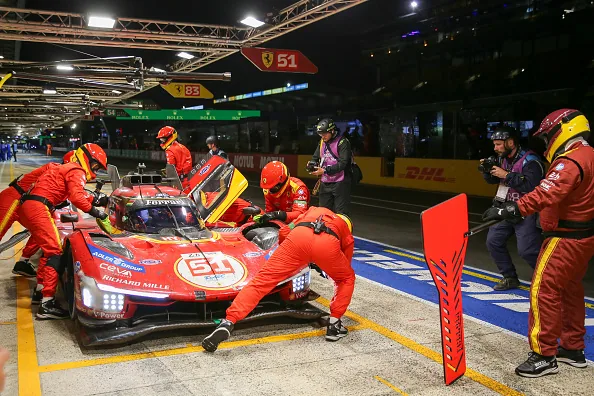
Only six mechanics can work on the car: four for changing the tires, one responsible for refueling, and one responsible for the “lollipop” to give the stop and go signal to the driver. The four mechanics who work on changing the tires must also take care of cleaning the car and the windshield while the refueling is carried out. Only at the end of refueling, according to regulations, can the tire change begin. This is why many teams try to do at least two stints on the same tires to avoid losing too much time in the pit lane.
There are no mechanics for lifting the car because a system of lifting jacks incorporated into the car’s floor and operated by compressed air, known as air jack, is used. This mechanism is activated and deactivated by a mechanic who inserts and removes a compressed air hose on the side of the car. The two pairs of mechanics responsible for changing tires operate divided on the front and rear axles, without interfering with each other.
Read more Ferrari in Brazil, Coletta: “The goal is to keep the fight open in both championships”
Did you make it?#FerrariHypercar #Ferrari499P #WEC #LeMans24 pic.twitter.com/bNdVNqszk3
— Ferrari Hypercar (@FerrariHypercar) June 18, 2026
We witnessed a sequence of consecutive pit stops between the two cars, #50 driven by Nielsen first and #51 which refueled on the next lap. On the in-laps for both drivers, Nielsen and Giovinazzi, their respective track engineers gave precise instructions on the lap time to be respected to ensure that operations proceed in the best possible way, without interference between the two teams and without entering traffic situations, which would complicate things considerably. The suggestions given are not only related to the lap time to maintain but also on the lift and coast phases in certain corners to allow. In short, the driver and engineer work like a pilot and an air traffic controller guiding the plane during landing and subsequent takeoff. Curiously, while stopping, Nielsen asked via radio when Giovinazzi would stop as well, which is not surprising considering they were glued in seventh and eighth position at the time.
The start from the pit box is also guided by the track engineer who counts down to the driver and the mechanic with the “lollipop” for the restart. The dialogue between driver and track engineer continues even during the out-lap on cold tires suggesting the lap time to keep and there are also, even in this phase, comments between driver and technician on the quality of the execution of the in-lap and out-lap. This feedback is useful considering that in a twenty-four-hour race there are at least thirty pit stops.
The pit stop of a Hypercar in conclusion is certainly much longer than that of a Formula 1 car, but the very limited number of mechanics working on the car and the different phases they must perform such as cleaning, refueling, tire change, visual check of the car make it an extremely fascinating team work moment
Read more Valentino Rossi returns to Goodwood behind the wheel of the BMW V12 LMR