




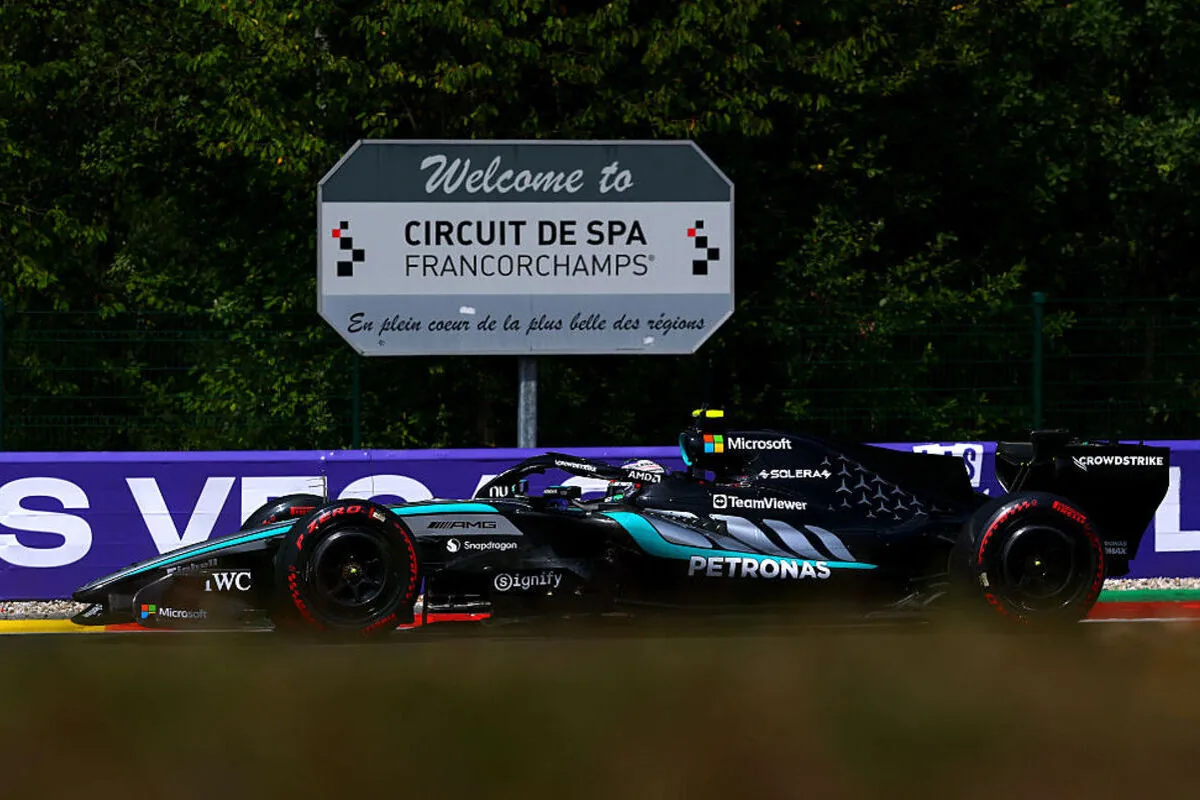
The third and final free practice session of the Belgian Grand Prix confirmed how complicated it is to find a truly effective optimization on the Spa-Francorchamps circuit. All teams worked on energy management and Power Unit usage modes, but the different strategies only partially unified. There remained, in fact, huge differences not only between one car and another, but even between two consecutive corners.
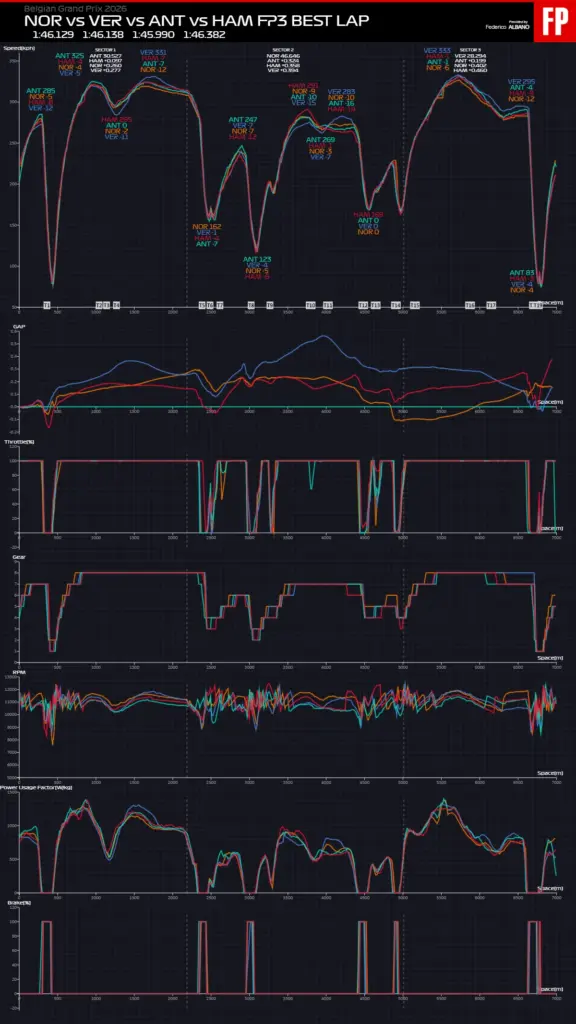
The most representative point is probably the passage at Pouhon. Ferrari actually releases all the available energy in the downhill approach to the fast double left-hander, while at the opposite extreme Max Verstappen performs harvesting throughout the downhill phase, with a speed difference reaching 15 km/h in favor of Hamilton. Immediately after the corner the situation reverses: Red Bull releases all the accumulated electric power, while Hamilton starts recharging, and the delta between the two rises to 19 km/h this time in favor of Verstappen. Numbers that tell how different the philosophies used by the various teams to tackle the lap are and how much the optimization between the various packages depends on the characteristics of the individual car and the Power Unit, with many more variables than usual on a track like this.
Red Bull chooses its own path again
Red Bull continues to make unique decisions compared to the rest of the field. Verstappen slows down a lot on the Eau Rouge climb, sacrificing speed in that section, then immediately releases energy at the start of Kemmel. And already here the differences compared to the competition are significant, both in terms of lower minimum speed and higher top speed, but it does not seem to depend only on aerodynamic load choices.
The RB22 then performs quite a bit of harvesting in the first half of the second sector, giving up something precisely in the most technical part of the circuit. The goal, however, is to reach the lower part of the track with a lot of energy to use. It is there, especially in the third sector, that the Red Bull Power Unit seems to work better, so much so that Verstappen set the best reference precisely in the last part of the lap. The doubt that arises looking at the data is that the Milton Keynes team has a greater sensitivity to elevation changes on the track, with a more pronounced charging phase downhill and a more evident discharging phase when the track is uphill. Whether this is out of necessity or a radically different strategic idea from that of the rivals is unknown, just as we do not know if it is a simple coincidence. We will see if in qualifying and race we will find this pattern again.
Ferrari follows an almost opposite philosophy. The SF-26 is very effective in corners and uses all possible energy in the first and second sectors. The price to pay, however, comes at the end. The car loses quite a bit of time in the lift and coast phase before turn 8 and arrives in the last sector with an obvious energy shortage compared to the competition, with clear repercussions on the third sector time.
Mercedes is the best synthesis
McLaren appeared instead very aerodynamically loaded, as shown by both the speed gap and the performance trend. Norris’s gap from Mercedes grows almost linearly in the first and third sectors, while it decreases in every corner of the central section. A choice that should also be linked to the need to build an effective race car, considering the ten-place penalty that the reigning World Champion will have to serve on the grid.
Mercedes, for its part, seems to have managed to combine the best qualities of all. The W17 is fast where energy is needed, but it is also competitive in almost all corners. The only obvious exception is Les Combes, where Antonelli loses something compared to the best references. Otherwise, the Brackley car appears complete, balanced, and above all capable of using power at the most profitable moments of the lap. The obvious exception so far is obviously Russell who cannot find a driving style suitable for this car and for such a complicated track from the energy management point of view. The three-pointed star is currently playing with only one point and it will be interesting to see in qualifying if Russell will close the gap as seen in previous races or remain far from his teammate and vulnerable to the rest of the group. Antonelli therefore arrives at qualifying as the big favorite for pole position. Formula 1, however, has accustomed us to the fact that just when a result seems written, something unpredictable often happens.
Ferrari must solve two different problems
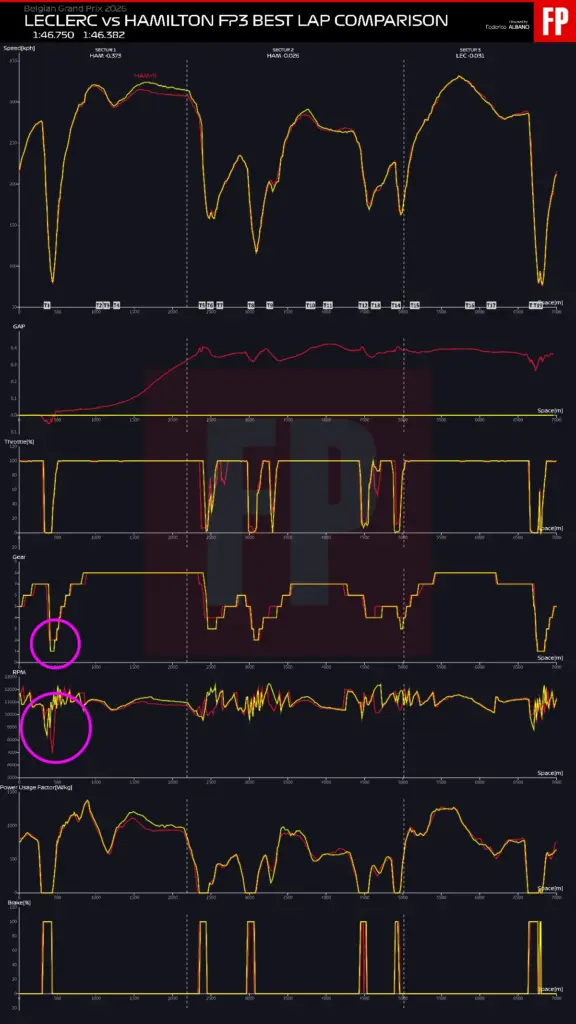
In Maranello, meanwhile, there is not only the race against time by the mechanics to fix Hamilton’s car. There is also the need to understand what did not work on Leclerc’s car.
Between the two Ferraris, no particular driving differences emerge. Almost all the gap originates on the Kemmel straight, where Leclerc clearly runs out of energy. A situation that has repeated itself more or less in all his laps and that can hardly be explained by a simple driver choice. The only real technical difference is seen at La Source: Leclerc always takes the corner in second gear, while Hamilton uses first. On the Monegasque’s car there is a significant drop in engine speed under traction, but it is hard to think that the problem is only that. If it were such a simple solution, the team would probably have already intervened.
Apart from the four tenths lost in the first sector, there are just five thousandths between Hamilton and Leclerc in the rest of the lap. Before qualifying, Ferrari must therefore win two challenges: get Lewis’s car back on track in time and restore to Charles the energy he continues to lack on the Kemmel.
Read more Alfa Romeo, the international expansion does not stop