

The first free practice session at the Spa-Francorchamps circuit showed from the very first lap the difficulties in tackling such a selective circuit on the Power Unit front with the current regulation cars. It is indeed more than clear from the data that the energy is not enough for the entire lap, with evident super clipping and charging sections and with energy usage strategies still very misaligned among the various teams. However, it was also possible to notice who went out on track with better preparation and what characteristic choices were made for this weekend start by the various teams.
Read more Mercedes against the current: here are the developments for the fast tracks
RedBull the fastest: PU that pushes high and a strategy always different from the others
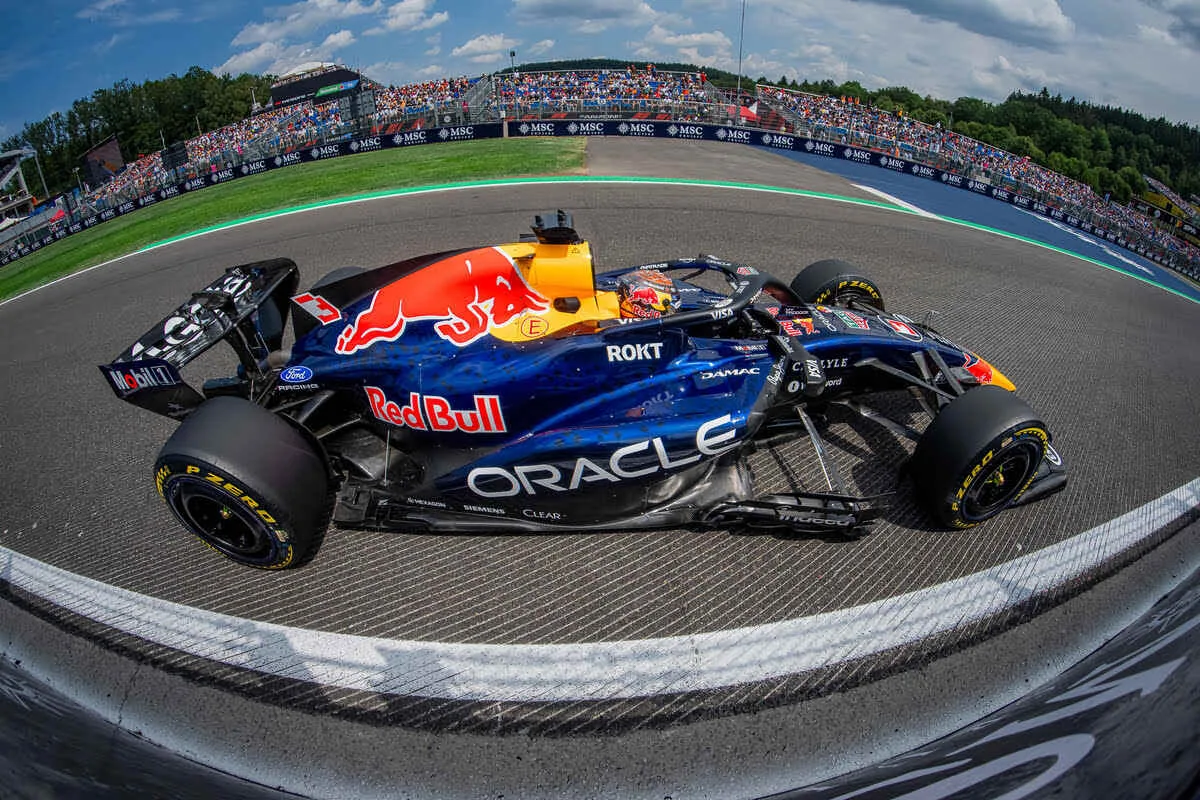
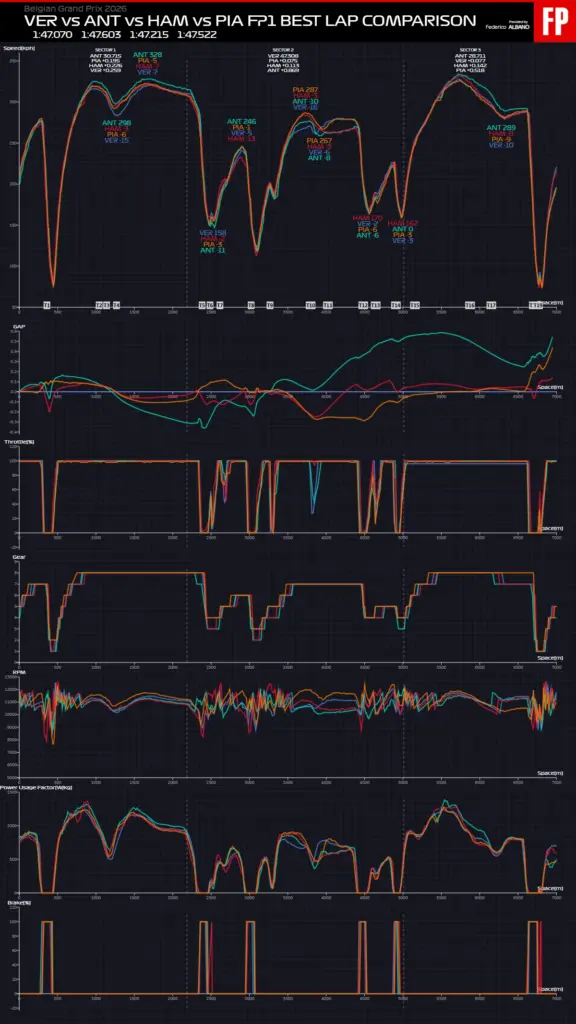
Best time for Max Verstappen and for a RedBull that appeared decidedly lively and fast from the first meters. Hadjar always close to his teammate throughout the session is a clear confirmation of this. Some RedBull shortcomings in the fast sections are evident, including the shockingly slow passage at Eau Rouge-Radillon but overall the compromise brought to the track by the Milton Keynes team seems good from the balance point of view and definitely reasonable as an energy delivery strategy, although some RedBull choices are always “original”. For example, on the descent towards Pouhon Verstappen leaves a full 16 km/h compared to Piastri, making great energy conservation, then releases it in the immediately following section. Overall, however, the Dutch Champion records the best middle sector, with a very “V-shaped” driving style in many of the fast corners, to minimize cornering time and, perhaps, brake a bit more to recover more energy. A profitable technique that also pays off in the third sector, especially in traction out of Stavelot. The super clipping that follows until after Blanchimont is a constant for everyone and is perhaps the worst point of the track, with cars slowing by about 50 km/h despite being in full throttle then starting to accelerate again towards the bus stop braking zone.
Ferrari close and fast, especially in corners
The Maranello team starts the weekend well, with both drivers, although Hamilton seemed to have something more on race pace. Once again, points of suffering for the SF26 on the energy side are noticed, but also an intelligent management that maximizes recovery in the less time-impacting sections of the lap to then use it in the points that guarantee the best gain. An example is the descent towards Pouhon where Ferrari constantly releases a large amount of energy to then exploit the good cornering load and “glide” until the Campus esses braking zone. The red engineers seem not to have sacrificed a large portion of downforce so far in the name of straight-line speed and for this they leave something on the energy front but the car is definitely the best in many of the Belgian track’s corners, both in terms of cornering speed and time gained. The difference between Hamilton and Verstappen is a matter of energy shortage out of Pouhon and a better exit from the bus stop for the Dutchman, otherwise the times are absolutely in line. It is also worth noting that Leclerc was not able to find the best third sector in his lap, otherwise he would probably have had the chance to close the session in first position. A Ferrari therefore that already seems at a good level of sophistication on such a complicated track and confirms itself as an excellent car in fast and medium-fast corners thanks to the excellent aerodynamic-suspension setup.
Read more F1 Belgian GP 2026, FP2: it’s time for qualifying simulation and long run, starting at 17:00 – LIVE
Mercedes the most struggling
Among the top teams, surprisingly the least brilliant seemed to be Mercedes. The data show a clear imbalance from the aerodynamic load point of view with the low downforce package that debuted on the W17 and that indeed brings tangible advantages in terms of straight-line performance, but also a really significant lack in the middle sector, where more downforce is needed to have grip in the fast corners. Between Les Combes and Stavelot Antonelli leaves almost 9 tenths compared to Verstappen and 8 compared to Hamilton, although he gains noticeably both on the Kemmel straight and in the last stretch up to the Bus Stop. The lack of grip also has a negative effect on energy exploitation in the twisty sections, as seen at Kimi’s passage at Pouhon where the Italian fails to make the best use of his Power Unit, the only slow one both on entry and exit. Work to do then for the Brackley team with the question whether the weekend path will be for them to go towards the track or the track, improving gradually, will go towards them.
We will already see in the second free practice what indications will come in this regard, both on the aerodynamic setup side and on the energy management front, where it will be interesting to note if an initial convergence of the teams will already be seen in this respect or if the important differences seen so far will be maintained.