








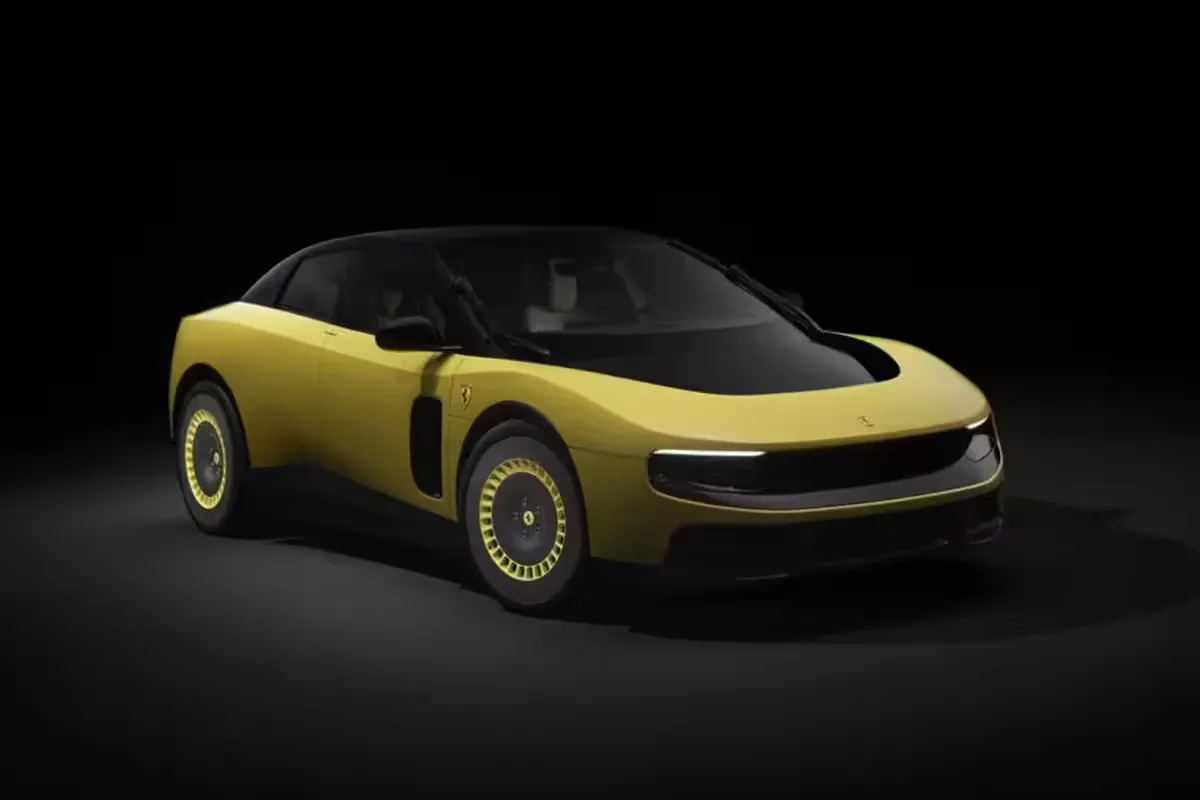
On the Ferrari Luce the battery pack is completely designed, validated and built in Maranello. And it is integrated into the vehicle floor. A solution that helps lower the center of gravity, improving overall dynamics. The battery consists of 210 cells in series and reaches a gross energy of 122 kWh operating at 800 V. The peak discharge power reaches 830 kW, while fast charging allows acquiring 70 kWh in 20 minutes, using a station up to 350 kW.
Read more Road safety, one of the most neglected challenges
The Ferrari Luce battery
The cells, co-designed together with SK on, are pouch type: they have a capacity of 159 Ah, with graphite anode and high-nickel nickel-manganese-cobalt cathode, using liquid electrolyte. In terms of electrochemical performance, the technology allows a density above 740 Wh/l and a specific energy of 305 Wh/kg. In the application co-developed with Ferrari, the cell is able to release up to 1200 A of peak discharge current.
14 cells per module
From an architectural point of view, the module is made up of 14 cells. Each pair shares an aluminum heat sink to manage heat removal. Between the mini-modules there is an insulating layer that functions both as compression distribution and thermal barrier. The 14 cells are compressed by aluminum side plates. The module includes a top and bottom sheet metal welded by laser to the side plates to form the structure. The pack contains 15 modules, 13 in the floor and 2 under the rear seats, with lateral protective components for CSC (Cell Supervisor Controller) and connections.
Read more Orgoglio Ezpeleta: “MotoGP is the best motorsport. From F1 I would only take the safety”
Cooling system
Cooling is entrusted to a set of hydraulic connections and three plates, designed with internal channels dedicated to supply/return management, so as to maintain thermal uniformity and reduce the risk of premature aging of the cells. The e-Box, located behind the second plane of the modules, houses the power electronics with BMS, fuses, relays and sensors, and also manages power flows and CAN communication. There is also a main fuse that interrupts the current in three milliseconds in case of a short circuit over 2000 A. The housing integrates the subsystems with an aluminum structure made of sheet metal, castings and panels, made without welding through mechanical fastening points and bonding. The anchoring of the modules helps increase the stiffness of the body. Consistent with the total integration approach, the arrangement of the modules in the floor and the compression plates contribute to energy density and power values at the top of the category, making the battery/chassis system highly competitive.
Click here to add Formula Passion as a preferred source on Google Discover: you will find our content more easily!
Read more Bezzecchi and Bagnaia’s Ducati missile: “You had sugar in the tank” – VIDEO