

The spin is a serious mistake, but it comes from a chain of important events to understand
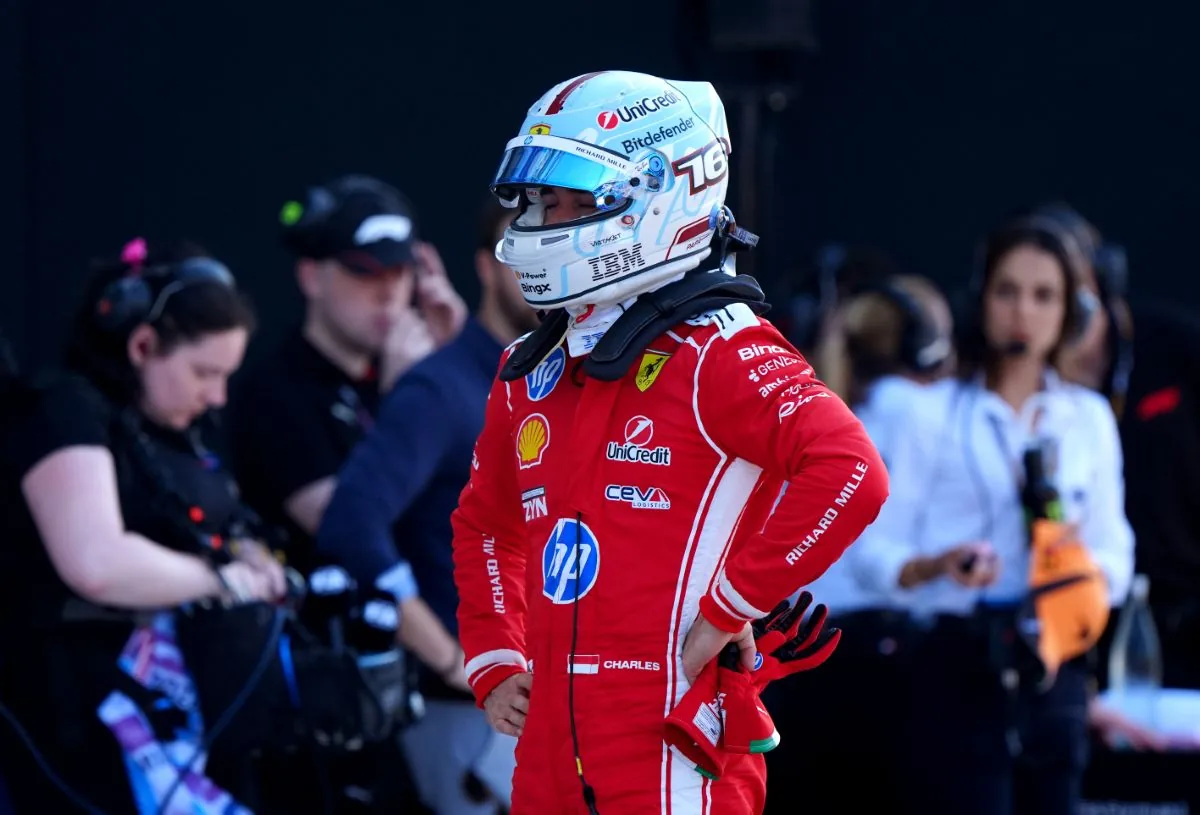
The spin by Leclerc on the last lap of the Miami Grand Prix was certainly not a good moment for the Monegasque and Ferrari fans. There is no doubt that the driver’s mistake, who until that moment had held third position in the race, compromised not so much the podium position but almost the entire race result, with the addition of the penalty imposed by the stewards after the finish that relegated the number 16 SF26 from a potential podium to a disappointing eighth place. Leclerc rightly took all the blame and we are not here to absolve him: the mistake exists and it is serious. But in our opinion, it is interesting to dig a little deeper into what happened and why Leclerc ended up making that kind of mistake.
Read more Two Williams in the points zone, Sainz: “A very solid Sunday”
The good first part of the race
Leclerc’s race certainly started under the best auspices: a good start and then a brilliant intuition at turn 1 put Ferrari in the lead of the race, and in the early stages of the race, Leclerc’s leadership was not particularly pressured, with the Monegasque’s good ability to gain crucial meters in the corners keeping rivals at a distance on the long straights, shielding him from an attack. However, problems arrived with the Safety Car and throughout the following phase. The safety car deployment brought Norris and Antonelli very close to Leclerc again, who found himself in a vulnerable position, especially on the straight. The main difference was that when the rivals had the possibility to use the overtake mode, they passed without problems, while when Ferrari had this option, the overtake did not happen because the straight-line speed was not sufficient. Not only that, the tire factor must also be considered: in the strenuous attempt to maximize the performance (which was very good in itself) of the SF26 in the corners, Leclerc was forced to use his set of medium tires a lot, ending up, inevitably, with tires more worn than McLaren and Mercedes, and starting to accumulate a gap.
The pit stop gone wrong
The pit stop, quite early, then added more frustration for the driver. The Ferrari pit wall decided precisely to bring forward the stop to defend the position against Russell. Leclerc, who was managing the race at that moment, did not appreciate the choice much, as it was not shared with him, but there is more even in this case: the bad pit stop (3.7 seconds) by the Maranello mechanics (usually very good, but this time they made a significant mistake) ruined the plan to defend the position, so Leclerc found himself with a very long stint to do and still behind the number 63 Mercedes.
The small turbine and the “background” problems
Russell’s problems on the Miami track nevertheless allowed Leclerc, after a long series of attempts, to get the better of the Englishman and gain a small margin over him on track, but compared to the leaders the pace was no longer there. As the race progressed, Ferrari’s pace gradually became more distant from the Mercedes-powered cars, and this is mainly explained by the issue of the smaller turbine of the engine: as the cars got lighter, the initial advantage of the smaller turbo became more and more a disadvantage, with straight-line performance increasingly deficient compared to the best, especially in traction. The new rules just introduced, combined with a track layout that did not challenge the electric part of the power units, highlighted the differences in internal combustion engines, and the Ferrari power unit struggled more and more. Just look at the standings, with 7 Mercedes-powered cars in the top 10 and Williams scoring points ahead of Haas to realize that the engine factor was decisive. Leclerc also mentioned in the interview “background factors to manage,” without specifying what they were. It seems easy to guess that it was always something related to the Power Unit and what has been described so far.
Read more Mercedes, three new models on the same production line
The overtake on Verstappen with the first tactical invention
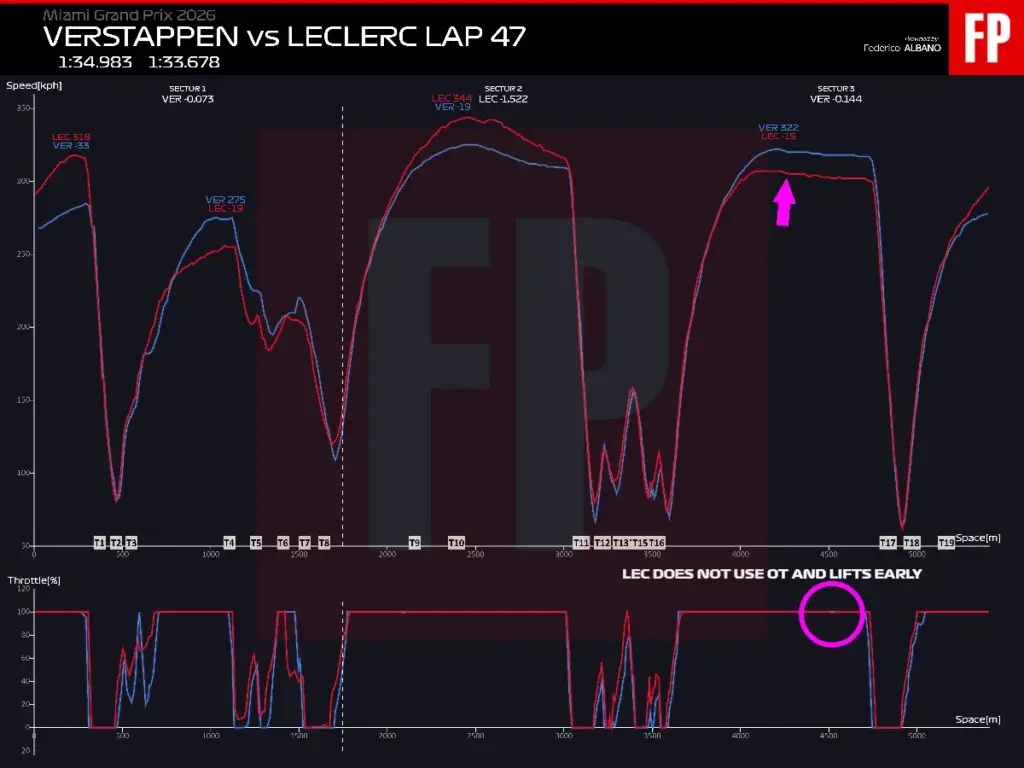
Having arrived behind Verstappen, Leclerc definitely had more pace, given the much newer set of tires and his SF26 being more performant in corners, but the problem remained the straight-line performance: definitely excellent for the Red Bull, definitely poor for Ferrari. And here comes Leclerc’s first invention: instead of forcing an attack on the braking, with Verstappen certainly not the easiest driver to pass under braking, Leclerc does not use the overtake mode and the related energy on the long rear straight. He also closes the wings much earlier than the braking point, all to conserve as much energy as possible to release in the acceleration stretch towards the finish line, where Verstappen would have fewer weapons to defend himself and, above all, would not be able to counterattack immediately. The tactic is risky but works and Leclerc takes the position on the rival and four-time world champion at the end of lap 47. Now between him and the podium remains the problem of the approaching Piastri, with a McLaren definitely in form.
The invention on Piastri and the mistake
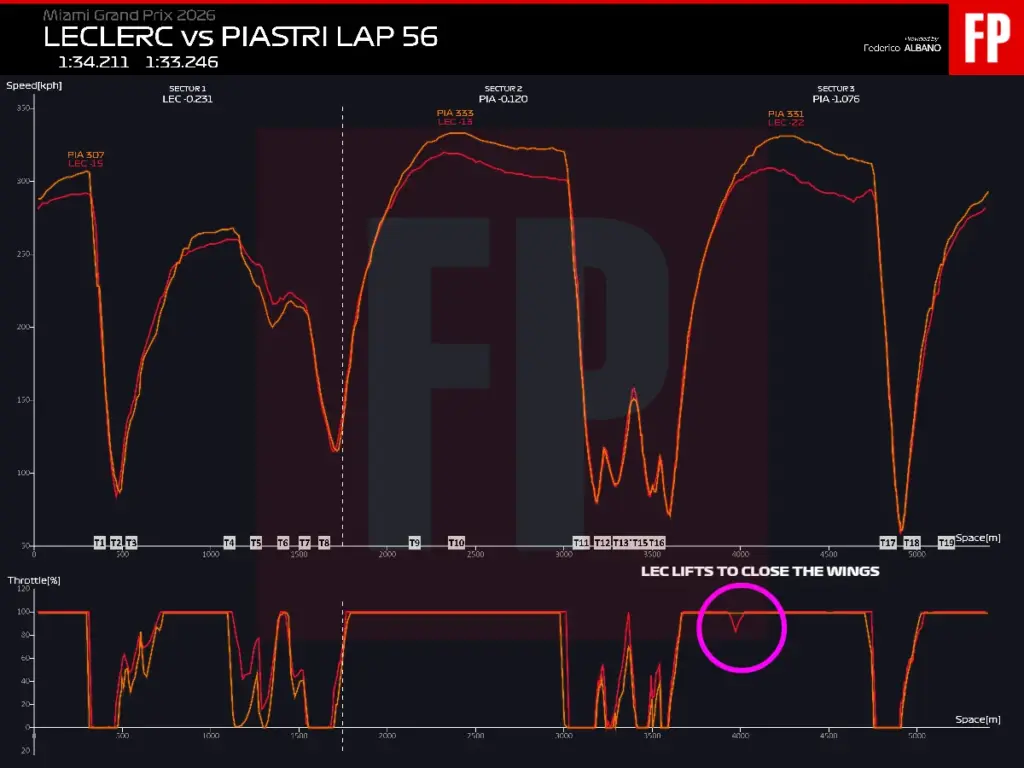
Once caught by Piastri, Leclerc quickly realizes that keeping the McLaren behind until the finish is almost impossible, because the performance difference on the straight is too large. He therefore decides to try an all-or-nothing tactic to secure the third step of the podium: Leclerc’s idea is to let Piastri pass on the penultimate lap and then stay close to him to have the possibility to use the overtake mode (the extra power granted to the follower within one second by regulation) and play his chances on the last lap with this option. And so on the rear straight he puts his plan into action, lifting off the accelerator early to close the wings and let the Australian’s McLaren pass. The problem arrives in the last meters of the lap: the papaya car has great traction and once past, leaves Leclerc behind who sees Piastri’s rear end quickly pulling away. The Monegasque desperately tries to stay close to then launch the attack, since if he falls out of the one-second gap it all becomes useless. Exiting turn 3 he tries to put some of the conserved power to the ground but overdoes it and ends up losing the rear and crashing. From then on the last lap becomes a ordeal with the damaged car practically unable to steer right, which is why Leclerc cuts almost all the corners on the track in an attempt to somehow reach the finish line. Overall, considering also some risks taken and the contact with Russell, the penalty does not honestly seem particularly excessive.
Not to save, but to understand
Seeing everything that happened, it is clear that Leclerc’s mistake is his and that all this turned a likely fourth place into an eighth, with important points left on the road. As said at the beginning, we are not here to save Leclerc from his faults, but it is hard not to understand the frustration of the driver who went from leading the race to being totally unable to defend himself against the competition, except by inventing imaginative tactics that sometimes pay off and sometimes instead become bad mistakes.