








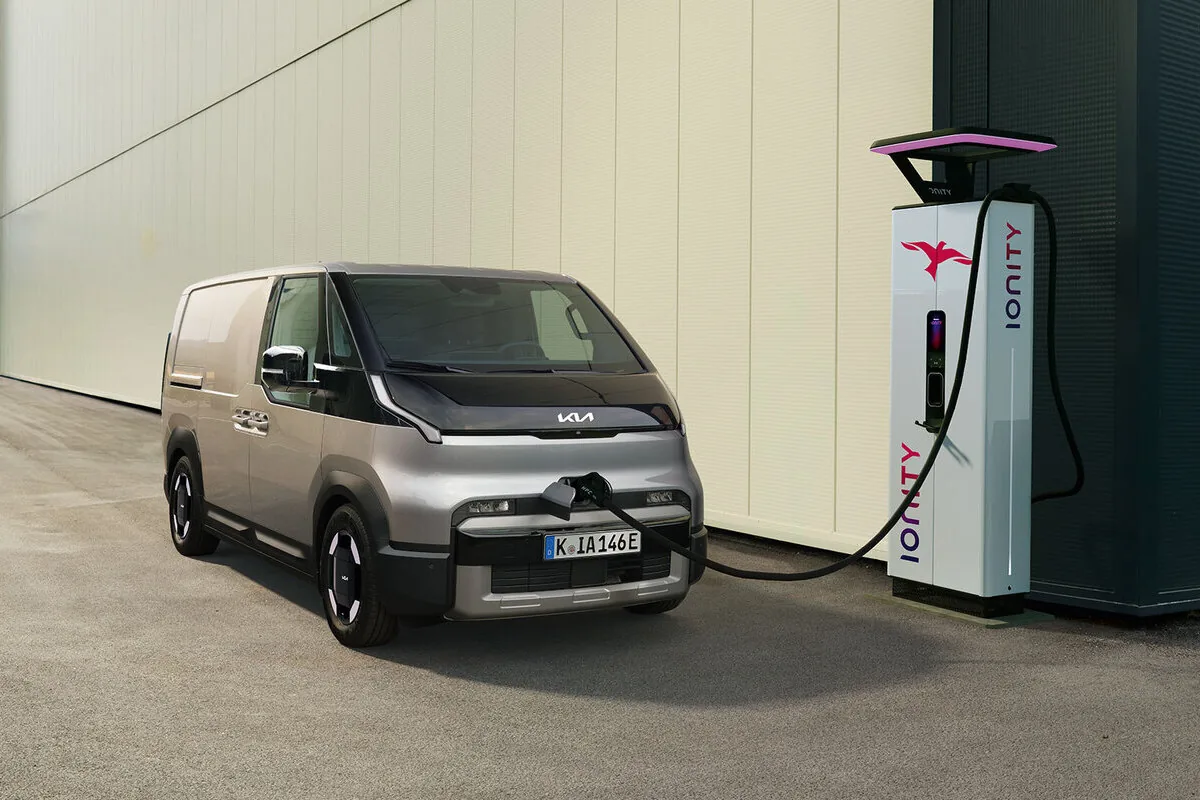
KIA expands its PBV family with the new PV5 Crew Van, a vehicle designed for those who need versatility between transporting goods and people. Derived from the base of the PV5 Cargo Long, the new Crew Van stands out for its ease of use. The transformation from a cargo van to a passenger vehicle requires no specific equipment or complex interventions. The one-touch solution allows, with a single lever, to unlock the reclining seat, tilt the backrest and slide the partition to switch from a two-seat configuration (maximizing cargo space) to a five-seat one in seconds.
Read more Razgatlioglu: “I gave more than 100% to score my first point”
KIA PV5 Crew Van
The PV5 Crew Van project is part of KIA’s “Made In Plant” strategy. The conversion is carried out directly at the factory, in collaboration with specialized partners, to offer integrated and highly customizable solutions. The cabin is equipped with an L-track system for securing loads and accessories. Instead, the cargo area is equipped with V2L outlets and a robust non-slip floor. These features are designed for sectors such as construction, maintenance, landscaping and airport services. In addition to the integrated offering, the Korean manufacturer also proposes specific local conversions for markets, allowing Cargo Vans to be reconfigured into Crew Vans with options ranging from additional fixed seats to adaptation interventions on vehicles already in use.
Read more Official: Lance Stroll on track in the Paul Ricard 1000 km
Electric commercial vehicle
From a technical standpoint, the new PV5 Crew Van is based on the engineering of the PV5 Cargo Long and the E‑GMPS platform, ensuring modularity, durability and advanced connectivity for fleet management. The dimensions of the cargo area range from 1.278 mm (five-seat configuration) to 1.965 mm (two-seat), with a useful volume between 2,4 and 3,7 cubic meters. The maximum payload is 625 kg. The vehicle is equipped with a 51,5 kWh battery that promises up to 283 km of range in electric mode. Production is scheduled to start on April 30, while commercial availability will be announced soon.