




Imagination at work
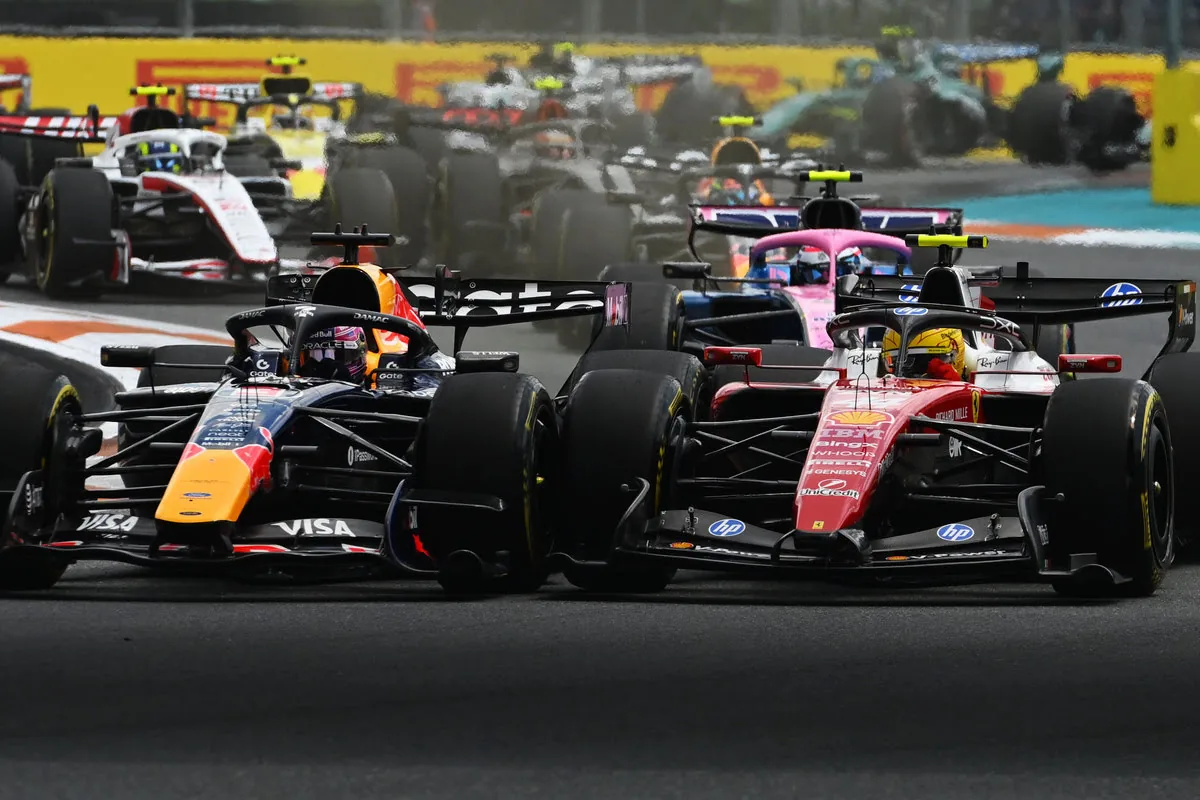
The Miami Grand Prix saw the official race debut of Ferrari’s so-called “Macarena” wing, but also the equivalent solution brought by Red Bull. The final concept is similar, with the rear wing flap moving so that when opened, instead of just decreasing its angle of incidence, it rotates until it is in an inverted position. This has a particularly positive effect on drag in the open position, thanks to the aerodynamic flow mechanism at the rear which tends, with the wing in that position, to stall causing the drag of the car to collapse. While drag has always been crucial in Formula 1, this year it is even more so, since drag not only means a greater power demand from the engine but also a higher amount of energy spent by the electric part, a key aspect of these cars. Changes to some rules, with the regulation text focusing only on the initial and final positions of the movable flaps, specifying very little about the transitional phases, have allowed engineers to work creatively, with various solutions for opening the rear wing seen on track, such as those from Audi and Alpine, but the lion’s share is obviously taken by the two “rotating” wings brought by Ferrari and Red Bull, which deserve some extra attention since we have engineers from two top teams tackling the same theme but with a certain freedom to express themselves.
Simple static differences
On the “static” part the differences are simple to spot and to guess. The Red Bull wing, once opened, creates a slot between the main-plane of the rear wing and the rotated flap, much larger than Ferrari’s. It is to be imagined that this produces an even stronger drag reduction effect than Maranello’s version, but in this case no definitive conclusions can be drawn since this data depends on the aerodynamic flows at the rear of the car and only aerodynamic analyses held by the teams can certify the better effectiveness of one solution over the other. The Ferrari flap, for example, could work with flows that interact more with those of the main-plane and achieve a better stall, while Red Bull’s could produce a greater amount of downforce (and not lift, obviously, since it is rotated) by unloading and stalling the diffuser of the car. These are all hypotheses currently impossible to verify. What is certain is that Ferrari has partially given up the efficiency of some side plates to incorporate the rotation mechanism, gaining in aerodynamic cleanliness on the profiles thanks to the absence of the central actuator, a path exactly opposite to that taken by the Milton Keynes men, with the large central actuator causing greater disturbance to the flows but keeping the end-plate area cleaner.
The transition, the real difference
Perhaps the most important difficulty to manage with this type of wing, however, concerns the transitional phases. Regarding the opening, management is theoretically simpler, since it happens during acceleration, generally with a straight phase ahead. In these terms Ferrari’s solution appears slightly better, since the wing’s rotation exposes the lower side of the profile to the direction of travel and therefore a slightly lower form drag, an important aspect considering the red car’s well-known engine difficulties.
The closing phase is, however, more critical, since it happens during braking, with the driver about to face a corner. Each transitional phase requires some time to complete and bring the flows “up to speed” around the car, which means that from when the wing starts to close to when the driver has the aerodynamic load available to tackle the corner there is inevitably a gap and it is therefore essential that this time is as short as possible and that, if possible, the aerodynamics help slow the car down, just as, with previous generations of cars, braking was somewhat “helped” by the closing of the DRS. In this phase there is a fundamental difference between the two solutions: the direction of rotation.
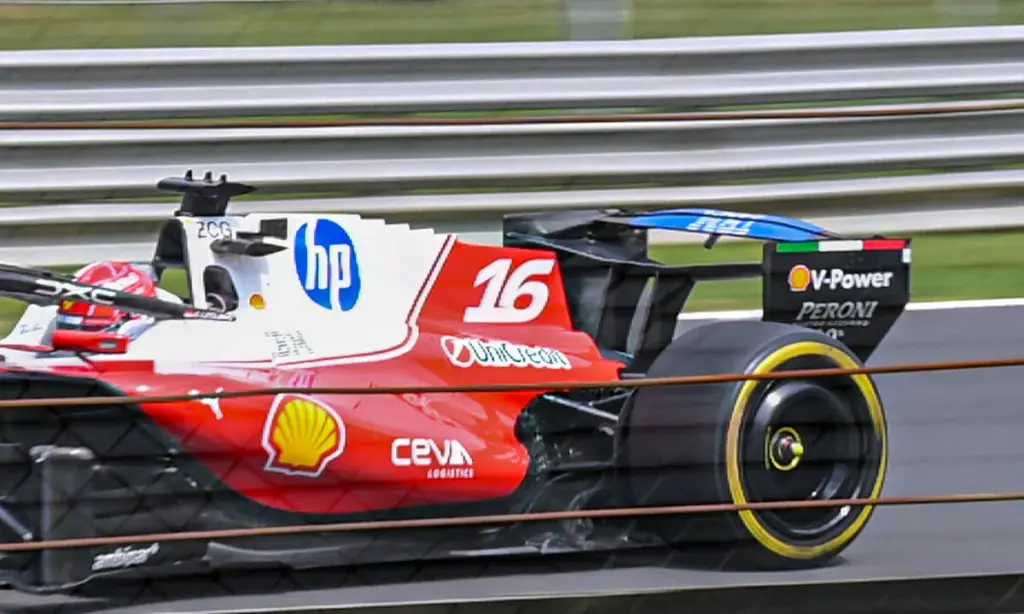
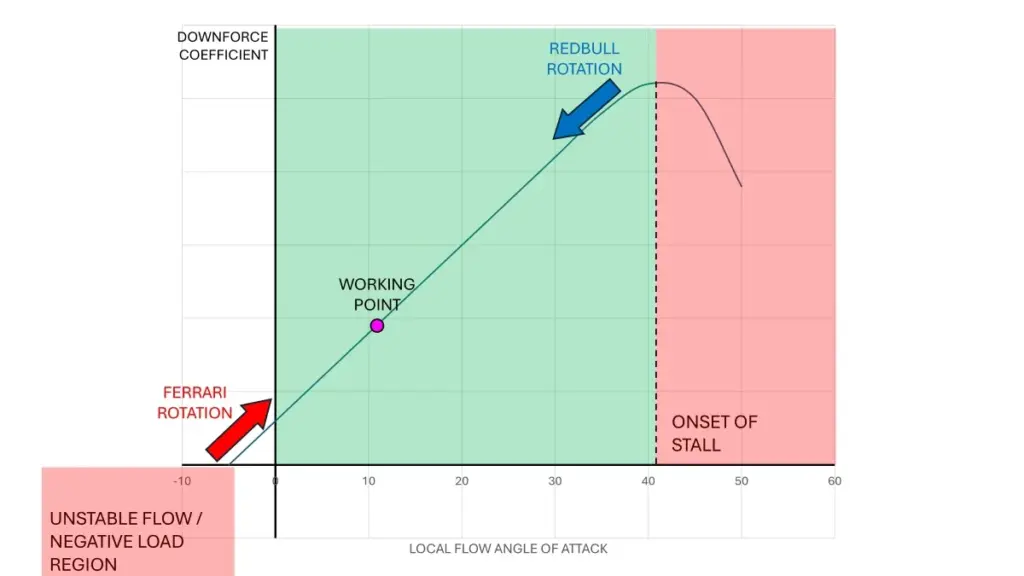
Ferrari’s wing, in fact, rotates exposing the lower side to the direction of travel, while Red Bull’s moves in the opposite direction, exposing the upper part before positioning itself in the closed position. And it is here that the fundamental difference emerges: Ferrari’s wing generates, as in opening, less drag, and reaches the closed position passing through negative angles of attack. Red Bull’s passes for a moment through a configuration reminiscent of a small parachute (obviously greatly simplified), with a movement similar to a spoon, then positioning itself relative to the flow with very high positive angles of attack, which gradually reduce until the closed operating position. Still greatly simplifying the concepts, this means that the flows on Ferrari’s wing must wait to stabilize until the very last degrees of flap rotation, a problem not always easy to solve, which in China, for example, caused Hamilton to spin in free practice while experimenting with this solution. On Red Bull’s wing the flows stabilize initially with high angles of attack then settle as the closure is completed, as if the car first passed through a position of maximum aerodynamic load which then gradually reduces to the closed position.
Read more Mansell slams Aston Martin: «Their crisis is a shock, Honda was naive»
Graphical analysis
To understand what we are talking about we created this (very simplified/approximate) graph which serves to explain what happens to the downforce coefficient with the variation of the angle of attack. You can see how Ferrari approaches the working point passing through the zone of negative angles and flow separation, while Red Bull passes through stall then has a very high load coefficient which decreases as the wing returns to position. Red Bull’s path is clearly longer than Ferrari’s, and while intuitively one might think this is worse, the reality to consider is that the time spent closing by the two profiles is the same (0.4 seconds by regulation) and so the key point is that Ferrari’s solution reaches the “useful” zone (green) only at the last moment, while Red Bull’s starts working and generating aerodynamic load (even in excess) much earlier. It is quite intuitive to understand that Red Bull’s solution should guarantee a more effective transitional phase and therefore greater safety for the driver entering the corner regarding the reestablishment of aerodynamic load. Potentially the solution seen on the RB22 could even allow closing the wing a few moments later than Ferrari’s.
Regulatory cleverness
Regarding the regulations, it is interesting to note how rule C3.11.6 establishes that the rear wing flap must have a lower angle of incidence in the open position compared to the closed position, but does not establish anything regarding the transitional phase. And it is here, probably, that part of Red Bull’s cleverness lies, which did not worry at all about progressively decreasing the angle of incidence until the wing flips over as Ferrari does, but actually increases it until the overturning given by the final position, remaining formally within the regulations although in the transition it does the opposite of what the regulation itself would intuitively suggest.
Conclusion: Red Bull more aggressive on rules, Ferrari goes towards the SF26
Summing up, Red Bull’s solution appears decidedly more aggressive from a regulatory point of view, since it “skirts around” the rule very cleverly, as is tradition for the Milton Keynes engineers and at the same time gains an advantage in the critical braking zone. On the other hand, Ferrari, first to propose this solution on track, is more aggressive technically with the actuator hidden in the side plate of the wing and above all maximizes the opening phase, with slightly lower drag which can help in traction given the well-known power issues of the car. On the other hand, as explained, it has to give up something in the braking phase. After months of talking only about energy and batteries, being able to work on a technical and aerodynamic comparison of this kind is really like breathing fresh air, and given the flood of updates on the cars we will have this season it is absolutely likely that other similar interesting topics will soon emerge.