

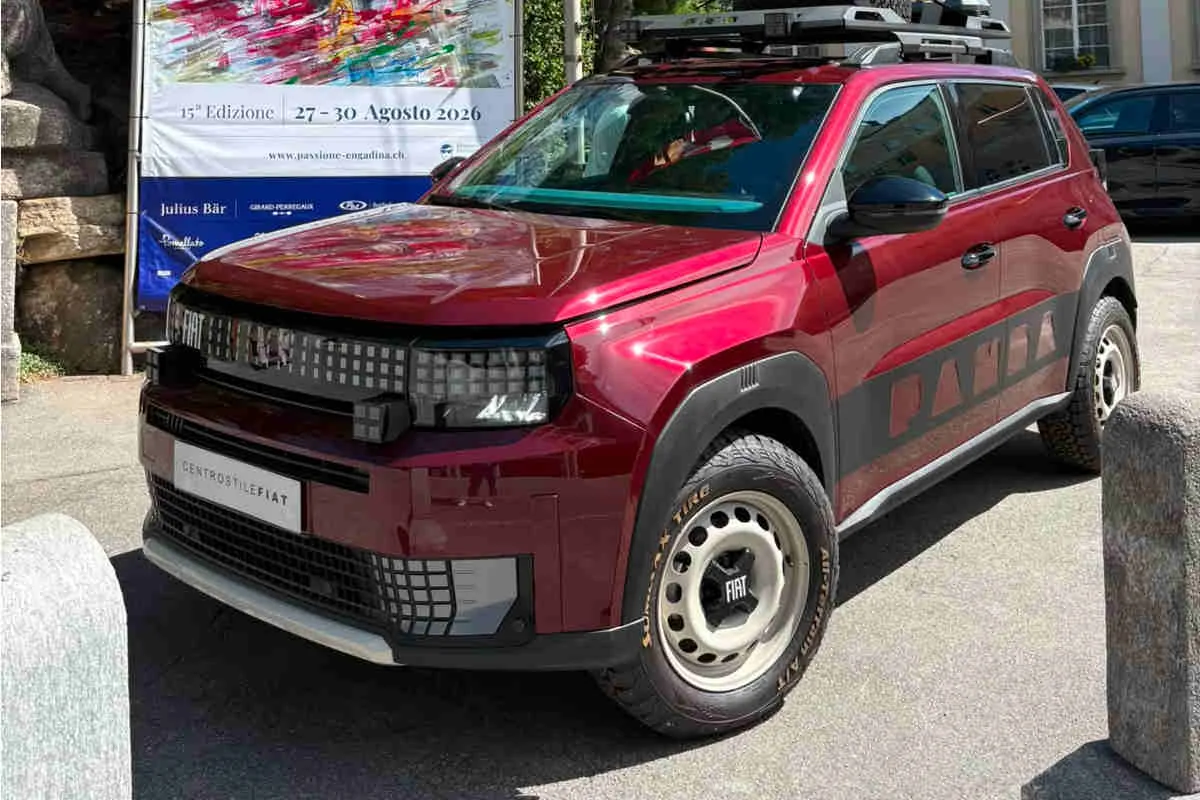
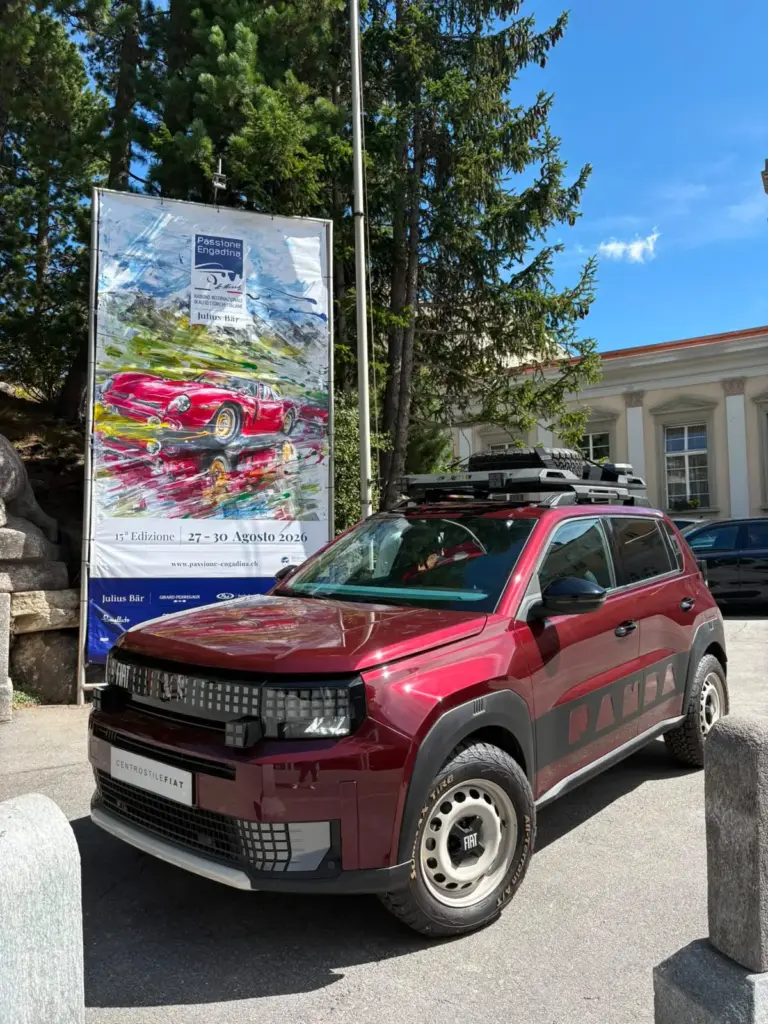
At Passione Engadina, this year with the subtitle “Italian Job,” the «most precious» cars parade. It’s a title that does its job: it promises rarity, prestige, an Italy of coachbuilders and surnames. Amid that procession, or at least at its official margins, Fiat has unveiled its most anticipated concept. It’s called Grande Panda 4×4. It’s not a Ferrari. It’s not a Maserati. It’s not even, to be precise, a car you can buy. It’s a hypothesis on four wheels, painted in a deep burgundy, with beige details whose declared purpose is to evoke nostalgia.
Nostalgia, in Italy, is a building material used more than cement. It works. Especially when it concerns the Panda. The 1983 Panda 4×4 became an icon as happens to things that are useful. Small, boxy, capable of climbing where more polite cars stopped to think. You could see it under the snow, in ski school parking lots, in mountain courtyards, hitched to a trailer, covered in mud, with the dog on the back seat and a toolbox in the trunk. It didn’t promise adventure. It made it, with that somewhat gruff modesty that Italians immediately recognize because it resembles them.
Now the heir presents itself as a concept. Car manufacturers, for a few years now, have been launching visions. The Grande Panda 4×4 would be the future of sustainable mobility that does not give up the adventurous spirit. Translated: there’s still an engine in front, and an electrified axle at the rear. Four-wheel drive, once a matter of drive shafts and somewhat rural mechanics, becomes a matter of electronics. When needed, the rear wheel lends a hand. It’s a smart solution, and also a bit of our era: all-wheel drive as a service on demand.
That this idea is displayed in Engadina, among Alpine passes and hotels that have seen better and worse, makes sense. There, precious cars go to be admired. The Panda, historically, went to be used. Putting them side by side is a small Italian short circuit: the country that collects beauty and the one that has to reach the top of the trail with the groceries.
The design is bold. Bold is a word that should be used sparingly on small cars, I know, right. But here it means more pronounced fenders, raised suspension, plastic protections, two extra headlights on the luggage rack, wheels that recall the sheet metal of the past. The dark red of the Eighties has become burgundy. Beige acts as a counterpoint, like an old photograph refocused. It works visually. You immediately understand what it wants to be. You understand a little less what it could be, because a concept is always a bit like an evening dress: it looks great standing still, and the rest we will see.
There is, in this whole operation, a typically local trait. Taking a popular object, declaring it a legend, and then asking it to represent the future without ceasing to resemble the past. Freedom, adventure, reconciliation with nature: the vocabulary is that of brochures, which is the most tired vocabulary in the world. The real Panda, the one you still see struggling on real dirt roads.
That 1983 car taught a generation that off-roading was not necessarily a privilege. It could be a format. Compact outside, spacious inside, poor enough not to have too many scruples and stubborn enough to get where it was needed. If Fiat tries to bring that idea back to life — even with an electric motor at the rear, even with a showroom color — it deserves applause. Especially because it does so at a gathering of precious cars.