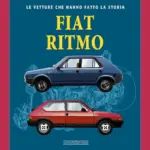



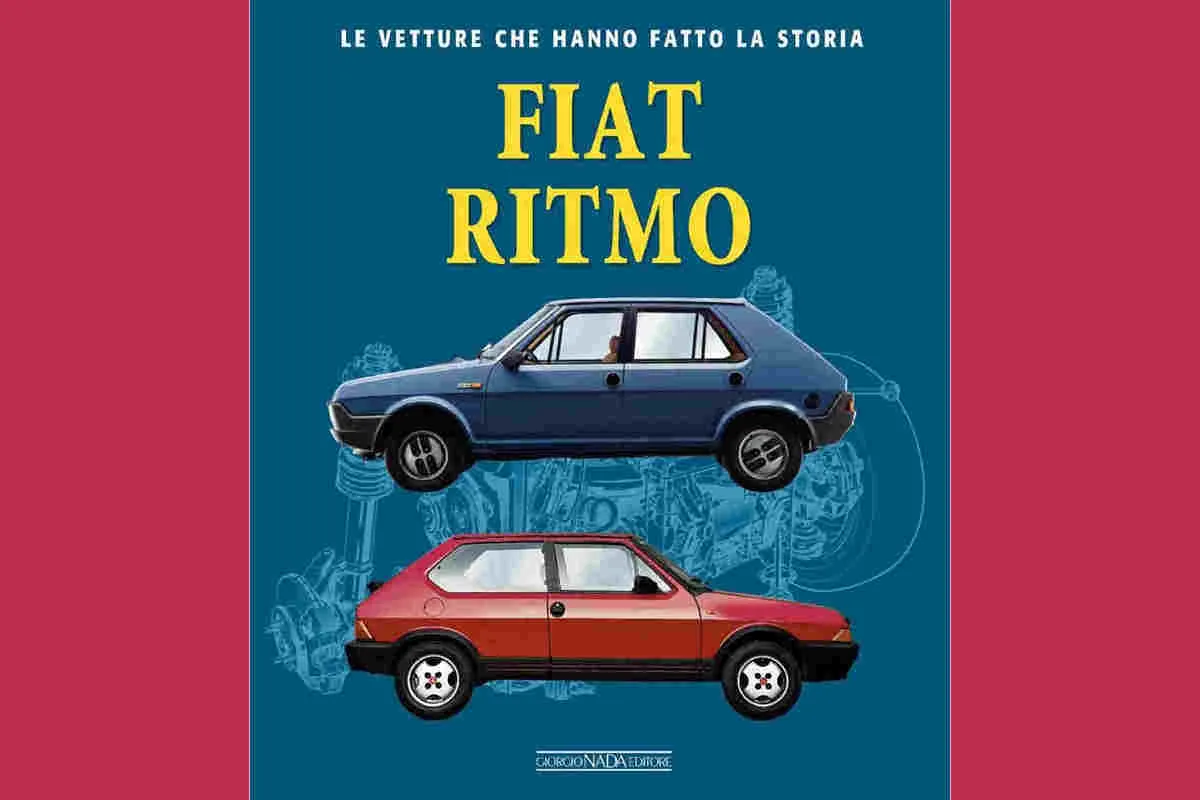
Forty-eight years after its debut at the Turin Motor Show, the Fiat Ritmo has a monograph worthy of its strangeness. It is simply titled Fiat Ritmo, authored by Stefano Dalto for Giorgio Nada Editore in the series «The cars that made history», and has been in bookstores since May 2026: 120 pages in 24×27 format, hundreds of archive photos, original drawings by the author, a chapter on restoration and the color range. Preface by Alfredo Stola, the father of all prototypes and the most important show cars ever. Cover price 35 euros.
Read more Lindblad: “A not very exciting race, but I am happy to have brought home 2 points”
It is the portrait of a car born after the 1973-74 oil shock, designed for those who wanted space and low consumption, but which instead remained memorable for something else: integrated plastic bumpers, inset round headlights, circular handles, the cockpit as a design object. Stola, in the preface, places it alongside Brionvega, Cappellini, Alessi, and Kartell. It is not a collector’s whim: it is the memory of someone who, in 1979, at eighteen years old, went to SACAUTO on Corso Racconigi in Turin and paid seven million lire for a light gray 65 CL, license plate TO T90908. First car. The only license plate still remembered.
From the “Future Studies” to the assembly line with robots
Dalto reconstructs the workshop. At the Fiat Style Center there was a division, the “Future Studies,” directed from 1968 to 1984 by engineer Sergio Sartorelli, who came from Osi and Ghia after the death of Pio Manzù. There they worked with a freedom that series production did not allow: drawings, then clay models at 1:10 scale. In 1970, under Sartorelli, there were among others Paul Breuer — who in 1971 would see the 128 Sport realized — and Pierangelo Andreani, working on a stylistic alternative to the 128.
The Ritmo project, code X1/38, is also a methodological leap. “Child of robots” was not just a slogan: computerized calculation entered extensively into design and production. For the first time, computer simulations were used to model body deformation and occupant injuries in a frontal crash, leveraging the experience of ESV prototypes. The structural designer was no longer alone: alongside him came the analyst and the experimenter. The team had to verify together comfort, soundproofing, safety, ease of construction, and speed of replacement of body parts.
The result, presented in April 1978, is a two-box three- or five-door that in ten years exceeded two million units, built in Cassino and Rivalta. Alongside the everyday versions remain the icons: the Bertone Cabrio, the 105 TC, the Abarths.
Read more Tesla Roadster, here we are: end of the soap opera
The World Championship that never came
One of the most beautiful chapters concerns sport. At the beginning of 1979 Fiat decided to downsize its presence in the World Rally Championship. The 131 Abarth, fresh from glory, only raced the commercially most useful events. The idea of replacing it with a Ritmo coupé with a mid-engine — the path Renault would take in 1980 with the 5 Turbo — also fell through. With the new regulations, another path was chosen: abandoning the 131 and building a dedicated car, mid-engine, rear-wheel drive, 2000 cc twin-cam supercharged by a volumetric compressor, 280 declared horsepower. In 1982 that project became the Lancia Rally 037, homologated by Pininfarina in two hundred units based on the Montecarlo. The Ritmo stayed on the sidelines. The more aggressive versions, especially the Abarths, still lived a racing life on the road and track. But the book has the merit of not turning every Turin compact into a missed winner: it tells an industrial choice, not a legend.
An orange Cabrio and ten years standing still
The chapter on restoration is concrete, almost like a workshop. The photos show an orange Ritmo Cabrio bought in 2005 by the current owner, then traded in at a dealership. It remained still for about ten years “for bureaucratic reasons,” with other cars waiting. When it came back on sale it had a partial soft top and damaged interiors. Then the disassembly: soft top, fender, windows, tailgate, doors, bumpers, front collar. Interiors and coverings partially removed. Rust is where expected, and where not expected: door hinge area, base of the side windows, where the fabric seal of the soft top ended up retaining water. A textbook case for anyone today wanting to bring back on the road a convertible born already delicate.
Ode to the Ritmo
The Ritmo was long the ugly duckling of collective memory: too Seventies for the purists of “beautiful Fiat,” too plastic for those who dreamed of the 124 and 131. Dalto puts it back in its place, which is that of a transitional car: the first true contemporary mid-size from Lingotto, a laboratory of materials, robots, marketing, and cockpit. Stola closes the preface with a sentence that the whole book seems to confirm: like love, the first car is never forgotten. In his case, it was a 65. For two million other Italians, in ten years, it was one of the many Ritmos that really made history. vb
Read more Citroen Classic Tour, the first edition is a success