

The main variable of the Miami race will be the weather. Rain is ready to hit the Hard Rock Stadium circuit, which would put the new cars to the test on wet for the first time. Even with the new regulations, however, the intermediate tire seems to be the most suitable for rain, provided that its graining can be managed. In the case of a dry race, instead, the most likely strategy is a one-stop, as explained to FormulaPassion Simone Berra, Chief Engineer of Pirelli.
Read more Fuel excise cut: the problem of funds
Intermediate still favored
In recent years, the extreme wet tire has often remained unused, as the conditions that would have required its use almost always led to the red flag being shown. According to Berra, however, the preference for the intermediate goes beyond visibility issues: “If it were to rain heavily and the track were particularly flooded, the full wet tire would provide greater resistance to aquaplaning. However, we also know that the full wet overheats very quickly and this should push teams to go as much as possible on intermediates. You will have to survive in high aquaplaning risk areas, knowing that you can get better performance in high-speed corners and traction from low-speed ones. This is because the intermediate tire, having less tread block movement, ensures better performance.”
The big question is whether the intermediate can cover the entire race distance. “Hard to say”, replies Berra. “It will depend on how much water is on the track. If there is enough, certainly the intermediate could do very long stints. We saw it last year too: if it doesn’t rain, temperatures are high and the track dries quickly. This causes more mechanical wear on the intermediates, with overheating that leads to sliding, triggering graining. This results in high wear, which in some cases last year reached 100%. In mixed conditions, you have to stop to change and put on a new intermediate, or, if it is sufficiently dry, switch directly to slicks.”
Options for the crossover
Sunday in Miami opened with a violent thunderstorm, but the weather should improve by midday. Teams could thus find themselves on a damp track, but not completely dry, conditions for which Berra believes the C5 is the most suitable compound: “I expect teams to go on the soft tire. I say this based on last year’s experience, when a wet Sprint was held, with the track then drying quickly. Last year’s C5 compound was not as consistent as this year’s and proved to be very fast.”
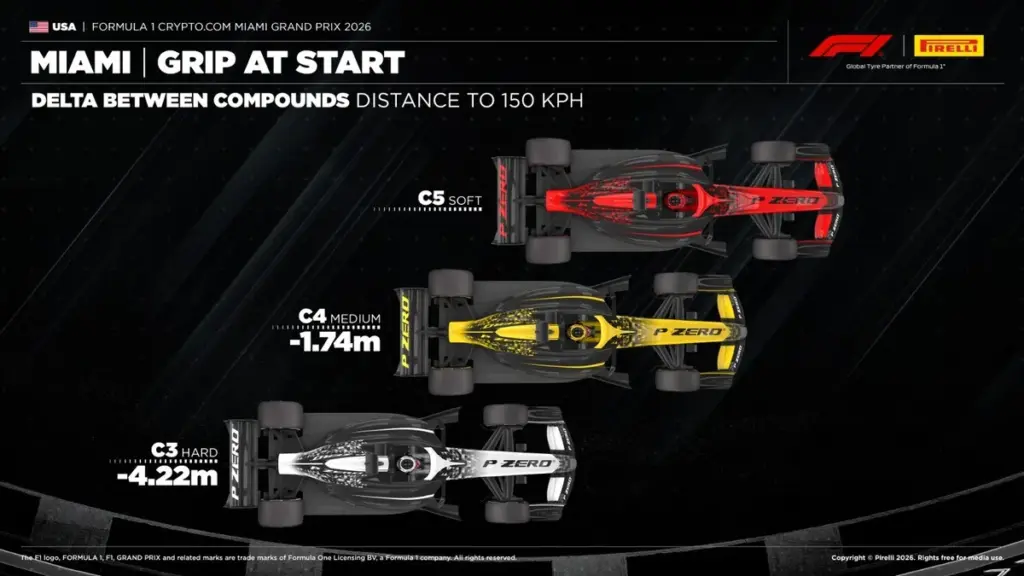
“It is clear that some considerations come into play that teams tend to make. If the transition from wet to dry occurs towards the end of the race, maybe with 5-10 laps remaining, the soft would certainly be mounted. If instead more than half the race is still missing, it is clear that it would become difficult to think of going on softs, because the risk is having high degradation at the end and at that point you would have to stop again. In that case, maybe teams will choose the compromise of the medium tire. Certainly, however, the hard is not the right tire.”
Read more Leclerc: “Nice to be closer, but honestly I just want Ferrari to be ahead of everyone”
One stop on dry
The hypothesis of a completely dry race remains alive, even if the scenario would be far from that of the past days. The Pirelli Chief Engineer comments: “Certainly the conditions will be different from Friday and Saturday. The sky will be cloudy, temperatures have dropped and the asphalt will not reach the 50-55°C of the past days. We will have about 20°C less and this obviously helps thermal degradation on the tires.”
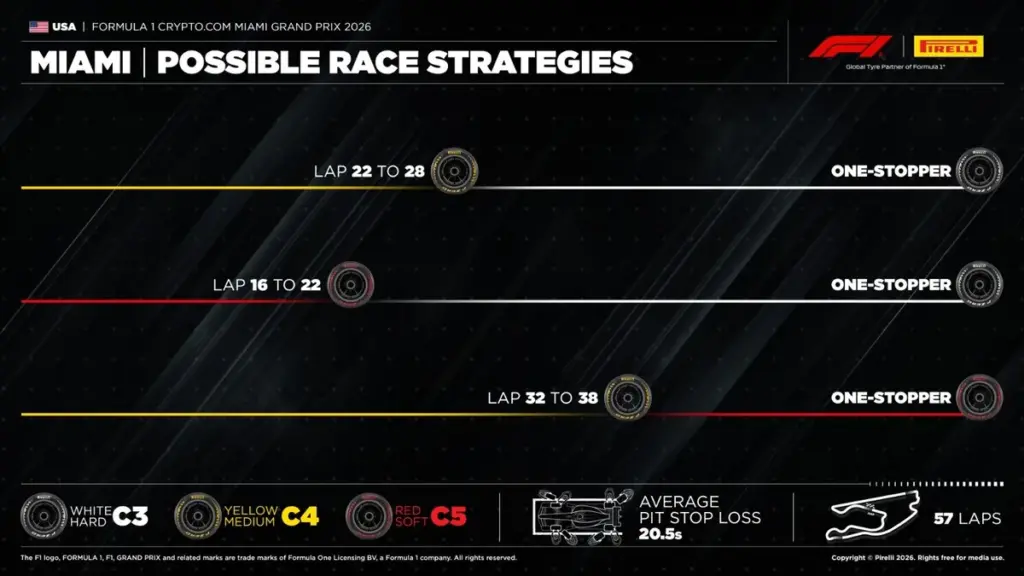
“The soft tire can come into play. The medium should be a very good tire performance-wise and, with proper temperature management, it also allows you to significantly extend the stint. The hard is also very consistent, but maybe struggles a bit more, because it has less grip, tends to slide and therefore generate more surface temperature.” Regarding the number of stops, Pirelli has no doubts: “From our simulations, given the low degradation, on dry it should be a one-stop race. […] We do not expect a two-stop, because it is about 10 seconds slower.”
The best strategy on paper is the medium-hard combination, with the pit stop around the 22nd-28th lap, but with wide margins for adaptation: “Since both the C4 and C3 are very consistent, you can be flexible on when to stop, maybe trying to extend stints to take advantage of a Safety or Virtual Safety Car.” An alternative would be to start on soft, then switch to hard between the 11th and 16th lap, but there is an even more aggressive option: “We do not feel like excluding the medium-soft strategy, starting with the C4 and trying to extend the stint beyond the 30th lap, then trying to do the last twenty laps with the soft tire and the track more rubbered in, in situations maybe more favorable to attempt some overtakes on track”, concludes Berra.