

What Qualifies in Madrid
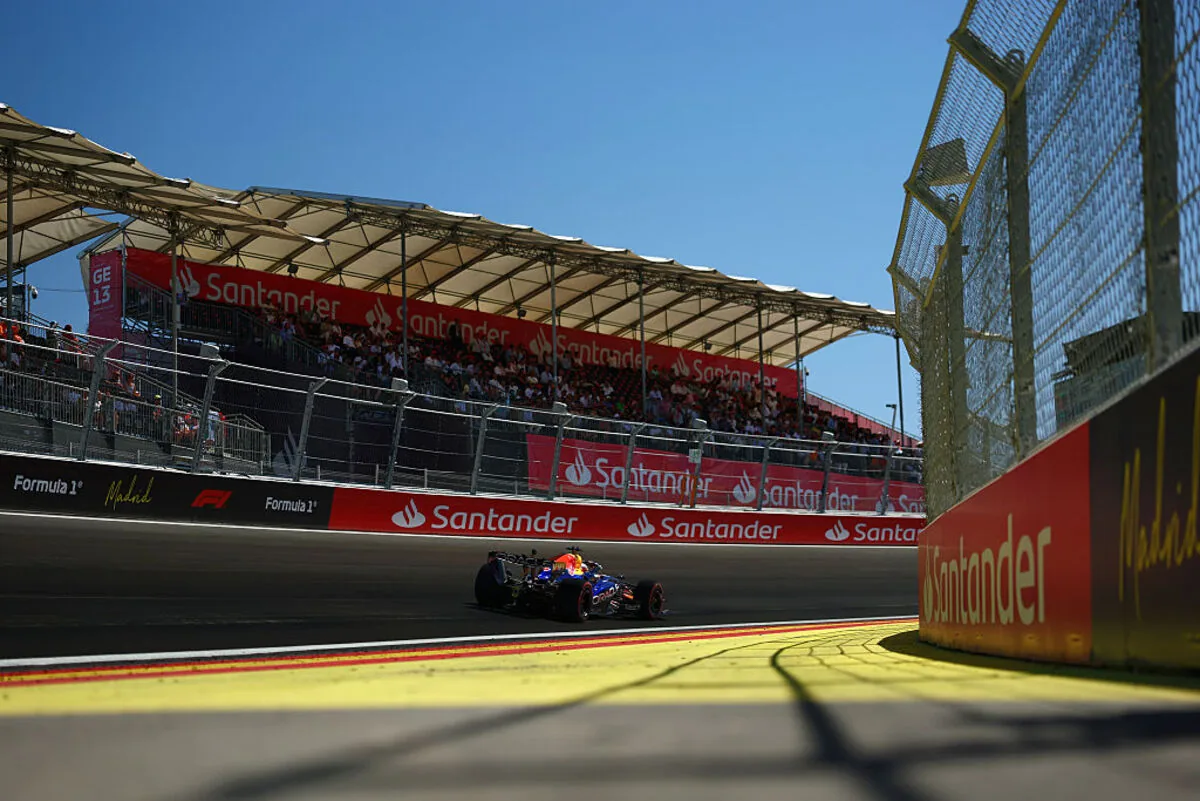
The qualifying for the Spanish Grand Prix lived up to all the pre-race promises, delivering an extremely tight battle and, above all, confirming what emerged from the free practice sessions: on the Madring the values of the top teams are incredibly close. The top five are contained within just two tenths, which tells of a situation where it becomes difficult, and probably also wrong, to look for a technical explanation for every single position. When the differences are so small, the human factor, lap preparation, small deployment differences, and the ability to extract the maximum from the tire inevitably take on enormous importance.
Phenomenal Norris: the Soft tire becomes his weapon
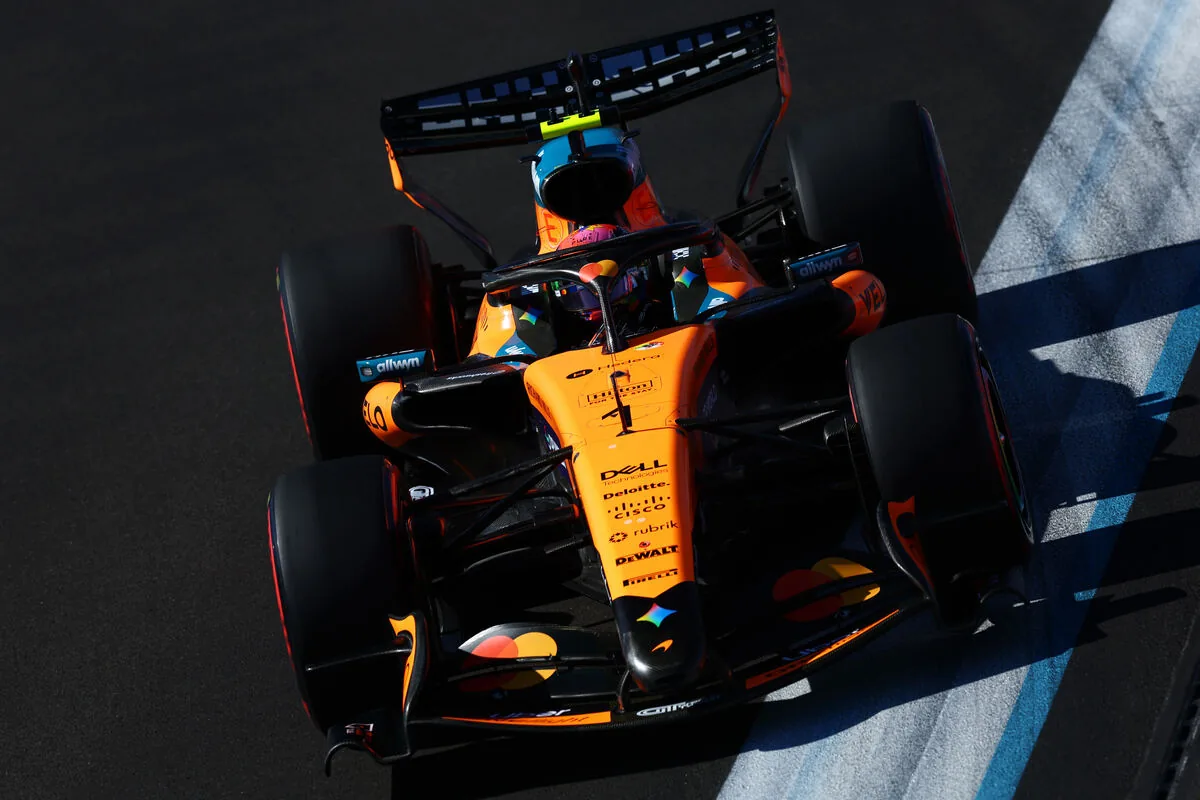
And it is probably no coincidence that, on a track we had defined very much “driver’s” since Friday, the reigning World Champion Lando Norris is at the front, continuing his truly stellar driving path this season. The British driver’s pole lap was simply exceptional.
The McLaren did not appear to be a car clearly superior to the others; on the contrary, it showed a series of difficulties in the free practice sessions, often on the traction side, exiting slow and fast corners, but Norris managed to use practically everything the Soft tire had to offer on the very last lap, at the decisive moment.
The impression throughout the weekend was indeed that the softer compound, when used for the flying lap, with maximum lateral and longitudinal loads, as well as the enormous compression of the Monumental, struggled to stay in the ideal operating window for the entire lap, with performance often collapsing in the third sector.
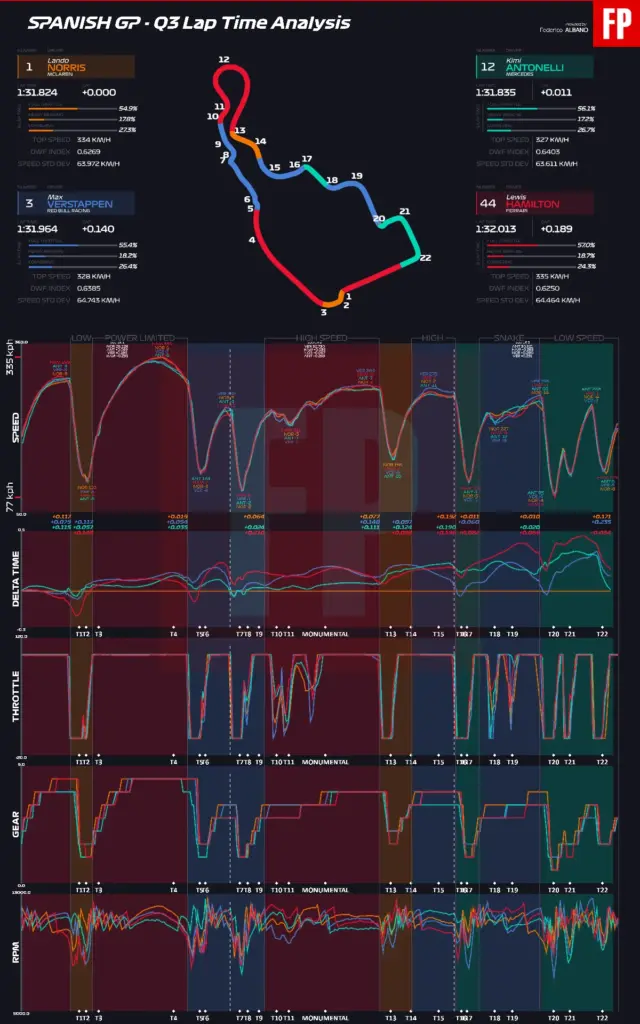
And here came into play one of the qualities we have often highlighted when talking about Norris: the ability to push extremely aggressively while keeping the tires in their ideal window. Lando literally won a world championship like this. In Madrid qualifying, this is clearly seen from the data already in turns 1 and 2, but also at turn 13 and especially in the remarkable entry to the Snake, at turn 18, where Norris manages to carry speeds higher by 12 and 16 km/h compared to Antonelli and Verstappen.
In short, the British driver manages to demand a lot from the tire at the decisive points while still having some available in the final part of the lap. Paradoxically, the pole lap was not perfect: Norris made a noticeable mistake in the last corner (in fact, over the radio he was convinced he had ruined the qualifying) which, according to our findings, cost him about two tenths, entering too fast and having to lift and correct on exit. Without that inaccuracy, the margin over the pursuers would have been much more evident and would have given an even greater dimension to the McLaren driver’s performance.
Antonelli still ahead: Mercedes seems to have something up its sleeve
Behind Norris we find Kimi Antonelli’s Mercedes, and here too the driver factor seems to have played an important role. On such a complicated track, talent was needed and the young Italian once again showed he has it in abundance, bringing Mercedes to the front row while George Russell did not go beyond sixth position, about three tenths from pole.
On the technical front, however, there remains a feeling that accompanied us practically throughout the session: Mercedes may not have fully used the potential of its Power Unit. We see Antonelli with lower speeds in the points of greatest acceleration such as towards turn 5 (-8 km/h from Hamilton) and in harvesting zones like turn 15 (-11 km/h from Verstappen).
The reason could be related to the need to limit overheating of the rear tires during traction phases. It is a strategy we have seen Mercedes use before, in the years of the super Power Unit, and the torque of these hybrid units is so high with the qualifying map that, combined with the extra load of the Monumental, it can push the rear tires out of the ideal window, making the last sector much more problematic.
During qualifying, Mercedes also tried to modify the Power Unit management and maps, but the impression is that the compromise was not fully optimized. Antonelli still managed to extract a very high-level performance, moreover first on track in the last attempt, while Russell appeared decidedly less effective.
Verstappen maximizes once again what he has
Third is Max Verstappen, with a performance that probably once again represents something very close to the maximum available for his car. The Dutchman built his lap perfectly exploiting the strengths of the car, particularly at turn 15 and in the Snake, but above all limiting losses in the less favorable zones.
This is precisely one of the aspects that often distinguishes Verstappen: when the car does not allow him to gain, he at least manages to prevent the deficit from becoming too large. RedBull was struggling in the last sector, and it will be interesting to see if in the race the Dutchman can contain the energy and tire problems lap after lap.
Read more Norris in symbiosis with McLaren: Ferrari illusion, what was missing
Ferrari: the Power Unit limit remains visible, but Hamilton was not perfect
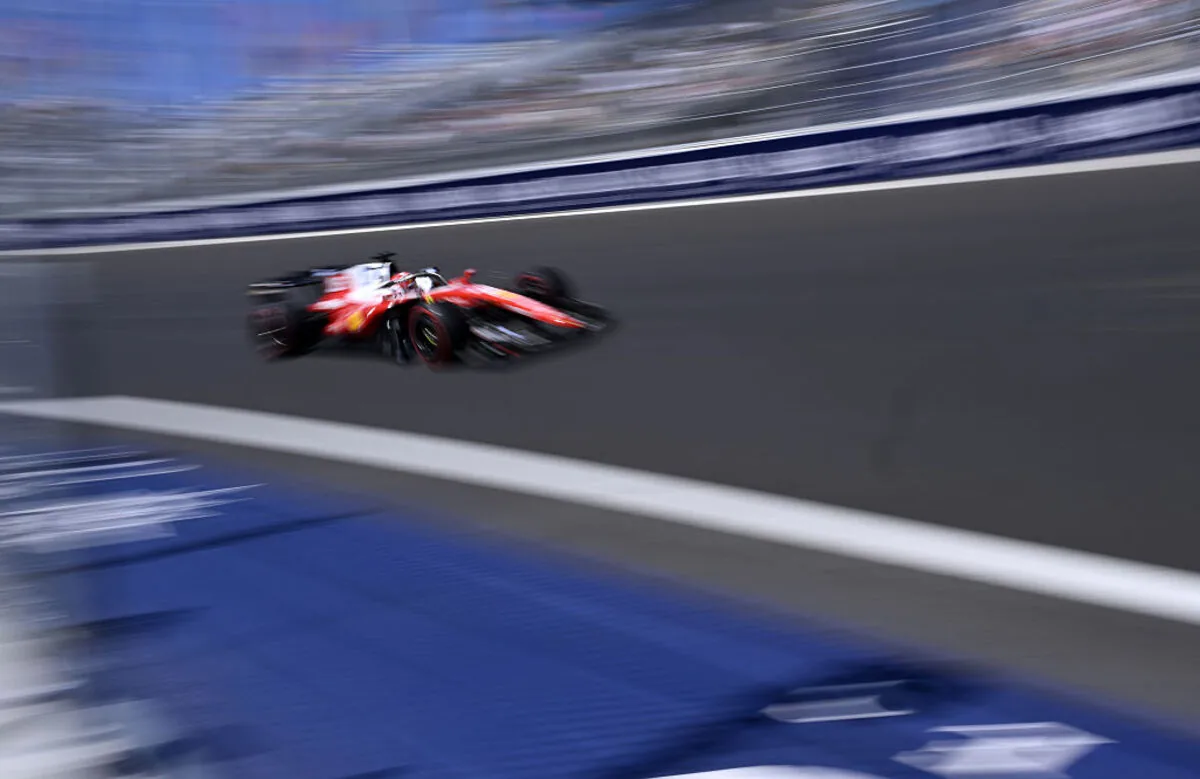
Ferrari closes with Lewis Hamilton fourth and Charles Leclerc fifth, separated by just six thousandths. This data also tells well the situation of the SF-26: Maranello continues to be the only top team with two drivers practically overlapping in performance and with a car that seems to offer a sufficiently wide operating window to allow both to express themselves at very similar levels.
The feeling, looking at the data, is that Ferrari has used practically everything it had available from the Power Unit, probably accepting also some extra risk on the reliability front given the importance of grid position on a circuit where overtaking could be extremely difficult.
The well-known limits under the hood remain evident. In the stretch between turns 6 and 7 there is indeed a real “performance hole” that remained present throughout qualifying and that, overall, cost about two tenths, and it is no coincidence that it is the rather steep uphill section, where the torque gap of the thermal engine is felt, as we had seen very similarly at Suzuka in the first sector.
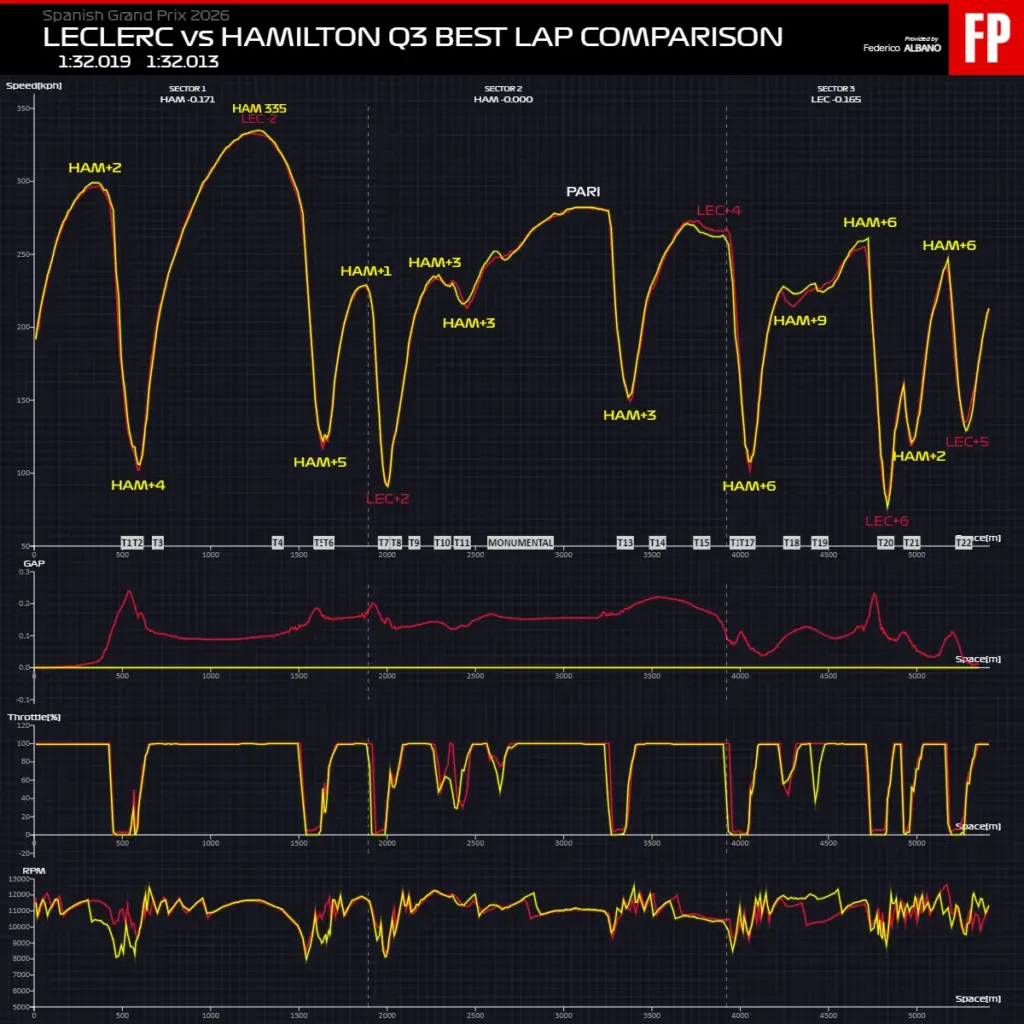
Between the two drivers, Leclerc seems to have managed to use practically everything he had available. Hamilton, on the other hand, probably has a few more regrets. Compared to the penultimate attempt, Lewis left about a tenth and twenty only in the first two corners and, although improving afterwards, his last lap was not particularly clean.
Also from the deployment point of view, not everything worked perfectly: the British driver lost about five hundredths already on the first straight compared to his previous lap and another tenth or so in the turn 15 area. The delta would even seem less than the about 2 tenths that the famous “ADUO 2” was supposed to bring, so it remains to be understood what really influenced Hamilton’s deployment and whether his engine was able to exploit the full potential of the new version.
Considering the final gap from pole, it is clear that with a better final lap Hamilton could at least have seriously targeted the front row. There is also another element common to the two Ferraris. Both Hamilton and Leclerc struggle significantly in turns 1 and 2, where the SF-26 seems to have some difficulty absorbing the higher curbs and immediately regaining stability once the first direction change is completed.
The impression is that the suspension setup was stiffened on the roll front, but something was lost on the curbs. After all, the new Spanish track is a technically complete challenge and requires compromises on all fronts.
When five drivers can take pole
The central point of qualifying is probably another: Norris, Antonelli, Verstappen, Hamilton, and Leclerc all realistically had the chance to take pole position. We are no longer talking, as in other weekends, about macro-technical trends but about minimal differences where the driver can make a huge difference, and the top 5 of this qualifying does not seem to have come out by chance.
Ferrari can hope for something thanks to the two very close drivers: in a race where strategy will be fundamental, having two cars in the same group can represent an important weapon, naturally provided Hamilton and Leclerc can work together, a test to understand if the post-Monza discussions have been fruitful.
And it is precisely the race, at this point, that represents the real unknown of the weekend. The heat, the high degradation, the possibility of seeing several stops, the continuous evolution of the track, the risk of Safety Car and, at the same time, the difficulty in overtaking make any prediction extremely complicated. Qualifying told us that on the flying lap the best are all there. On Sunday, however, many more variables will come into play. And on a circuit that so far has continued to present different problems at every session, the feeling is that the real puzzle of the Madring is yet to be solved.
Read more Marquez, record of cornering in qualifying at Misano: 65th