








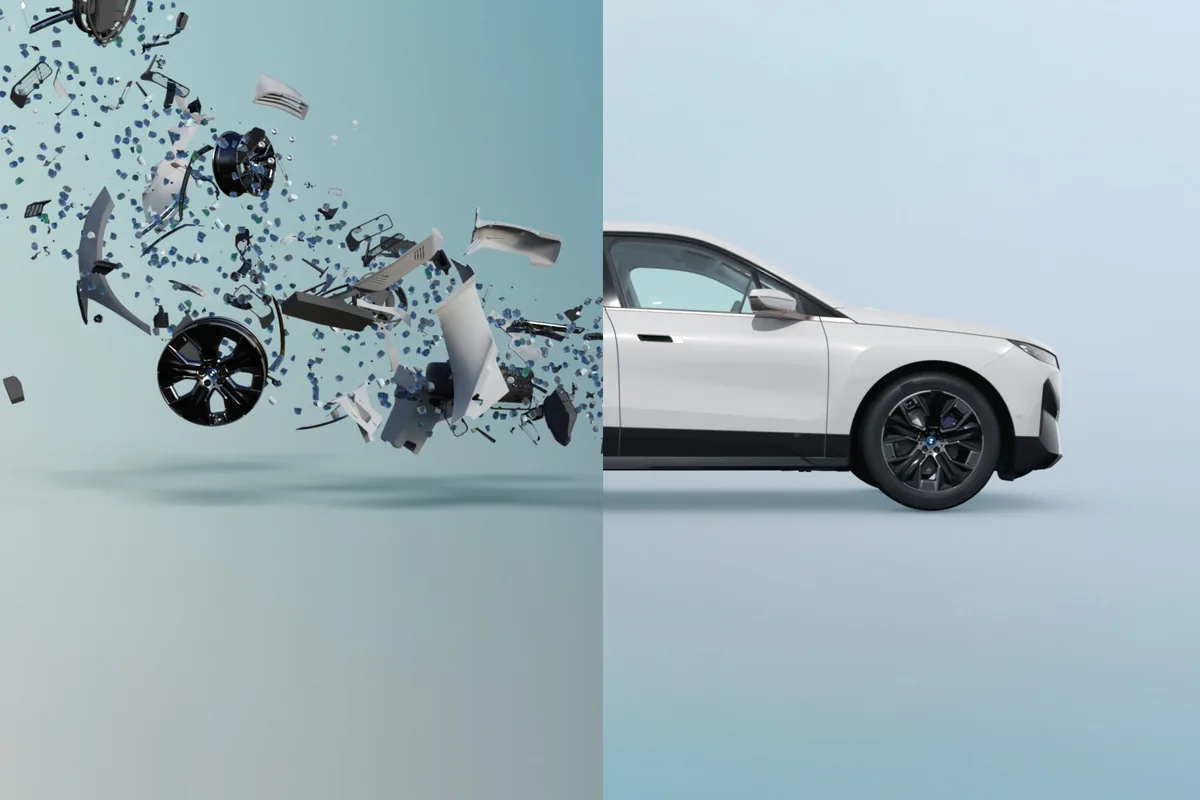
Through the Car2Car research project, the BMW Group and consortium partners have demonstrated that high-quality material cycles are technically feasible even in the automotive industry. Car2Car focuses on recovering materials from end-of-life vehicles to be used in new automotive applications. It analyzes under what conditions it is possible to reintroduce these resources into the supply chain without losing value. The goal is to verify the feasibility of processes that allow subsequent use with characteristics compatible with the production of components for modern cars.
BMW and high-quality material recycling
The main result is the increase of the “Car2Car rate” from 6 to 51%, achieved thanks to expanded processing and selection conditions. In particular, steel, aluminum, and copper have reached very high recovery potentials. A key aspect of the work is that the research achieved these results without having to dismantle vehicles beyond the standard mandatory dismantling that the industry already adopts before recycling. The “Car2Car rate” represents the share of recoverable materials from an end-of-life vehicle that can, in principle, be reintroduced into the cycle with sufficiently high quality for use in new automotive applications. This implies that the determining criterion is not only the recyclability of the material but also its ability to re-enter the value chain at a comparable level.
Steel, aluminum, and copper
The project focused mainly on steel, aluminum, and copper, also evaluating potentials and limits for plastics and glass. In the case of steel, the research demonstrated the effectiveness of an additional processing phase, based on selection, to reduce copper-containing impurities and obtain high-quality scrap, then used to produce flat steel intended for automotive applications. The results were tested on an industrial scale.
Read more Tsolov completes his first Formula 1 test with Racing Bulls
Industrial scale testing
In the field test at the BMW Group plant in Leipzig, over 100,000 series components were produced from recovered steel and installed in vehicles, using 433 vehicles of 60 BMW Group models, including test vehicles less than five years old. However, this field test does not automatically mean that the processes are already widely available on the market. Furthermore, for plastics and glass progress has not been comparable and requires further innovations in vehicle design, dismantling, selection, and recycling.
Click here to add Formula Passion as a preferred source on Google Discover: you will find our content more easily!
Read more Alonso’s Salary: Stroll asks Honda for a substantial contribution for 2027-2028?