
Art and tradition on the track
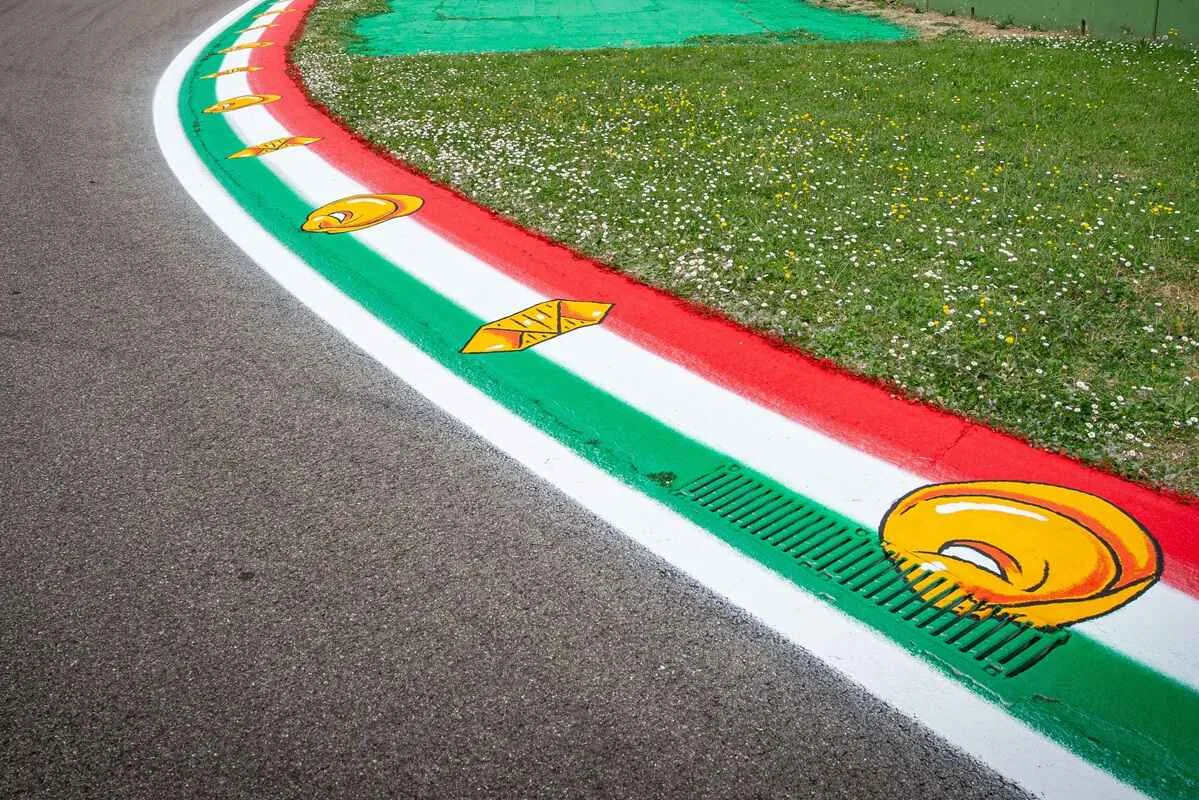
The Enzo and Dino Ferrari International Autodrome is enriched with a new and original artistic intervention that combines tradition, territorial identity, and passion for motorsport, debuting during the FIA WEC 6 Hours of Imola. The project was born from the desire of the Municipality of Imola and the management of the autodrome to enhance one of the most iconic points of the circuit, the inner curb of the Tosa corner, transforming it into an element capable of telling the story of the territory also through visual language, which will soon host the House of Events inside the corner.
Read more Ferrari 499P triple at the WEC preseason tests in Imola
The protagonist of the intervention is the artist Marco Alpi, who conceived and created a work directly on the track, choosing to represent two symbols of the local gastronomic tradition: the Romagna tortellino and the typically Imola garganello, which since 2003 has also given rise to an award: the “Golden Garganello,” awarded annually within the enogastronomic and cultural event “Baccanale” held in November, aimed at enhancing chefs, scholars, and institutions distinguished in promoting food culture. The shapes of the work, painted on a tricolor background, alternate along the curb, creating a continuous pattern that ideally recalls the speed and trajectory of the racing cars.
The intervention was carried out using brushes, rollers, and acrylic paints specific for racing surfaces, fully respecting the technical characteristics of the track. Overall, the work consists of 50 elements – 25 tortellini and 25 garganelli – that extend along the entire inner corner. Each figure was hand-painted, with slight variations that make each element unique, just like in the tradition of homemade pasta, where each piece, despite its apparent uniformity, retains its own identity.
A work that is not only decorative but also represents a symbolic gesture: bringing to the track, in the heart of the autodrome, elements deeply connected to the culture and daily life of the territory. A way to strengthen the bond between the sports facility, the Region, and the city, making the visual experience of the circuit even more recognizable and distinctive not only in terms of Motor Valley but also Food Valley, an expression of Made in Italy as a whole.
Read more Almost 600 laps completed by the Ferrari 499P in the Imola Prologue
All this about four months after the recognition of Italian cuisine as an Intangible Cultural Heritage of Humanity by UNESCO. Defined as “the cuisine of affections” and recognized as a living heritage, it celebrates a unique set of traditions, biodiversity, passed-down knowledge, and conviviality, making Italy the first country in the world to obtain this important recognition.”
“This was a very interesting experience for me because I was able to experience the autodrome in a completely new way, working for two days on a truly unique support – said Marco Alpi – I also had the opportunity to leave, through art, the same tortellini and garganelli with which I grew up since I was a child to the autodrome and the city.”
“We are pleased to present this work, which helps make the circuit increasingly distinctive and recognizable also from a visual point of view – said the Director of the Autodrome, Pietro Benvenuti – the inclusion of artistic elements linked to the territory directly on the track represents an important added value, capable of strengthening the bond with the city and offering a unique image at an international level.”
Read more Another step forward for Mattia Drudi: new reserve driver of the Aston Martin Valkyrie