








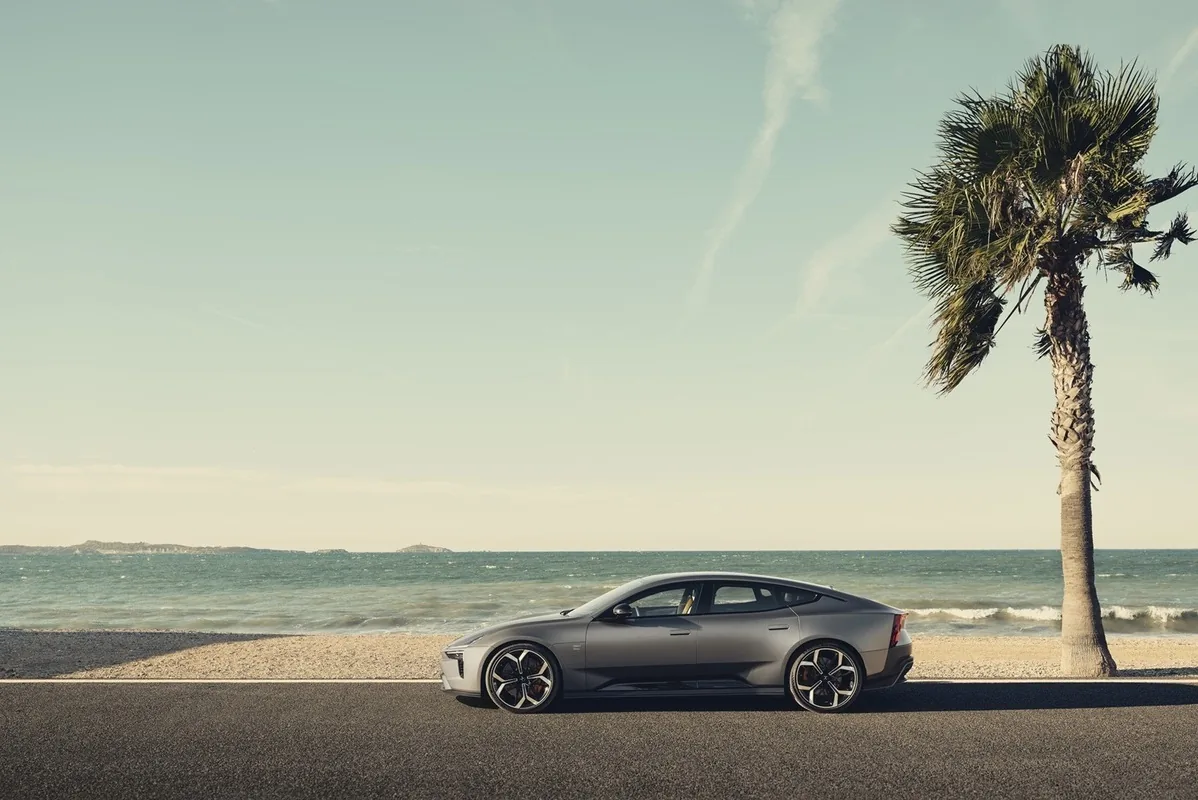
Polestar continues to drive the automotive industry towards greater climate transparency by publishing detailed and verifiable assessments of emissions related to its vehicles for years now. Since 2020, the Swedish manufacturer has made the Life Cycle Assessments (LCA) of all its models public, and now the analyses cover every car in the range, including the new Polestar 5, the four-door GT. Making cradle‑to‑gate data available to the public, such as the complete carbon footprint of the Polestar 5, equal to 23,8 tCO2e, allows customers, suppliers, and competitors to understand where emissions are concentrated along raw material extraction, production processes, and delivery.
Read more Volkswagen recovers in China, BYD off the podium
Carbon footprint of Polestar 5
At the heart of the emission reduction strategy are materials and sourcing choices: aluminum, one of the most carbon-intensive components in the automotive industry, has been reimagined for the Polestar 5. 13% of the aluminum used is recycled, while 83% comes from smelters powered by renewable electricity, decisions that allow for avoiding over 14 tCO2e per car compared to traditional practices. Renewable electricity in production plants and critical component suppliers (such as battery cell modules) also contributes to significantly reducing manufacturing-related emissions.
Read more Official, Qatar GP postponed to November 8
Sustainable performance
Inside the cabin, Polestar integrates innovative and circular materials, from flax-based ampliTex natural fiber composites to Econyl mats made from fishing nets, recycled PET fabrics, and a mono-material PET front luggage compartment, as well as chrome-free Bridge of Weir Nappa leather options from supply chains attentive to animal welfare. This transparency and the adoption of low-emission materials do not compromise performance: Polestar 5 is a powerful and technological GT, with up to 650 kW (884 hp), 1.015 Nm of torque and a range of up to 678 km (WLTP), as well as an 800 V electrical architecture that allows DC charging up to 350 kW, from 10 to 80% in about 22 minutes.
Read more 2026 Drivers’ Championship: the standings after the Chinese GP