





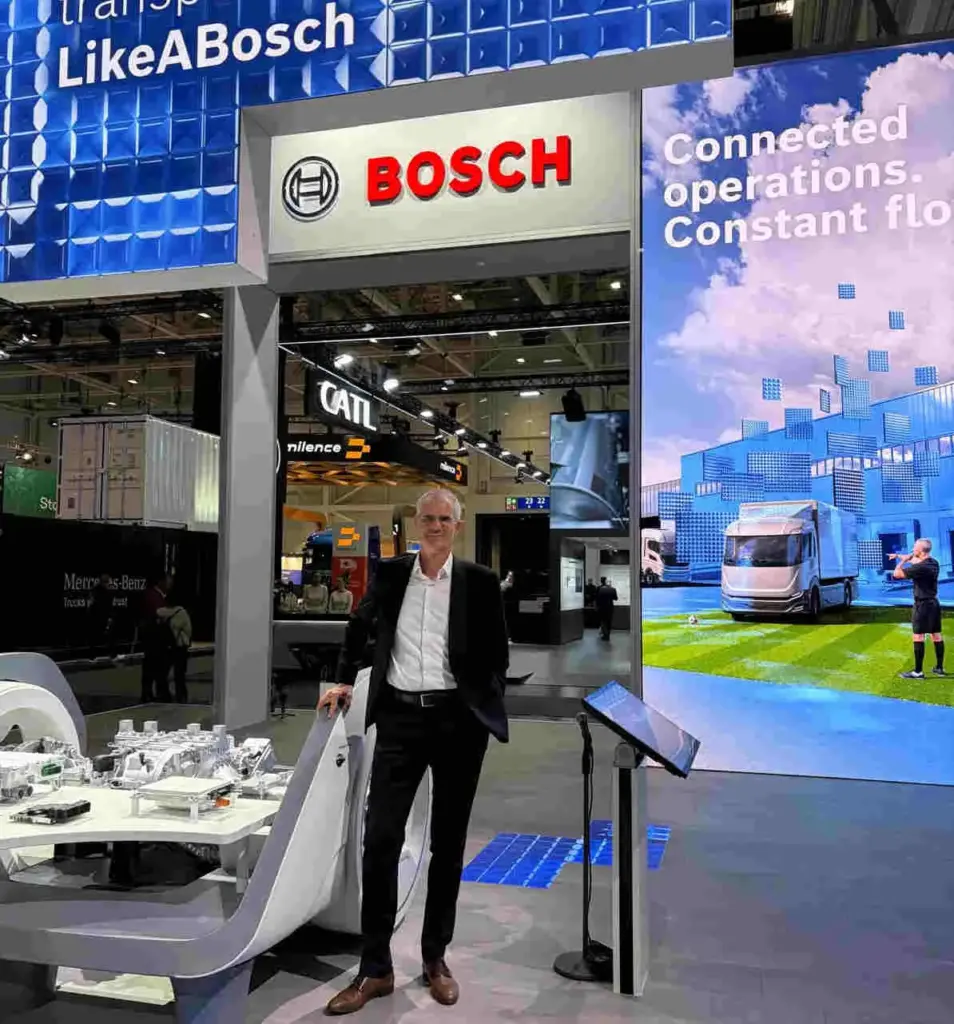
Bosch presents itself at IAA Transportation 2026 with a clear message: freight transport is radically changing and the company wants to lead the transformation. The declared goal is to double sales in the heavy commercial vehicle segment by the mid-2030s, a business that already exceeds 4 billion euros today.
Read more Pasticcio Monumental and other stories from Madrid: The Dubbed F1 Podcast – VIDEO
“The heavy commercial vehicle business represents an important growth area for us,” said Markus Heyn, member of the Bosch board and president of the Mobility sector. “We aim to double sales in this segment by the mid-2030s.”
The market context helps. Even in a year when global vehicle production is declining, the heavy truck segment proves more resilient. Bosch expects moderate growth in global production of about 1% in 2026, up to 3.3 million units, with the goal of reaching 4 million by mid-decade. On this basis, the company sees room to double revenue in technologies for heavy trucks.
Propulsion: not just batteries
Bosch’s strategy is deliberately technologically open. By 2026, one in three newly registered electric trucks in Europe will be equipped with Bosch electric motor and inverter. A new order from Daimler Truck for the eActros further strengthens this position.
At the same time, the company continues to invest in fuel cells (systems from 100 to 300 kW for buses, long distances, and stationary applications), hydrogen engines, and alternative fuels. “Achieving climate goals in transport is not a matter of choosing one technology or another,” Heyn emphasized. “We must use all solutions that allow us to move away from fossil fuels.”
Concrete innovations at the fair: the new rigid e-axle, which integrates motor and transmission reducing weight and consumption; a high-voltage 800 V fan for thermal management of electric vehicles; and the Digital Fuel Twin, cloud software that automatically documents the use of renewable fuels such as HVO and the related emission reductions.
Safety, sensors and first steps towards autonomy
Since July 2026, the European Union has made more stringent automatic emergency braking systems (also on pedestrians and cyclists) and driver monitoring mandatory. Bosch responds with a camera integrated into the left digital mirror, already in series production at two European manufacturers, which detects fatigue and distraction without the need for an additional unit.
In 2027, the new multifunction camera MPC4 will arrive, with computing power twenty times higher and sensor data fusion already onboard the camera, and the seventh-generation radar with proprietary chip and artificial intelligence algorithms. The declared goal is to reach Level 4 autonomous driving, also to address the driver shortage.
Read more Dall’Igna: “Is Marc Marquez alone? Bagnaia is struggling, but we have Alex and Aldeguer”
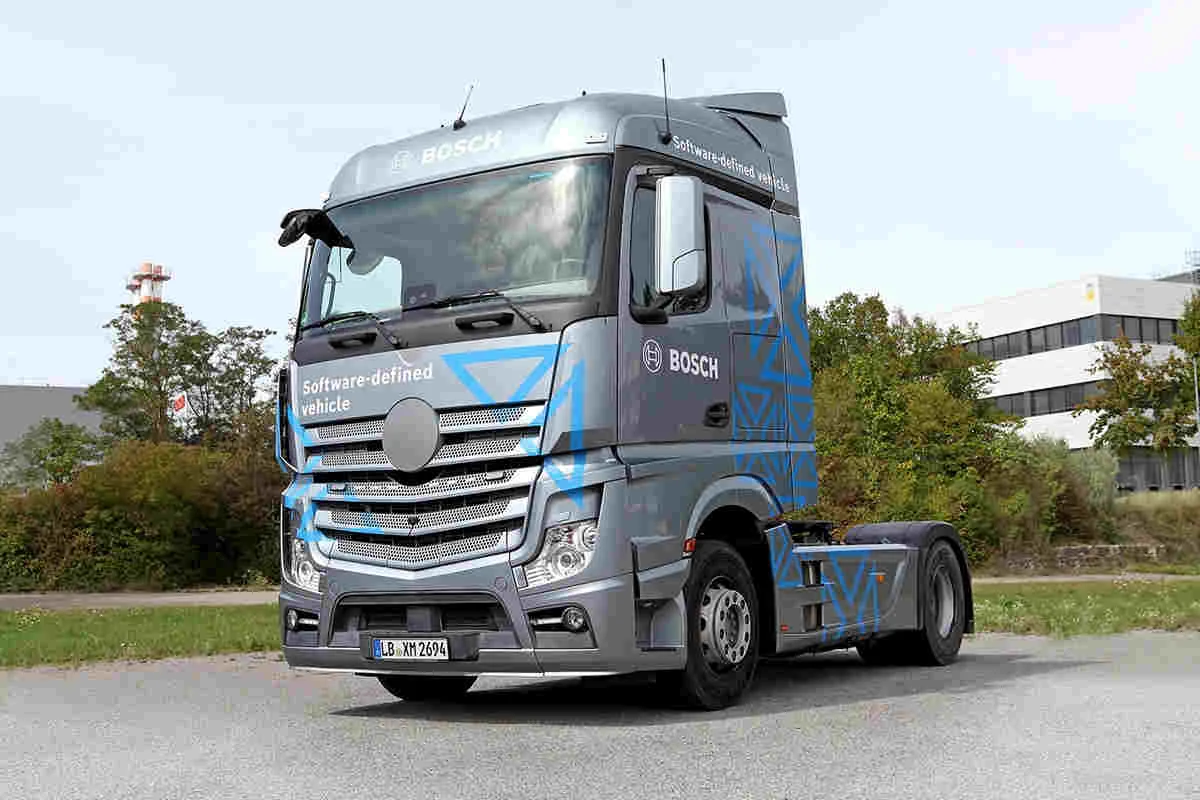
The software-defined truck
The real step change, according to Bosch, is architectural. Commercial vehicles are moving from dozens of scattered control units to high-performance central computers. Bosch and its subsidiary ETAS are developing centralized E/E platforms, integrated cockpits, and software based on the open source initiative Eclipse S-CORE. This allows over-the-air updates, new on-demand functions, and easier fleet management.
“The truck of the future will increasingly be a high-performance computer on wheels,” said Camillo Mazza, General Manager of Robert Bosch GmbH Branch in Italy. “For Bosch, this evolution means combining different skills and developing technologies that make transport not only more sustainable but also safer, more efficient, and competitive.”
Mazza highlighted Italy’s role: “Our team significantly contributes to the development of technologies for the mobility of the future also in the commercial vehicle sector, supporting customers in the transition.”
Electric steering and new joint venture
Among the hardware innovations stands out ServoE, the fully electric steering without oil, with a redundant architecture designed for autonomous driving and future steer-by-wire. Completing the offer are the electrohydraulic Servotwin system, rear axle steering to reduce turning radius, and a specific airbag unit for trucks, also capable of isolating the high-voltage battery in case of an accident.
Bosch also announced the intention to establish by the end of the year a joint venture with Brakes India and Wheels India (TSF group) to develop intelligent actuators for compressed air, air suspensions, and parking brakes. The operation is still subject to approvals.
Bosch’s Mobility sector, which in 2025 posted revenues of 55.8 billion euros (61% of the group), thus confirms its ambition: not only to be a component supplier but a system partner for manufacturers and fleets in the transition towards cleaner, safer freight transport increasingly defined by software. vb
Read more Power unit, Honda changes the leader: Yoichiro Fukao takes the place of Tetsushi Kakuda