

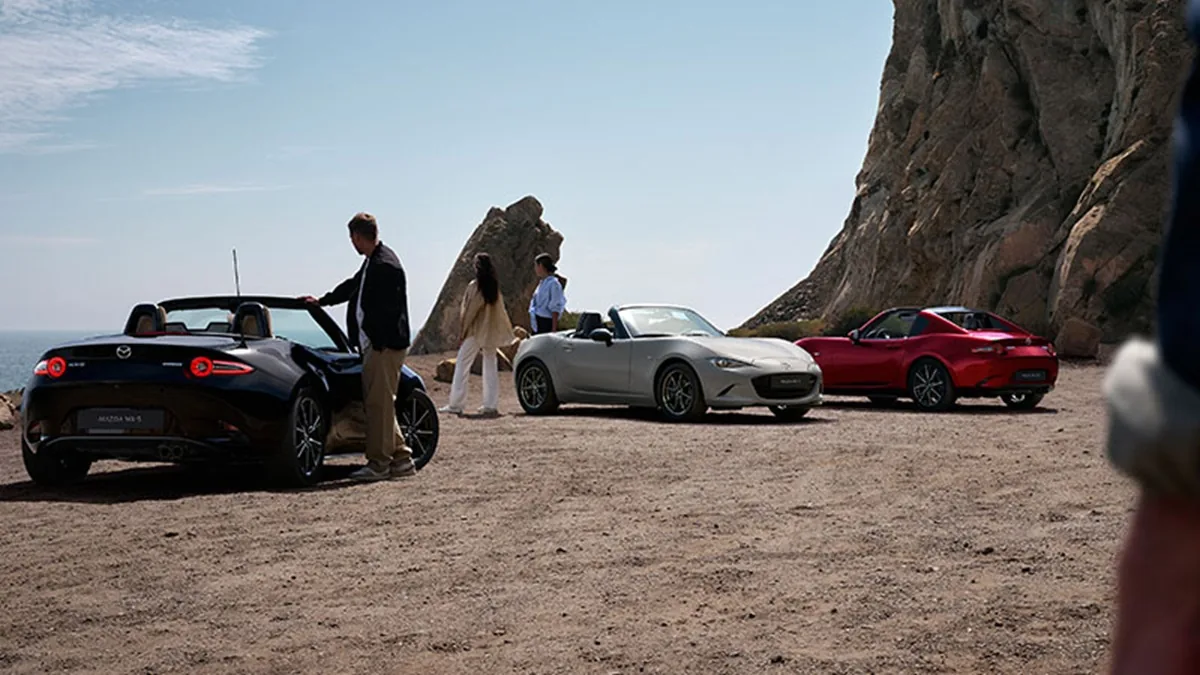
You don’t need an engineer to understand the new Mazda MX-5. You need Jeremy Clarkson: a tall, loud Englishman, specialized in saying true things with the voice of someone who really knows cars. He was the one who declared that little Japanese roadster a five-star masterpiece, and that if he could, he would have given it fourteen. It’s an exaggeration, of course. But exaggerations, when honest, are worth more than balanced reviews.
Read more Tardozzi: “With Acosta we have a very promising future, he is already a certainty”
Clarkson also had to defend the car from the most Italian accusation there is: that it is “for hairdressers.” An old, masculine, somewhat tired accusation. As if fun, to be authentic, had to come with a wide front, a German price, and a certain conquering scowl. The MX-5, instead, is light, open, without frills. It costs 33 thousand euros. It doesn’t promise to make you look like someone. It just makes you feel better. Which, in an era of anthropometric SUVs and dashboards that look like switchboards, sounds almost subversive.
When the Fiat 124 Spider arrived, a close cousin dressed in Italian style, Clarkson dismissed it as “an elephant on a unicycle”: same family, less soul. The original Japanese, in his opinion, remained leaner, more engaging, less watered down. You can debate the judgment endlessly, but the MX-5 remains an amazing car.
The fourth generation is from 2015. The first model, however, is from 1989, and by 2016 one million had already been sold. A record, for a two-seater. The formula hasn’t changed, and that’s the point. Front engine, longitudinal, set back; rear-wheel drive; weights split evenly. It’s the geometry of 1960s British sports cars, resurrected by a Japanese company with the patience of someone who doesn’t need to invent a revolution every six months. Less than four meters long, just over a ton. The hood and trunk are aluminum. The soft top is canvas and opens by hand, while seated, effortlessly. You would expect, in 2026, a button, a servo motor, a jingle. Instead, no: a gesture. Bam and the roof is gone. Like on the Duetto.
The details
Inside, you sit tight, with the car tailored to you. Speakers in the headrests, the wind deflector that cuts vortices, and — finally, since 2018 — the steering wheel adjustable also in depth, so taller drivers stop driving as if they were uncomfortable guests. There are also electronic aids, those that nowadays no one dares to refuse: lane assist, emergency braking, blind spots. Modernity, here, sneaks in. But it is not the protagonist.
Read more Stewart “blesses” Antonelli: “Amazing work, and he is as mature as few at 20 years old”
The strategy
The spirit of the car is all in the 1.5 engine with 132 horsepower. Now on the new one there is only this, the 2.0 with 184 has retired. Better this way, the 1500 has always been the ideal engine for this little roadster. The perfect cheerful companion to a six-speed gearbox, very precise, “wrist-like.” The pedals invite heel-and-toe like some old kitchens invite cooking. The 1500 indeed revs up to 7,500 rpm and debunks the legend of small displacements being “weak,” so using the gearbox becomes a game.
Of course, the trunk is 130 liters: two duffel bags and a sense of guilt. The soft top, when closed, insulates little; above one hundred km/h it becomes a concert of rustling. The space for objects is scarce, the rear view is that of someone sitting very low and having decided to accept the consequences. Nothing tragic. Just the price of lightness, which you don’t pay at the dealership but pay every time you have to do the shopping.
Clarkson is right, after all, even when he gets the star ratings wrong. It’s a car for enthusiasts. An amazing and beautiful car, that makes you special, for a quarter of an hour, on a winding road. In a country that still confuses prestige with volume, and seriousness with weight, a car that opens by hand and weighs just over a ton is almost a moral argument. It won’t win any bar debates. But, unlike many bar debates, it makes you smile.
Read more Pirelli sets the strategies for Monza: “No degradation problems, single stop favored”