








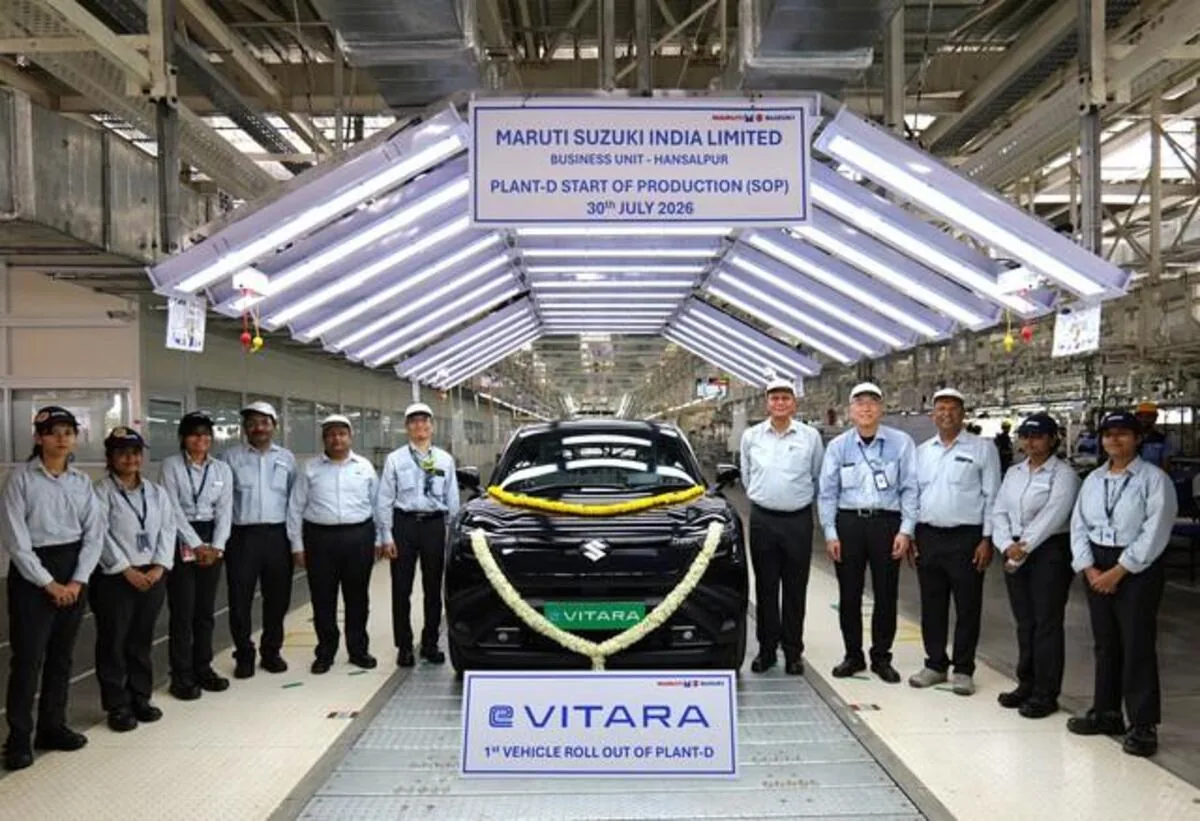
Maruti Suzuki India, Suzuki’s Indian subsidiary, has announced the start of production at the new Plant D, inaugurated last July 30. This was announced by the Japanese car manufacturer itself, recalling that the plant represents the fourth facility of the Hansalpur production complex, in the Indian state of Gujarat. The site boasts a annual production capacity of 250,000 vehicles, and the new Plant D will be dedicated to the production of the e-Vitara, Suzuki’s first fully electric SUV.
Read more BMW, useful in decline but electric sales are growing
Suzuki e-Vitara, news in India
The Hansalpur hub has seen a gradual growth. The facility has progressively expanded its production capacity with the start of Plant B in January 2019, Plant C in April 2021, and now Plant D. The commissioning of the new plant, Suzuki explains, represents a significant milestone for the Japanese manufacturer. The Hansalpur site, operational since February 2017 with the launch of the four production complexes, now reaches a total production capacity of 1 million units per year.
It is the first time in the brand’s history that a single production hub reaches this level of annual capacity.
Goal of 4 million units in the 2030s
We recall that Suzuki currently operates in India through four production plants: Gurugram, Manesar, Hansalpur, and Kharkhoda. With the commissioning of the new plant, the company’s total annual production capacity in India reaches 2.9 million units. And it doesn’t stop there, as production capacity growth in the country will continue in the coming years. In particular, through the continuous strengthening of its industrial presence in India, Suzuki aims to reach a 4 million units annual production capacity during the 2030s.
Click here to add Formula Passion as a preferred source on Google Discover: you will find our content more easily!