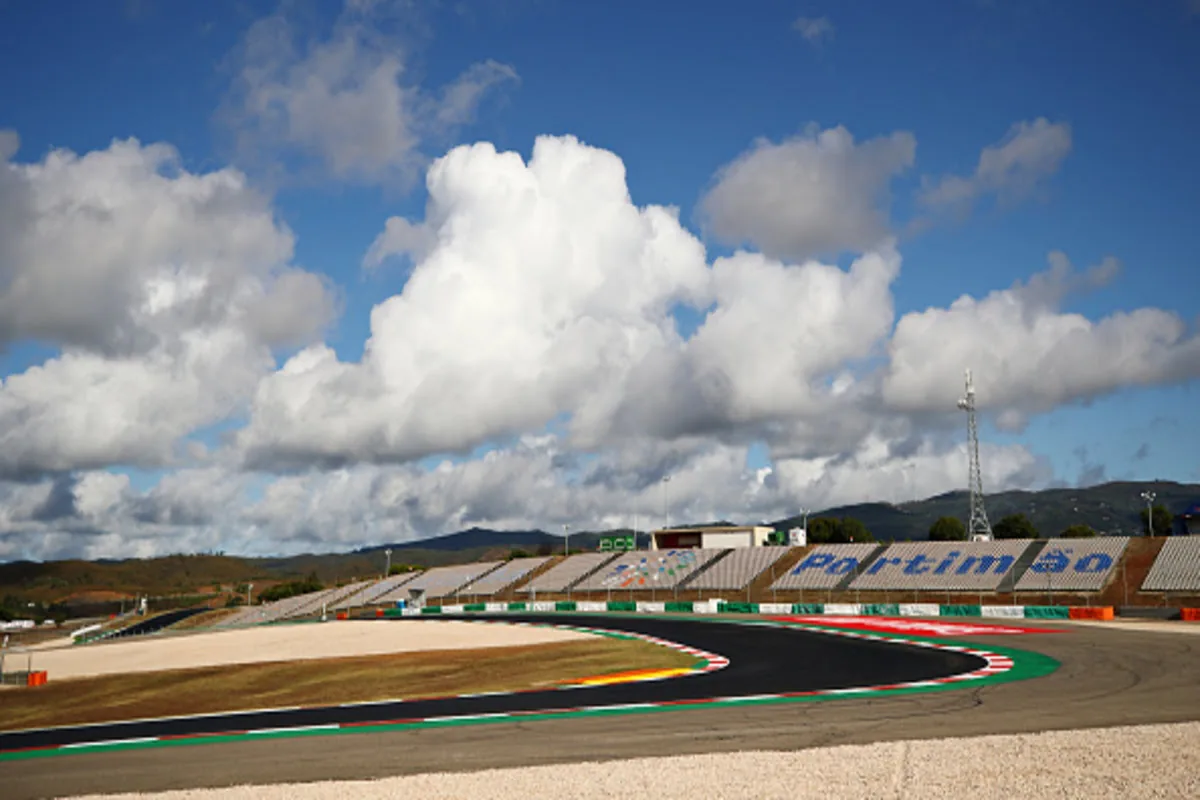







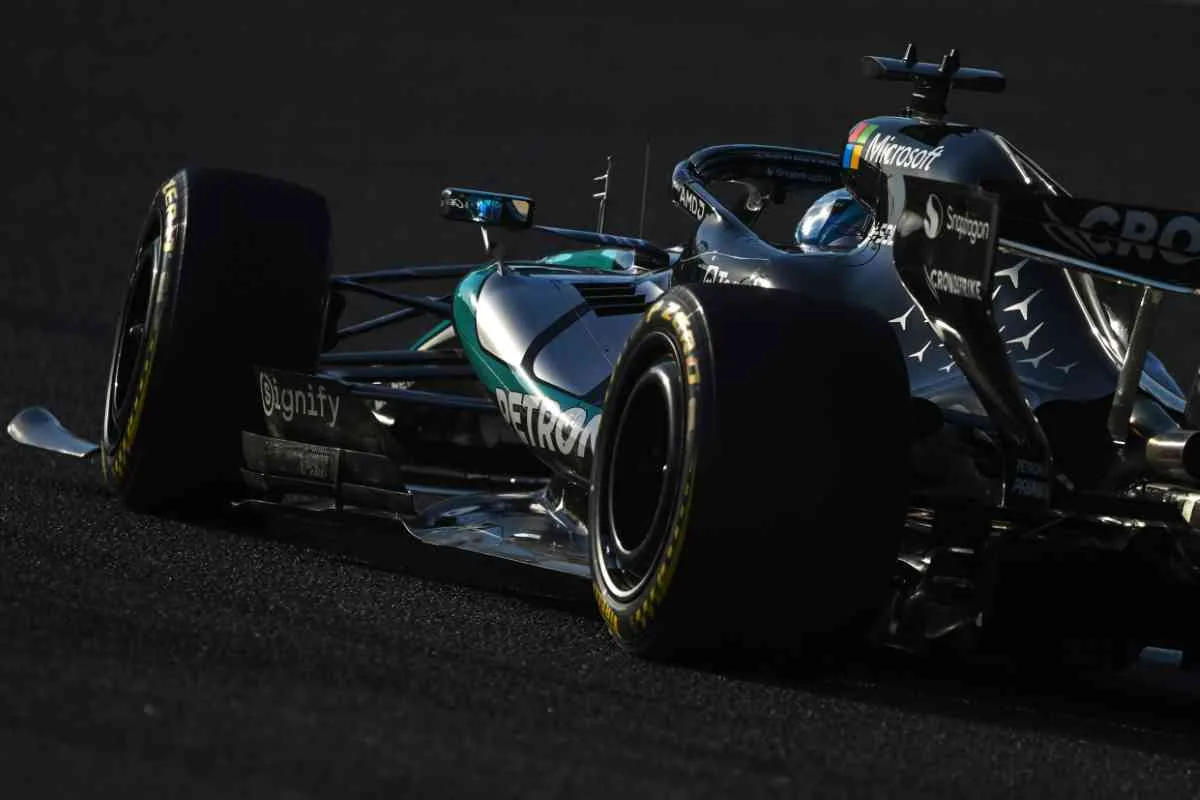
The first qualifying of the year has just concluded on the splendid Albert Park track in Australia, and if the final result is not so different from expectations, what was seen on track in terms of performance certainly made a certain impression. Mercedes indeed seals the entire front row with an abysmal advantage: Russell puts 8 tenths on Hadjar, the first of the pursuers and Antonelli finishes second with a half-second lead over the pack without even having time to properly calibrate the car’s mechanical setup. A dominance by the team led by Toto Wolff that goes beyond the eve’s expectations, thanks also, it must be said, to a series of combinations that partly amplified it. Verstappen’s absence in Q3 and a Ferrari with some energy management issues certainly helped to widen the gap even further in favor of the silver arrows, but it would have been difficult to drop below half a second. The engine manufacturers at Brixworth are undoubtedly the true protagonists of this result: the Mercedes Power Unit has no rivals in terms of energy exploitation and regeneration, the key aspect of these new cars, and the data betrays this unequivocally.
Mercedes: it’s not just the Power Unit, but a large part of the advantage comes from there anyway
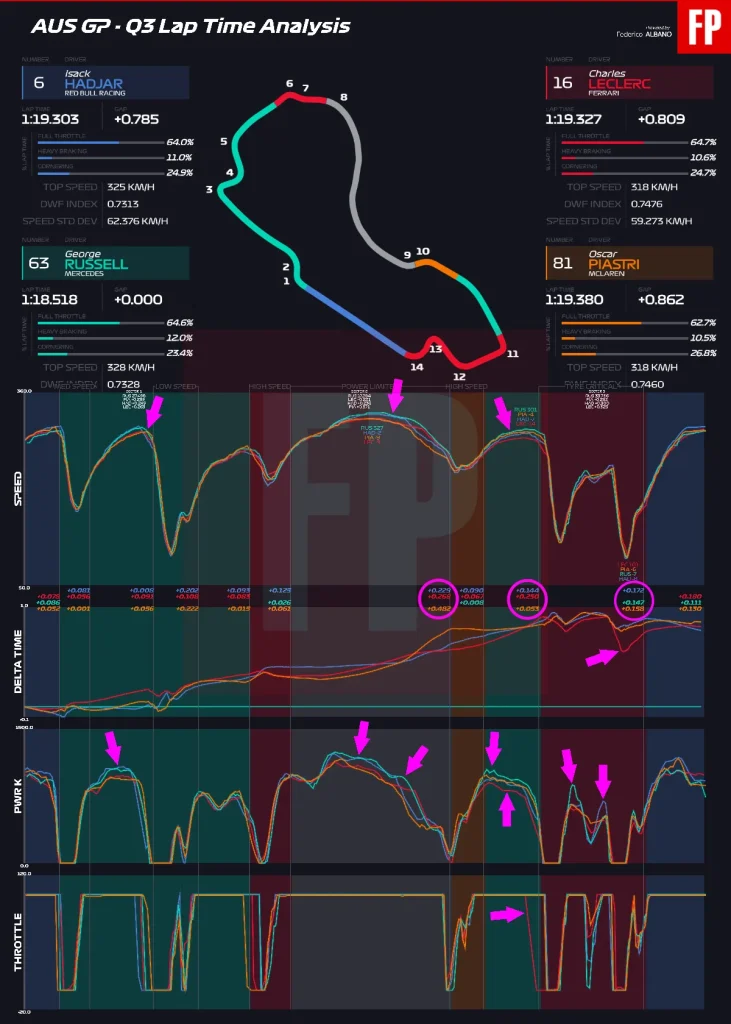
It’s true, the W17 driven by Russell and Antonelli does not dominate only thanks to the power unit. Following the data from the entire session, we saw how especially the British driver was conservative in the first phase to really push even in the corners only in Q3 and show an overall behavior of the single-seater that is excellent also at the chassis level: excellent balance and equilibrium between the axles, the aerodynamic load is abundant and the drivers travel on rails. But the bulk of the gap opens up when the limit becomes the capacity for energy exploitation. The margin that the Brackley team has appeared enormous in this sense, on a track particularly complicated from this point of view. The most evident example is the entire rear part of the track: the section from turn 8 to turn 9, the semi-straight characterized by the so-called super clipping, already sees a clear dominance by Russell, but even more happens in the section immediately following, between 10 and 11. That clearly represents one of the points where the Power Units are most “energy-hungry”, given that you arrive from the previous straight facing only the fast chicane of turn 9-10, without real braking, and where it is necessary to recover charge through the use of the internal combustion engine. Mercedes, despite being the fastest car in the first section, is clearly the fastest in the second as well, with the clear impression that the more complicated the conditions become from an energy profile, the greater the advantage available to Russell and Antonelli, who in that section alone put half a second on everyone. Furthermore, while it is evident from the data how everyone must somehow “spread” the available energy between the various straights, Mercedes excels in practically all speeds before the braking zones, confirming that they have more margin available for the entire lap. Clearly, adding the excellent chassis mentioned above to this type of capability, the result can only be the dominance seen in this session.
Ferrari: the best in corners in many sections. The chassis is excellent but the engine gap is significant
The Prancing Horse team, from a chassis point of view, has shown results even better than expectations. The car does not have the stability of the Mercedes, but it is effective in all corner phases, and is fast both in the slower sections and in high-speed corners. Not only that, the third sector of Melbourne is the most critical in terms of tire management, where cars like last season’s McLaren or the 2023 Red Bull made an enormous difference over the competition. And right in that section, Leclerc gains between a tenth and a half and two tenths on all direct rivals, demonstrating that the car has a solid base from an aero-mechanical point of view and a correct setup for tire temperature management. The problem is the engine gap which appears truly significant, even if the 8 tenths recovered are not entirely truthful. Both Leclerc and Hamilton, in fact, had several problems with the electrical part in Q2 which then had an effect on the optimization of Q3 as well. All this translated into a significant difficulty from a purely energy point of view. In the section from turn 10 to turn 11, the data clearly shows an “energy hunger” from the Maranello power unit, with Leclerc suffering a 14 km/h speed difference at the braking of turn 11, combined with an enormous Lift and Coast to “desperately” recharge, according to our data about 200 meters long. These problems would in all probability have been slightly lower without the issues encountered, but nothing to do with the gap suffered, which could perhaps have dropped to around half a second, but hardly less. Among the two drivers, Leclerc still shines, but it must be said that the Hamilton seen on track in Melbourne seems only a distant relative of the one from last season, with a second row missed precisely because of the difficulty in managing these issues, while in driving, confidence appeared decidedly improved, and this can only be a good sign for the seven-time World Champion. Overall, for the red team, there is an obvious atmosphere of concern because seeing a solid chassis base annihilated by such a difference in potential from an engine point of view represents a non-trivial challenge for the current season.
McLaren: Mercedes Power Unit but not yet the same results, for two reasons
McLaren is also part of the pack behind Mercedes, with Piastri also a whisker away from the second row and Norris right behind. The main question many are asking in these hours is why a team like the one from Woking does not show the same characteristics as Mercedes with which it shares the power unit? There are mainly two reasons: the first is that the MCL40 project involves a fairly different energy management philosophy from that of the parent company, with much shorter gear ratios and an approach that involves more lift and coast in driving (almost totally absent in Russell and Antonelli). The other reason, the main one, is that, as Andrea Stella explained directly, the supplier engine manufacturer has an enormous advantage this year in having full control of the electrical part management software, which requires extreme optimization of parameters and maps, to which customers do not yet have full access. From the data, we also notice some small difficulties for Piastri in the slow corners, signifying, perhaps, a car that has not yet reached its ideal weight, despite the “diet” it was subjected to before Melbourne. This seems to have a certain impact also on the race pace and tire management front, which appears from the simulations to be somewhat the weak point of the current McLaren and which will be interesting to verify precisely after the lights go out in Melbourne.
Read more Stellantis tries: electric at the price of diesel
The real positive surprise: Hadjar and the RedBull Power Unit
Beyond Mercedes, the other unexpected performance on the eve was that of the RedBull team. In a negative sense for Max Verstappen, given that an accident at the first corner of the first lap is certainly not what the four-time world champion has accustomed us to, even if from the dynamics it seems that the trigger of the energy recovery at the rear made an important contribution to the axle locking and the consequent spin. In a positive sense, however, Hadjar’s third place is absolutely to be celebrated, given everything we have usually seen happen to Verstappen’s teammates. The Frenchman seems able to exploit the opportunity of arriving in the Austrian team at the debut of a generation of cars complicated from an engine point of view, but decidedly less extreme on the balance and tire front, and therefore easier to bring to the limit. From the data, however, a surprising characteristic emerges, namely a RedBull Power Unit that is decidedly the second force behind Mercedes. The work done in Milton Keynes seems incredible and the energy available for Hadjar in his laps starting from Q3 was significantly higher than, for example, Ferrari and McLaren, especially in the upper part of the spectrum in what seems a clear transposition of the old Honda know-how that excelled precisely in that phase.
For the race, Mercedes’ enemies are the start and reliability
In light of all this, the prediction for the race is clearly for a Mercedes one-two, with reliability, however, as one of the main concerns for the team led by Wolff, also considering that Russell has already had to fit a new battery pack and a new control unit due to problems encountered during the weekend. The other doubt is about the starts, where Mercedes, with the large turbo, appeared more in difficulty in testing and where Hadjar and Leclerc place their hopes to be able to insert themselves into the first two positions, then trying to resist in a race that will see the management of overtaking as something extremely complicated.
Read more Hamilton: “From Q2 I had problems with the battery, we were on for the second row”