


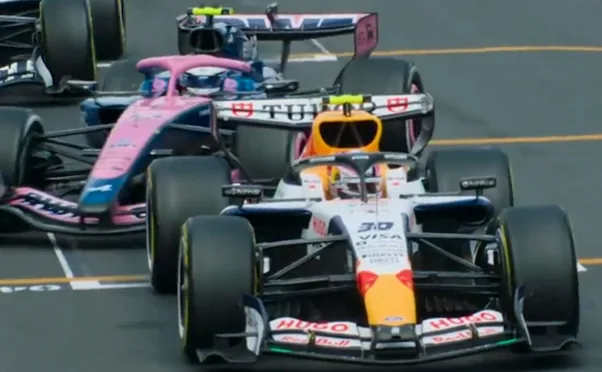
If we are here discussing whether this is Formula 1 or not, whether we like what we saw in Melbourne or not, whether Mercedes has a le(g)al advantage, whether the overtakes seen are real or artificial… well, it is above all thanks to the incredible reflexes of Franco Colapinto.
Read more Norris: “Artificial overtaking. We risk a big accident with speed differences of 40-50 km/h”
The Alpine driver avoided an accident of enormous proportions at the start, dodging – without even touching – Lawson’s Racing Bulls practically stalled at the start four rows further ahead. But the real luck (so to speak) is that practically everyone had problems at the start, effectively reducing the risk to a minimum: Leclerc, for example, was convinced he would easily drop from fourth to ninth/tenth position, and instead found himself incredibly leading into turn-1, slaloming between the Mercedes and Hadjar’s Red Bull.
Talk about a near miss 😰
Unbelievable reactions from Franco 💪#F1 #AusGP @AlpineF1Team pic.twitter.com/zf1MqgqS0x
— Formula 1 (@F1) March 8, 2026
An issue known for at least a year
The starts issue emerged only during the Bahrain tests, when Mercedes and McLaren in particular raised the alarm about the risks due to reactions being too slow because of the new power unit structure. The elimination of the MGU-H, in fact, has complicated the turbocharger’s response, generating the phenomenon of turbo lag, i.e., a delay in response to the power request, especially during the start phase.
Ferrari, however, was already talking about it a year ago with Frédéric Vasseur and is perhaps the only one to have considered this aspect in the design of its power unit, sacrificing maximum power in favor of better reactivity with a smaller turbo.
The Federation tried to remedy this by finding a sort of compromise between the parties so as not to penalize those who, like the Prancing Horse, had rightly made choices taking this aspect into account: it was therefore introduced a 5-second pre-start to allow everyone to prepare the engine and avoid trouble when the lights go out.
Evidently it is not enough: it will be necessary to understand how almost everyone found themselves on the grid with a battery charge level of zero, as well as finding solutions to avoid disasters in the future. Because the danger – and Colapinto knows it – is just around the corner, especially if a car in the front rows stalls. One more problem to think about, and quickly, instead of pointing the finger at the drivers’ criticisms or praising the increase in overtakes compared to 12 months ago…