

The Mercedes engine is always under the magnifying glass
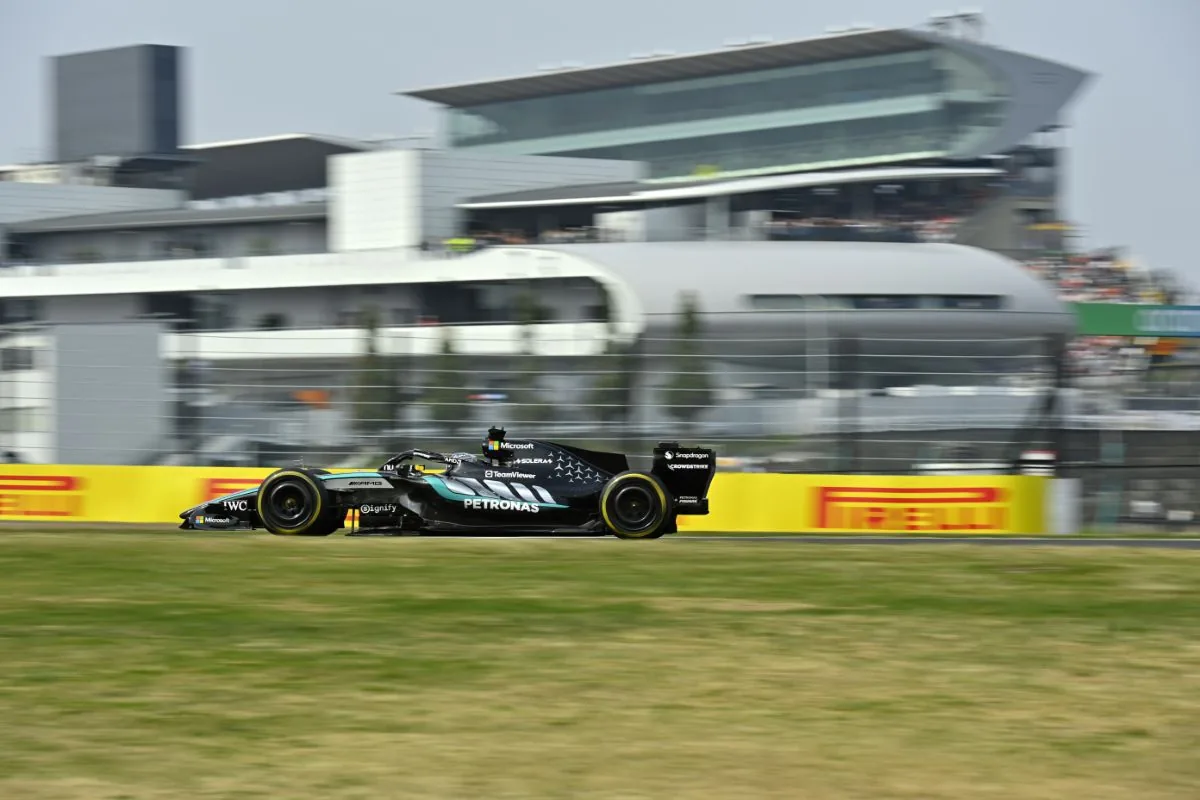
Not just compression ratio and two-stage front wing. After the Japanese GP at Suzuka the Mercedes engine returns to the center of the rivals’ magnifying glass because of another “trick” that would help to make the most of the power unit’s electrical power on the qualifying lap. Explaining the solution devised by the teams that have a Brixworth power unit is the authoritative English online publication The Race, with expert journalist Jon Noble explaining how Mercedes engines – but also Red Bull-Ford ones – manage to exploit an “emergency” mode of the power unit to improve single-lap performance in a perfectly legal way.
How the (legal) system discovered by The Race works
Current power units are in fact designed to reach a peak electrical power of 350 kW, which then gradually reduces by 50 kW with each passing second. In this way, therefore, the electrical horsepower, once it reaches maximum thrust on the straight, decreases in stages until it reaches zero, leaving room only for the internal combustion engine. Mercedes and Red Bull-Ford, however, have reportedly found a way at the software level to avoid this gradual reduction in power: according to The Race, in fact, the engine manufacturers in question would manage to benefit from the 350 kW power for a few extra seconds, then suddenly reaching zero, with a sudden shutdown of the MGU-K which thus avoids the descent that leads it to 0 gradually.
A solution that is permitted by the regulations, which in fact do not establish any limit either in terms of time or power, in the phase of reducing electrical delivery. In any case, to avoid abuse of this system, the FIA mandates that the electronic control unit goes into protection mode if the MGU-K suddenly runs out of energy: thus, when there is not a gradual but a sudden reduction, the power unit can no longer use the power of the electric motor for 1 minute, which obviously makes it inconvenient to use this stratagem in the race, because the loss of speed in driving for 60 seconds without electricity would not be remotely compensated by the few extra seconds with maximum power available.
The Mercedes engine’s extra-boost in qualifying
The situation is different in qualifying, however: the Red Bull and Mercedes-powered teams would in fact use all the power available on the final straight, before the finish line, suffering the sudden cut of electrical horsepower and the consequent “emergency block” for 60 seconds only on the cool-down lap or the lap back to the pits, when the drivers would proceed at low speed anyway, also having to worry about giving way to the fast cars arriving. A “trick” indeed used by some drivers starting as early as Melbourne and which would be evidenced by the fact that some suddenly stall in the first sector. This was evident, for example, at Suzuka with Alex Albon (tweet by Federico Albano below) who after crossing the finish line in Q1 practically stalled in the first sector, repeatedly pressing the accelerator pedal because his power unit was not responding to commands.
Read more Villeneuve: “Hamilton’s drop in the closing stages at Suzuka? Ferrari has an unstable rear end”
when the accelerator doesn’t work and you press it a thousand times until it restarts #JapaneseGP pic.twitter.com/soS6r35UTm
— Federico Albano (@Fred__18) March 27, 2026
This happens because of what Max Verstappen calls a “glitch” (a software problem related to the operation of these power units): if a driver does not downshift quickly after the finish line and perhaps slows down more than necessary to let another car pass, then the engine revs drop suddenly and the turbo loses pressure so quickly that it is then difficult to restart except through a system reset and the slow “recharging” of the turbine already required at the start, given the absence of electrical boost. It is the reason why we sometimes see cars stopped on the track even though the power cut for 60 seconds would only affect the electric part and not the thermal one. This aspect is also evident in Albon’s telemetry, who downshifts with unnatural speed immediately after crossing the finish line, but ends up stalled in the first sector, effectively without a turbine but also with the MGU-K in protection.
Read more The new ‘Mr. Saturday’ is Norris: open streak of 34 Q3s in a row