




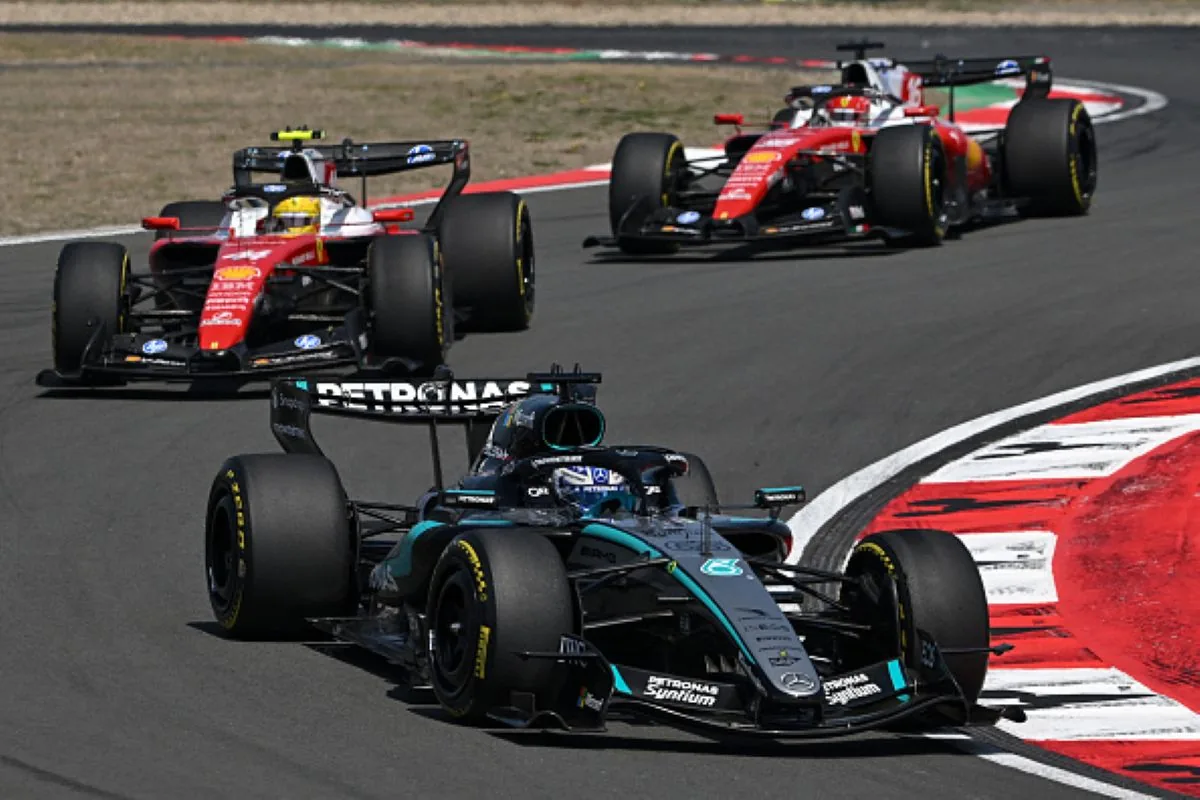
The qualifying sessions for the Chinese GP were definitely more interesting, although they concluded, once again, with an all-Mercedes front row. At this moment, it is difficult for the qualifying session to go much differently, considering the engine advantage the Brackley team possesses, especially in the discipline of the flying lap. This time, however, it was an excellent Kimi Antonelli who put everything together, the author of a clean and linear session after the bad mistakes made in the Sprint. The situation was different for George Russell, who suffered technical problems at the end of qualifying, taking to the track practically at the last moment and without the possibility of optimizing his final attempt. Despite this, he still managed to secure second position, confirming the qualifying margin that Mercedes enjoys. Third was an excellent Ferrari with Lewis Hamilton, who confirms he is back in form, immediately ahead of a very close Leclerc, followed by Piastri and Norris with the McLaren, which gets closer in qualifying thanks to the Mercedes power unit but remains the third force on track, as confirmed by the drivers themselves after the session. Let’s go, as always, to see what the data tells us from the comparison between Antonelli’s pole lap, Hamilton’s third-place lap, and Oscar Piastri’s fifth-place lap.
Read more Leclerc: “In the race Mercedes are ahead by 3-4 tenths. But unlike 2025 we can do something”
Mercedes horsepower is evident, but Ferrari confirms the best chassis
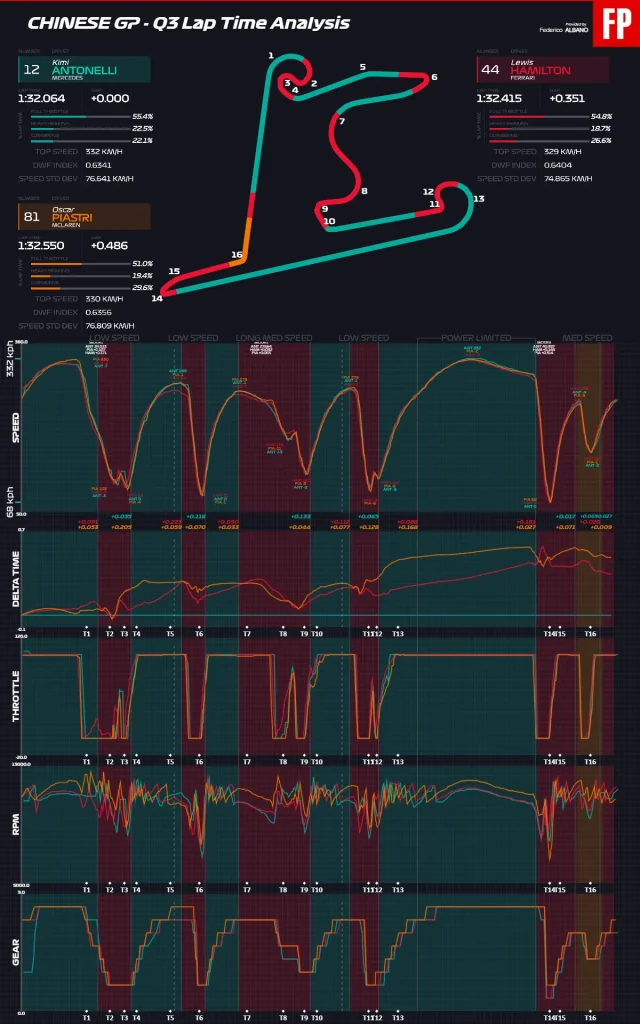
Observing the trend of Lewis Hamilton’s gap chart compared to Antonelli’s reference, a recurring element clearly emerges: the linear growth of the gap in all the straights. It is the classic sign of the power advantage of the Mercedes power unit, which expresses more torque at the bottom and more power in the high spectrum of the rev range, especially in terms of energy, with all the straights in the first half of the track seeing a much slower Lewis Hamilton, evidently to save energy for the subsequent section.
Ferrari, however, confirms it is indeed an excellent car from a chassis perspective, as already seen in the Sprint. In corners, both in slow and medium-speed sections, the Maranello car is the best in the group, with Hamilton gaining an average of 1 tenth at every corner. It is no coincidence that the seven-time world champion manages to record the highest cornering speed at the last corner of the circuit once again, a section where he was in huge difficulty with last year’s car. Hamilton confirms he is increasingly back in form, and seeing him drive with this level of confidence is certainly a positive sign for the team.
McLaren suffers in traction due to car deficiencies, then stabilizes on the engine side
From the gap chart, an interesting aspect regarding Piastri’s McLaren is also noted. The gap tends to increase at corner exits and during the traction phase, only to stabilize when entering the full straight phase. This suggests a car that is more complicated to operate from an aero-mechanical point of view at the rear: probably with less downforce and less grip, and perhaps also slightly heavier. However, when the performance limit comes solely from the power unit, the papaya car manages to recover and align with Antonelli’s performance, showing a much better understanding of the power unit compared to Melbourne, and that the gap now resides mainly in chassis deficiencies.
Mercedes is the best in terms of energy, even compared to McLaren, and significantly compared to Ferrari
The only real exception to this is the long back straight, where it is noted that Antonelli has something extra both in traction and in the final stretch. In this case, energy management also comes into play, with a particularly efficient hybrid distribution that appears more optimized on the Mercedes compared to the customer team. Precisely on the energy level, an evident difference emerges between Mercedes and Ferrari. Hamilton is forced to give up about two tenths and 14 km/h already at the exit of turn 5 to perform harvesting, i.e., to accumulate energy in the battery. The same dynamic is then repeated at turn 7 and turn 11, leading to about 0.25 seconds lost on the long back straight, simply due to a lower availability of energy to use.
Leclerc – Hamilton comparison: two identical laps, separated only by energy management
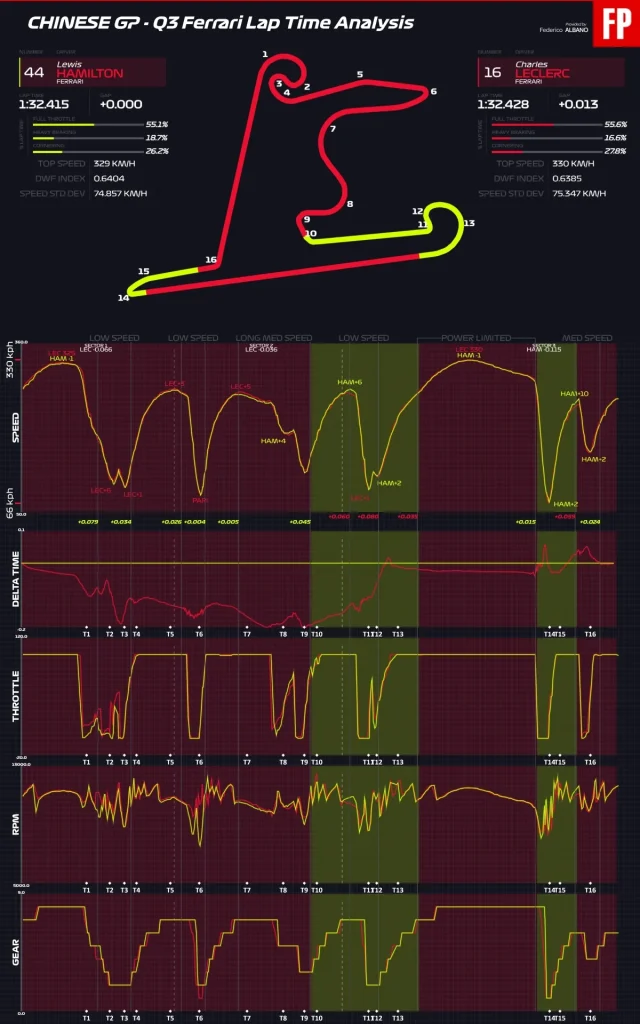
The internal comparison between Hamilton and Charles Leclerc is also interesting. The two laps are extremely similar. Leclerc builds an initial advantage in the first half of the lap, up to turn 9, only to see it reduce millisecond by millisecond until turn 13. Here too, it is mainly a matter of deployment, i.e., the use of stored energy: the Monegasque uses more in the first straights, only to then perform a very marked harvesting just before the long back straight. Hamilton does the opposite, and in fact, the two laps on the long straight realign practically to the millisecond. In the end, the difference at the finish line will be just 13 milliseconds, with two laps that are essentially identical.
Race with Mercedes as favorite, but Ferrari definitely dangerous at the start
In race perspective, Mercedes obviously starts as the favorite. It remains to be seen if and how the internal challenge between Antonelli and Russell will develop. Ferrari, however, could have something to say, especially in the first part of the race, between the start and the first stints with heavy cars. The smaller turbo adopted by the Maranello team is indeed very helpful when the car is heavier, and at the same time, the qualities of the chassis emerge, especially regarding tire management. As the laps go by and the fuel load drops, however, the situation tends to approach pure qualifying performance, where the Mercedes advantage becomes more evident. It will therefore be an attacking first part of the race for Hamilton and Leclerc, who will try to take the lead and, perhaps, build a gap to spend in the final part. Obviously, such a plan remains not easy to implement given the strength of the Silver Arrows, who start ahead and (if neither of them stalls as happened to Antonelli in the first two starts of the year) will not be overtaken very easily. McLaren, on the other hand, seems unlikely to join the fight, especially in the early stages of the race: the lack of downforce and high graining with low temperatures should represent a limit for Piastri and Norris that is not easy to bypass. Coming to the tires, on this track, tire behavior could once again be a central theme for the race. A clear signal was already seen in the Sprint: as soon as the safety car came out, practically everyone rushed to the pits despite only a few laps remaining until the checkered flag. In this regard, having clean air in front will certainly be an advantage, but the impression is that the greatest additional stress could come from battles on track, which could therefore significantly affect degradation. The race promises to be very interesting, primarily to see if an Italian will return to the top step of the podium and how the Mercedes-Ferrari challenge of this season, which has just begun, will evolve.
Read more Mekies: “We need to understand the reasons for the step back compared to Melbourne”