

The oldest circuit in the world
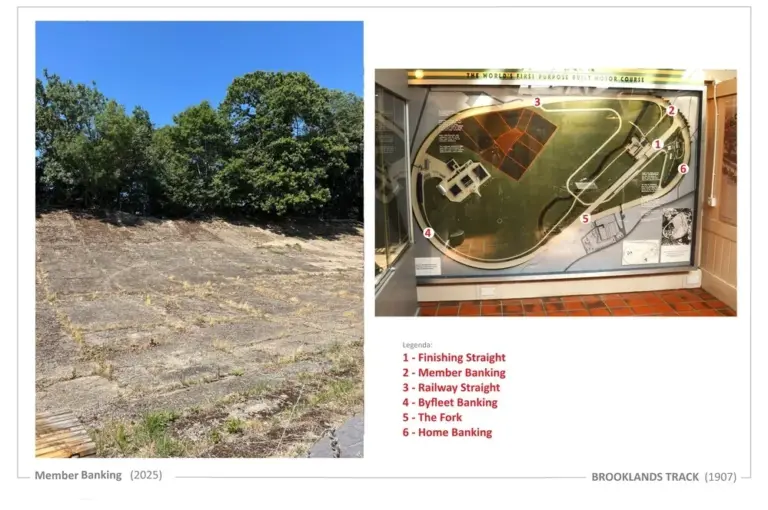
At the time, a generalized and rather low speed limit had been introduced in England; the Motor Car Act of 1903 had set it at 20 miles per hour. The aim was to increase safety, but it also fueled fears that it could slow down the British industry in the rapid evolution of vehicles that was taking place in Europe. Although the idea of racing was still embryonic, the myth of speed and records was emerging. Hugh and Ethel Locke King, to meet various expectations, thought of a circuit where the highest possible speeds could be developed, and in 1906 they put their plans into action, beginning construction on their 330-acre estate in Weybridge. The choice fell on an oval with 2 banked curves of different radii, a Y-junction, and three straight sections that could be configured in different ways to create multiple layouts; the length of the Grand Prix version was 2 ⅝ miles (≈4210m).
Read more Bezzecchi: “Difficult period, so many doubts about myself. Valentino was close to me”
The banking, 30 feet (≈9m) high, was achieved with earth embankments, while concrete was used for the road surface, considered more suitable than asphalt given the curves’ gradient. Immediately after the inauguration on June 17, 1907, Selwyn Francis Edge used the track for a record attempt, which he succeeded in: in 24 consecutive hours of driving, he covered 1581 miles at an average of 66 mph. Racing also began, for which rules and language were improvised, drawing inspiration from horse racing: drivers’ jackets were identifiable (like jockeys’), and there was even vehicle weighting to level performance, a BOP ante litteram. After the war interlude, events began to take on an increasingly international character with shared regulations; in ’26, just a few days after the centenary celebrations, the first British G.P. was held at Brooklands, included in the World Championship organized by the A.I.A.C.R. A particularly curious series was the Double 12 held in ’29-30-31: a 24-hour endurance race, following the success of Le Mans which began in ’23, but divided into 2 parts to avoid racing at night and thus preserve the tranquility of the adjacent town of Weybridge. During the same period, the very fast BRDC 500 Miles was held on the oval (outer circuit); in the ’35 edition, John Cobb won at the wheel of a colossal Napier-Railton; following that success a few weeks later, during a record attempt session, he achieved the fastest lap, which remained unbeaten, at an average of 230.84 km/h. With the arrival of World War II in ’39, sporting activities ceased, but, unlike other European circuits, they never resumed here. Brooklands, with its long straight, almost immediately also became an airport, among the first and most important in England: all this had attracted the attention of aeronautical industries, Bleriot, Hawker, Sopwith, Martinsyde, and Vickers, which had erected important production facilities there. This naturally meant they became bombing targets during the war, with a particularly destructive one in September ’40 against Vickers, resulting in over 80 casualties. After the war, it was Vickers itself that acquired the racetrack’s land to rebuild, even at the expense of the track itself, larger production facilities, thus decreeing the end of sporting activities. Production continued for another thirty years, with over 18,000 aircraft manufactured in the Brooklands area, then closures and relocations began, with the last facilities ceasing operations in the 1980s. Wisely, the problem of how to preserve the historical memory of such an important site was addressed: it was decided to set up a museum of cars, motorcycles, and airplanes, utilizing the interesting original infrastructures that remained. It is these very buildings that transport the visitor back to the era of the racetrack and aeronautical constructions, recreating the atmosphere of the time: the Clubhouse (1907), the only brick-built one, erected to house general services,
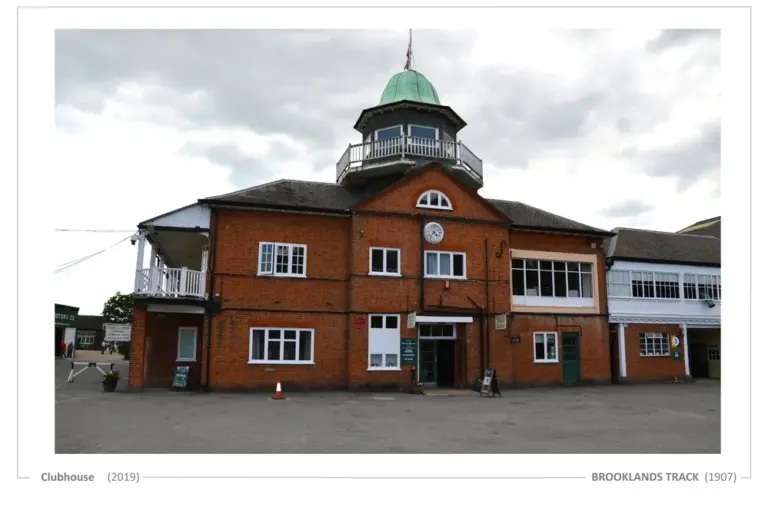
recalls the aristocracy at the races, the Merrie England with the motto “The Right Crowd and No Crowding”; the wooden huts, here called “sheds”, some supporting constructors like Bentley, Era… others actual premises for preparers, now those of Robin Jackson (1931) and Malcolm Campbell (1926) (the speed record holder) stand out; in their presence, one has the feeling of being in the ” Birthplace of British Motorsport” ;
Read more Autonomous driving, Waymo will start testing in Munich
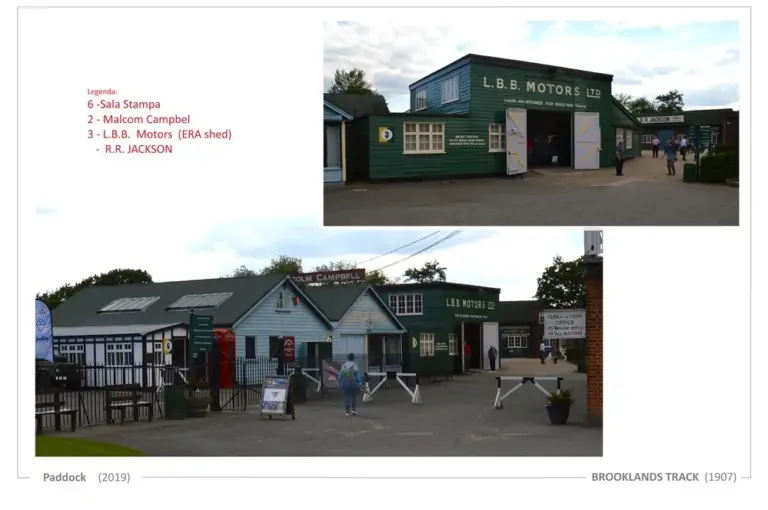
the hangars, among which there is a Bellman (1940), a “mobile” prefabricated structure that the British assembled to restore production where they suffered bombing damage, also houses many manual tools used for sheet metal working… here is all the strength of the British industrial heritage. As for the exhibited pieces, the list is long and varies according to temporary exhibitions; I would highlight the Delange 15 S 8 from ’26, and two aircraft produced at Brooklands, the Wellington Mk1A bomber from ’37 and the Concorde from ’76: the Delange 15 S 8 was a very advanced car, it won the aforementioned 1st British G.P. and that year’s World Championship, the Wellington is worth seeing for its complex geodesic structure
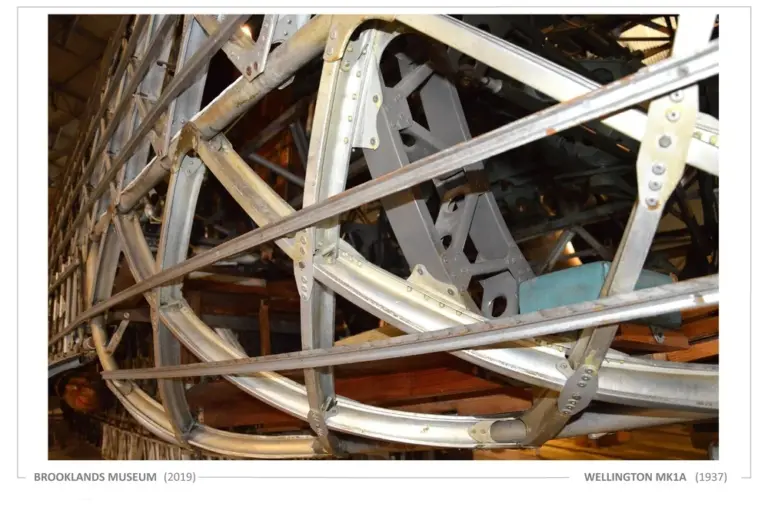
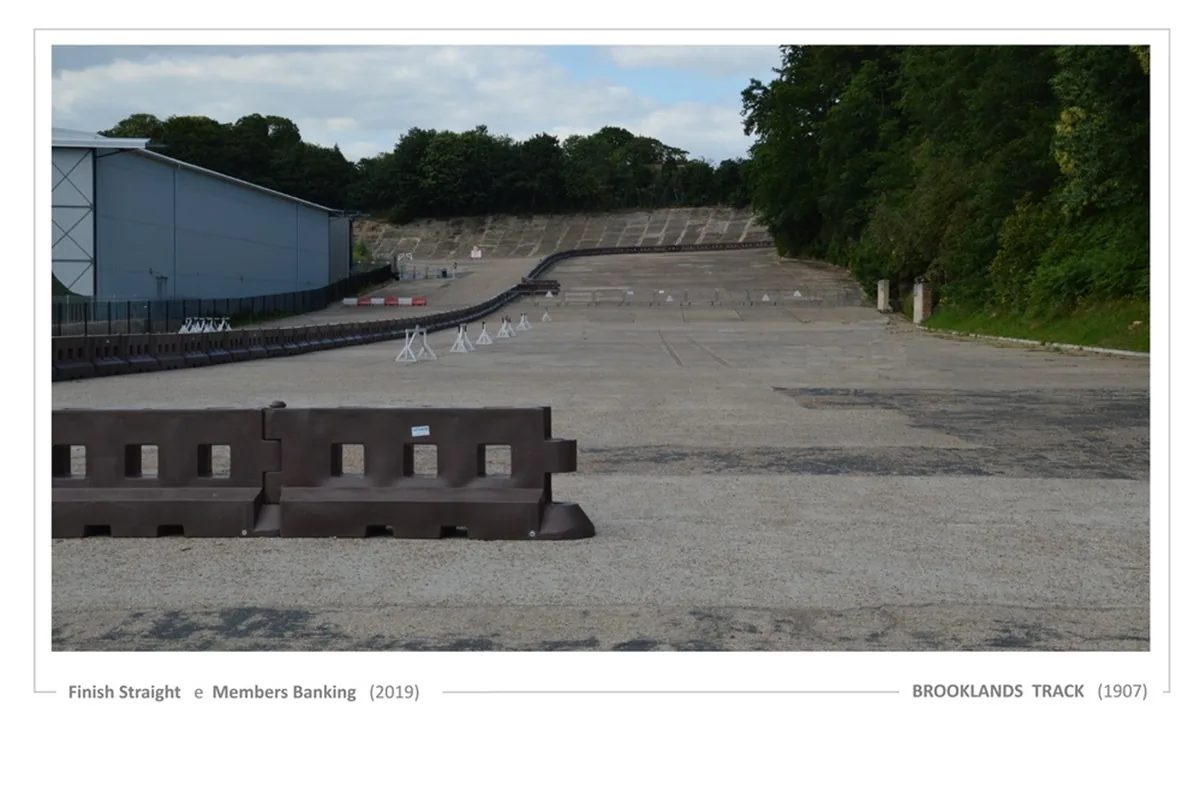
in aluminum covered with fabric, and the Concorde because it is practically the only supersonic aircraft to have entered stable service. Regarding the latter, the story that led to the particular delta wing planform is interesting: the protagonists were mathematician Johanna Weber and aerodynamicist Dietrich Küchemann, who managed to identify the characteristic “S” (ogival) shape that significantly improved supersonic efficiency and sonic boom management, essentially making the entire project sustainable, something that the contemporary Tupolev Tu-144 failed to achieve. To conclude, a few notes on the circuit: the remaining areas, sections of the banking (80%) and the starting straight, are quite damaged: vegetation has in many places infiltrated the concrete cracks resulting from small differential settlements, which in truth began to cause concern early on; the positive news is that funding has been allocated for the conservative restoration of the parts adjacent to the paddock… it deserves another visit.