

Hungarian Grand Prix qualifying was a very complicated session. If in previous races the bottleneck was undoubtedly power, **in Budapest tires were once again the protagonists**: the correct preparation of the tires before the lap and their management during the attempt were among the main differentiating factors of performance, with the third sector acting as the deciding factor for those who arrived with the rear still in the optimal operating window and those who did not. Added to this were the general track conditions, with a **very bumpy asphalt**, very hot but cooling down quickly, which made the entire session very difficult for everyone to interpret, so much so that, listening to the drivers, no one said they were truly satisfied with their lap or their balance.
Read more Stella: “Ferrari remains the favorite for the race”
McLaren returns to pole: thanks to upgrades, the track, and Norris
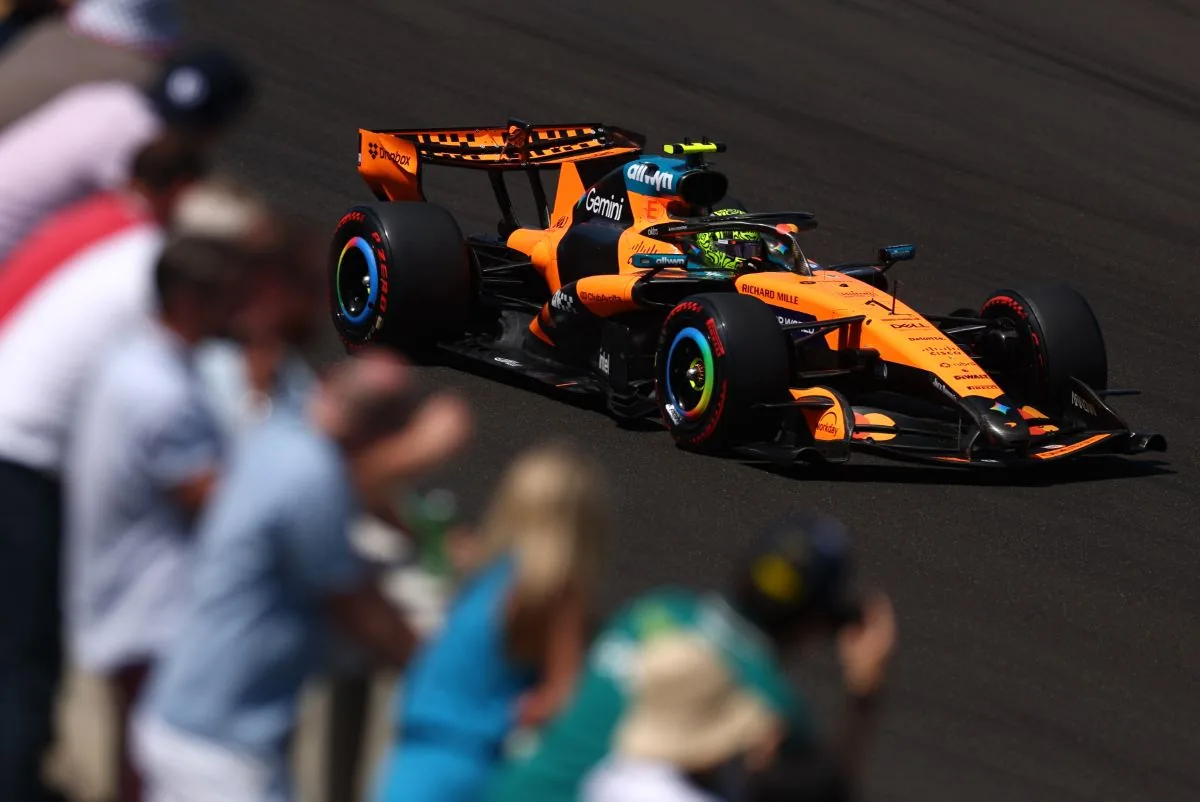
After a head-to-head with Hamilton that began in FP3, reigning World Champion Lando **Norris** took pole. The McLaren driver also showed this weekend that he is in excellent form and is increasingly comfortable with the MCL40, especially after the current round of upgrades. The Woking single-seater found some of the aerodynamic load that Andrea Stella had complained about lacking since the beginning of the season, and on a track like Budapest, which also has 4 active aerodynamic zones, it did not pay in terms of drag. The strong point of Norris and McLaren was undoubtedly the **central sector**, in a mix of good downforce and high PU power, which also demonstrates that the papaya team’s engineers have found a good way to exploit the Mercedes power unit.
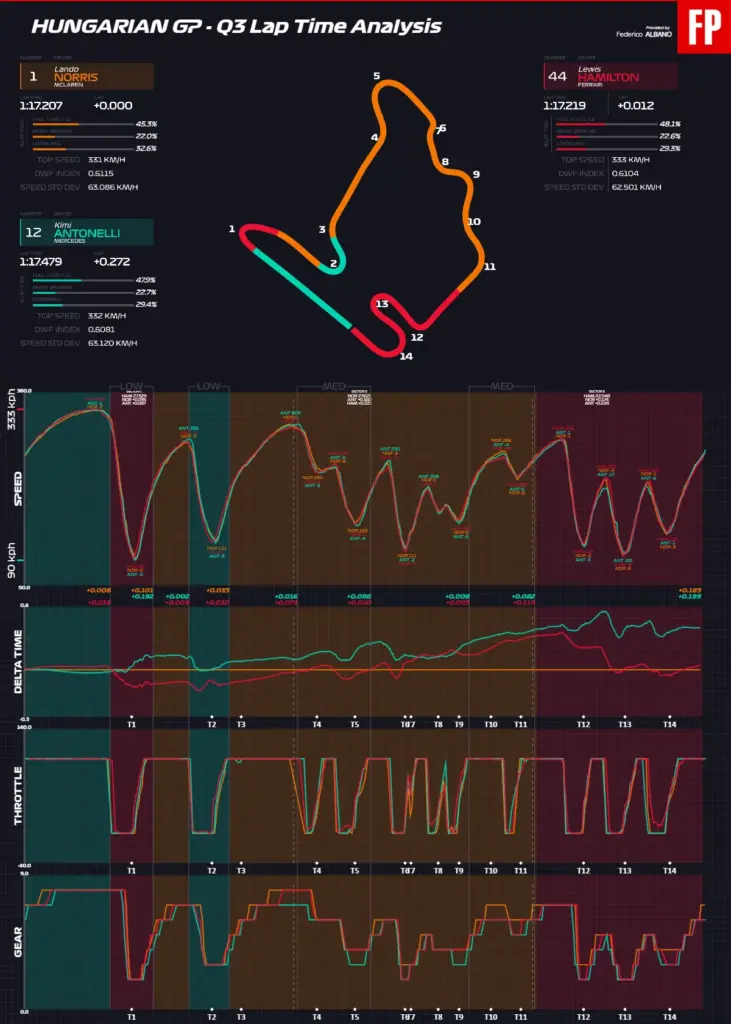
Even the gear ratios, shorter than those of the rest of the grid, proved to be a winning weapon, data in hand. Norris thus benefited from explosive traction out of slow corners. To this was added the **clear energy surplus**, which allowed him to push on every straight without having to save. All this obviously represents a technical underlying factor, but it should not diminish the great lap, once again from number 1, who, as we have always maintained, certainly does not lack speed among his flaws. The real unknown now for the poleman is the **thermal degradation of the rear in race pace conditions**. McLaren’s simulations on Friday were good but not exceptional, precisely due to some difficulty in managing degradation, and, even on a single lap, Norris tended to lose out especially to Ferrari in the third sector, arriving at the last three corners with the rear already tired. We know that Lando is very good at managing tires in the race, but it will be interesting to discover what his car will allow him to do.
Ferrari loses the bet on the last run and complicates its life with Hamilton’s penalty
Next to Norris, a **Ferrari** will start, that of Leclerc, but the Monegasque never gave the impression of truly being able to aim for pole in this qualifying session. Who, on the other hand, seemed to have the potential was undoubtedly Lewis **Hamilton**, beaten by just 12 thousandths at the finish line, about 87 centimeters. The impression, however, is that the margin for pole was in the pocket of the Maranello team and the seven-time world champion. The track showed rapid evolution during the session, but in the middle of Q3, it was cooling down quickly. This is a typical situation at the Hungaroring, where the track often even deteriorates in the last minutes of qualifying. Ferrari’s gamble was therefore to go out first for the last lap, but this quickly became a ***boomerang***. From the very first meters of the last attempt, both Hamilton, the first to launch, and Leclerc, immediately behind him, found a much slower track compared to the previous lap. Part of the poor grip could even be attributed to water lost from Russell’s Power Unit, but in general, the situation turned very much against Ferrari, with Hamilton and Leclerc being the first to launch on a very slow track. However, the progressive passage of the ten Q3 cars quickly brought the track back to a better grip level, which benefited the last drivers to launch, including Norris.
Ferrari’s characteristics were nevertheless evident throughout the session: the setup is clearly aimed at protecting the rear, and the third sector was constantly hunting ground for the red car, especially with Hamilton. While everyone else presented with their rear tires out of window, Hamilton consistently gained at least 2 tenths on everyone, thanks to a powerful entry at turn 12 and then excellent cornering at turns 13 and 14, although precisely on his best lap, Hamilton pushed just a little too hard on the exit of the last corner and left on the asphalt the 12 thousandths that earned Norris the best time. The good third sector and excellent thermal control of the tires can only suggest that the Maranello team **also worked with the race in mind** and put on track a car that will try to make thermal degradation containment its winning weapon in the race. Finally, there is another difference we want to emphasize. Many (erroneously) think that Budapest is a track where the engine matters little, but this is not the case. The track is indeed much more permissive in terms of energy management, but traction and short straights are still a motor challenge, moreover very suitable for these power units, specialized in putting power down to the ground in very short times. Looking at the graphs, it is particularly evident that Hamilton leaves Norris at least 1 and a half tenths between less torque in acceleration and less energy to spend on the straight. Considering the very tight gaps, **the engine issue remains a handicap with its weight for Ferrari**, even on tracks like this.
Penalty: a serious oversight that ruins the red team’s strategic plans
However, a significant shadow remains over all this, as Hamilton received a 3-place grid penalty and will therefore start fifth instead of on the front row next to Norris. **A colossal error by the pit wall**, which failed to warn Hamilton in time of Piastri’s approach, even though the driver himself, knowing he was the first to complete the attempt, could have moved aside more. A lapse with anything but marginal consequences, given that having Leclerc and Hamilton up front fighting two against one with Norris would have been a great advantage for Ferrari, also thinking, for example, of what happened last season with roles reversed, with Leclerc marking Piastri’s strategy and Norris being able to win by differentiating from his teammate.
Mercedes sixth and seventh: the race still remains an opportunity for Ferrari
Antonelli’s penalty relegates the Italian to only seventh position, and this opens up several scenarios for the race, given that Antonelli himself seemed to have the best race pace in Friday’s simulation. Some doubts remained about **Mercedes**’ thermal management of the tires, given the many difficulties suffered also in qualifying, but clearly if the current world leader had started fourth or even third after Hamilton’s penalty, he would have needed “only” a good start to seriously contend for victory. **From seventh place, the road is much longer**: the unknowns of turn 1 and the time needed to climb back up can deny Antonelli a real chance to fight for victory. This scenario opens the doors to an even tighter battle at the front, between Norris and Leclerc first and foremost. The start will play a fundamental role, with the very long run to turn 1 and then the bottleneck of turn 2 opening up many possibilities for those who are able to get off to a good start when the lights go out. The long runs indicated the softer compounds of the range as favorites, with Hamilton even saving a new set of softs for the start. The impression is that the race will move towards two stops but with a lot of strategic indecision and with the classification at the end of the first lap determining many subsequent choices in cascade. Despite Hamilton’s penalty and the missed pole, Ferrari seems to have a concrete chance to fight for victory, and the race promises to be decidedly interesting.
Read more Verstappen demolishes the Red Bull: “We don’t have tire degradation, we have car degradation”