






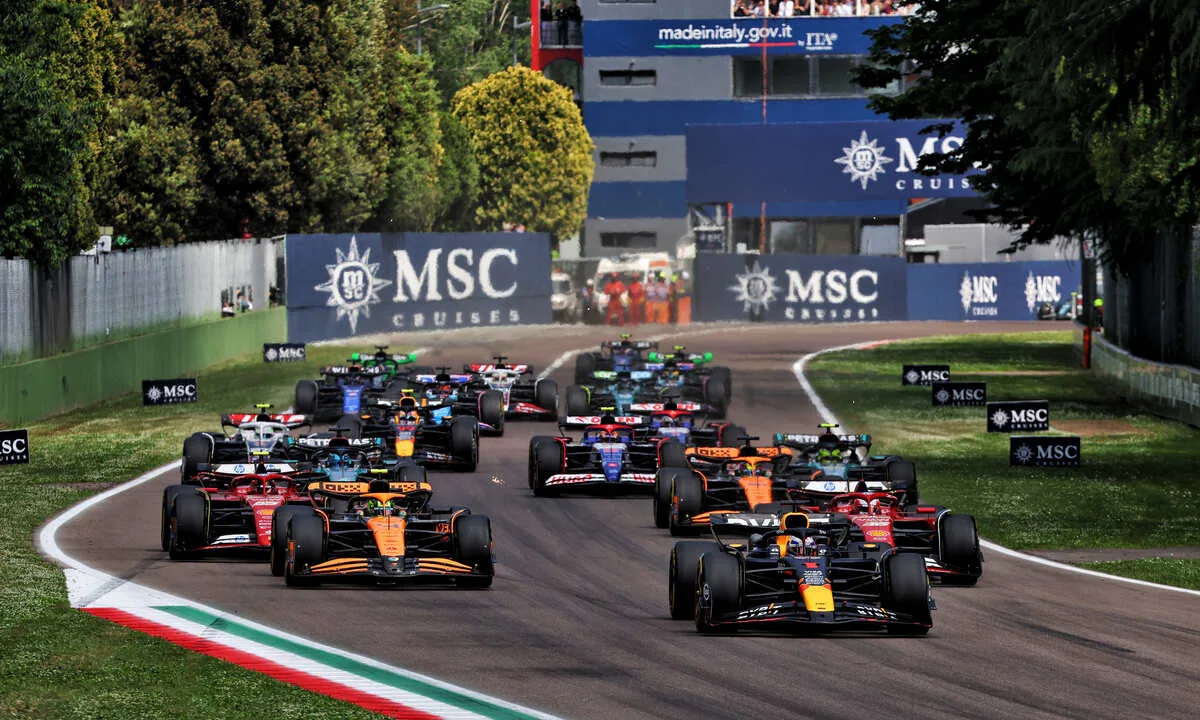
Imola has suddenly returned under the spotlight of Formula 1. Rumors about a possible return as a replacement for the Middle Eastern races – even for the grand finale in 2026 – have rekindled the hopes of Italian fans, who in the last five years have shown boundless love for the Romagna circuit by filling every possible space in the stands and beyond.
Of course, nothing is defined yet: the Mayor of Imola Marco Panieri wanted to keep his feet on the ground despite his presence in the Budapest paddock, but confirmed that contacts with the Formula 1 leadership are active to assess the feasibility of the proposal.
Among the main doubts that have emerged is obviously the timing. The hypothesized window is the weekend of December 6 in place of Abu Dhabi, but the Po Valley climate with fog, low temperatures, and short days has generated quite a few concerns.
The reasons for a very interesting challenge in Imola
The climatic context might not be so prohibitive, at least regarding tire management. On the contrary, having Imola in these conditions represents a very interesting challenge for teams and drivers who have already had the chance to face it, for example, in Las Vegas. The reason was explained to FormulaPassion.it by Simone Berra, Chief Engineer of Pirelli.
Read more 30 July 1995: Schumacher, the first German winner of the German GP
“We will go to Las Vegas again this year and we expect temperatures that could be aligned with those hypothetical of Imola, since in Nevada the race is at night and Imola would still be raced during the day – said Berra – Obviously the tires will be affected regarding warm-up, this is beyond doubt, but I don’t see any critical issues from the point of view of safety or tire unusability“.
“It could be particularly interesting because, instead of going for the use of Hard compounds in the race, one could aim for the softer compounds, seeing that our C5 (the softest compound in the Pirelli 2026 range, ed.) works particularly well”.
“Of course, it is not ideal to work with slicks at those temperatures, but I don’t see particular difficulties unless in December there are temperatures below zero such as to cause cold crack (a phenomenon where the compound loses elasticity at low temperatures and can develop cracks or superficial micro-lesions if moved or used, ed.). In this case, there would be a risk of damaging them even just handling or moving them inside the garage. Apart from this, however, with the temperatures generally experienced in Italy in early December everything can be absolutely manageable“, concluded Berra.
Read more New Q9, Audi’s biggest ever debuts