
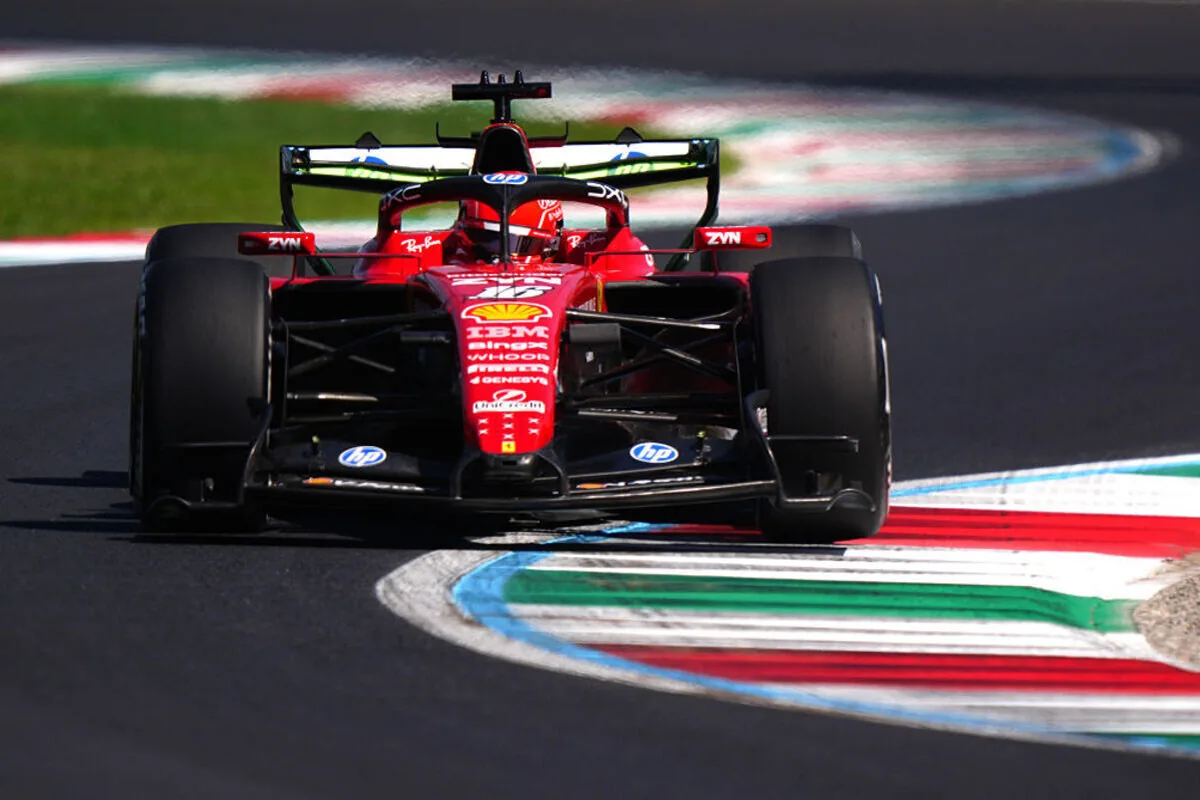
The second free practice session of the Italian Grand Prix offered a fairly clear picture of the on-track balance, at least regarding the behavior of the cars and especially the use of energy throughout the lap. As always in Monza, the engine levels used on Friday still leave several question marks, but some elements emerged from our usual data analysis seem particularly interesting, especially in the comparison between Ferrari and Mercedes.
Read more Leclerc: “We know our weaknesses, we will work on them”
Ferrari the best in slow corners
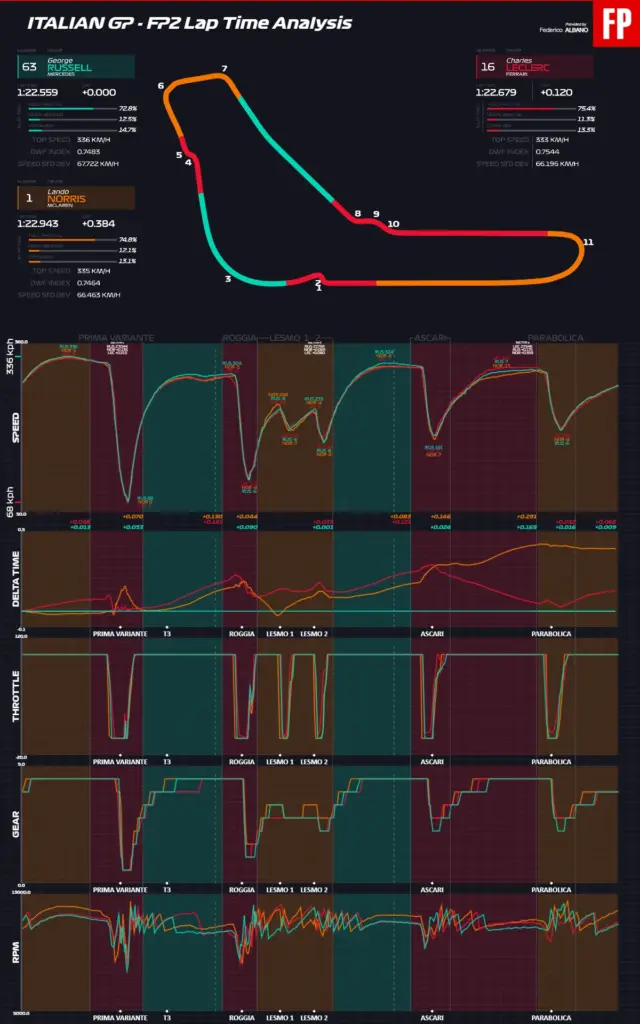
From our findings, the SF26 was the best car in the two slowest chicanes of the circuit, namely the Prima Variante and the Roggia. The Maranello car manages to be effective especially in the direction change phase and in the restart, showing a good combination of turn-in and traction, although with a setup that seemed slightly less “permissive” compared to the first free practice, so much so that “falling” off the curb at Roggia Leclerc even spun during the pace simulation. The Monegasque also seemed slightly more dialed in compared to Lewis Hamilton, suffering only at the Prima Variante, but then showing a slightly higher level of grip than his teammate (with better energy efficiency also on the long straight). Although he did not close the session with the best lap time, Leclerc’s lap was on par with Russell’s, with an imperfect exit from the Parabolica making the difference in favor of the Englishman. We are seeing that almost all cars exit the Parabolica with very little energy left in the batteries and every slight uncertainty in the cornering and exit phase of the last corner of the Brianza circuit significantly affects the finish time.
Ferrari and Mercedes: two opposite ways of spending energy
The most interesting comparison, however, concerns the management of the Power Unit’s electric energy. Mercedes tends to distribute the availability over the first three long straights of the circuit, thus spending a lot already in the first part of the lap. However, by the section between Ascari and Parabolica, the W17 seems to have much less left to use. Ferrari follows a practically opposite philosophy and somewhat similar to what was seen, for example, at Silverstone. The SF26 concedes something on the first straights, using less energy, then concentrates the release of a very important amount precisely from the exit of Ascari to the braking zone of the Parabolica. The result is significant: effectively limiting losses on the first three straights and then releasing energy where the competition struggles most, the Maranello team obtains the maximum differential in its favor and in that section the reds practically erase all the gap accumulated previously on the straights. We also saw others start copying this delivery strategy during the session, confirming that beyond the obvious limitations they have to face, the Maranello engineers who always have to “invent” delivery strategies on such complicated tracks do an excellent job, finding the most effective methods on which others then tend to converge.
Anyway, what we observe from the data is that practically all the engine gap accumulated in the first two-thirds of the lap is canceled by the SF26 in the section between Ascari and Parabolica and if this trend were to be confirmed also with more aggressive engine modes (as in qualifying), it would be an important indication of a significant step forward on the engine side compared to what is (ADUO ranking aside) the reference Power Unit, namely Mercedes.
McLaren with a lot of work to do, the straight worries
McLaren instead confirms the characteristics that could be expected in Monza. The Woking car performs very well in medium-speed corners, especially at the two Lesmos, where it manages to exploit its level of downforce and a particularly effective aerodynamic platform. It suffers in the slow Roggia and Prima Variante, although slightly less than expected. The serious problem, however, comes after Ascari. From that point, the MCL40 seems to run completely out of electric energy and loses a huge amount on the long straight towards the Parabolica. Basically, Norris’s lap has a similar trend to Leclerc’s up to Ascari, but while the Ferrari Monegasque can then release all the energy on the last straight, Norris is instead still with a half-empty battery. It remains to be understood how much this depends simply on the car’s drag and how much on other issues, including gearbox ratio management: data shows that McLaren runs for much of the lap about 500 engine rpm higher than the main rivals due to very short ratios. An element that could become particularly penalizing precisely on a track like Monza where much of the lap is covered at maximum speeds.
Race pace: Kimi very strong, then Russell-Ferrari battle
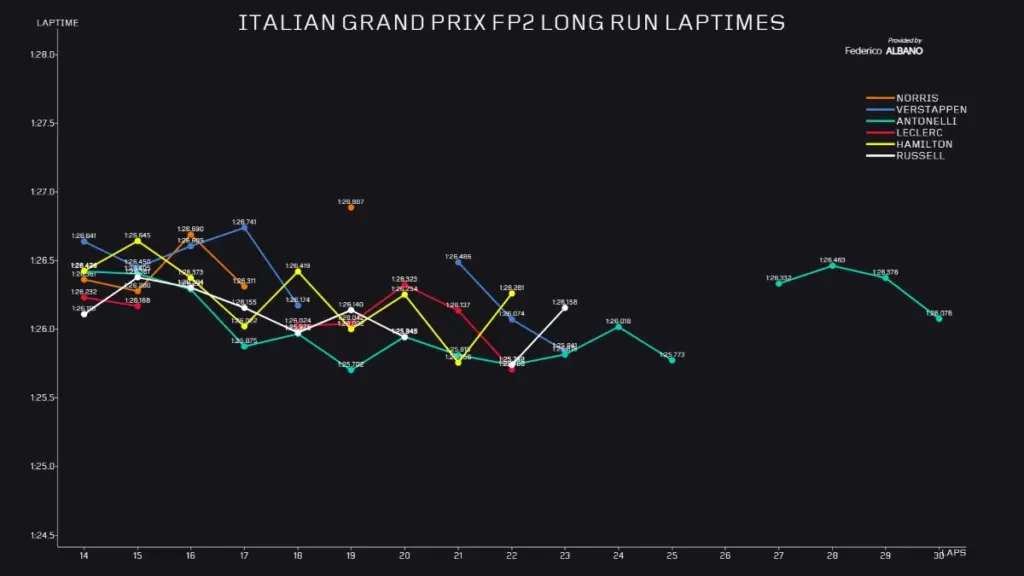
In race pace, Antonelli showed an extremely competitive rhythm sustained for a very long stint. But Ferrari also seemed definitely in good shape. The red car’s references are basically in line with those of George Russell and, at least after Friday, everything suggests that Ferrari and the number 63 Mercedes could find themselves in direct battle. Before drawing definitive conclusions, however, it will be necessary to understand how much power unit margin the various teams have still preserved. Ferrari with the new engine seemed to try it already at a higher regime in FP1, rising slightly for FP2. Mercedes instead seemed to start very conservatively, then raising the bar a bit in the second session. Overall, the impression is that Mercedes has more margin to squeeze, especially with the famous “qualifying map” that the Brackley team has available, but for this we will have to wait for the third free practice and especially qualifying to confirm.
Slipstream unknown and chaos
Finally, the big unknown remains qualifying. At Monza, the slipstream has always had an important weight, but with such reduced gaps and significant differences also in energy management, the position games on track could become particularly relevant. From what little was seen in free practice, the slipstream game seems to give more advantage than in past years in terms of lap times, and Russell will certainly be able to benefit from this thanks to the help that Antonelli should provide him (as Wolff directly anticipated). The risk, however, is that with such a significant advantage as seen on track, qualifying will see the classic battle for slipstreams that could lead to real pandemonium already from Q1.
Read more Antonelli and the slipstream to Russell: “It will count a lot, we will see tomorrow”