





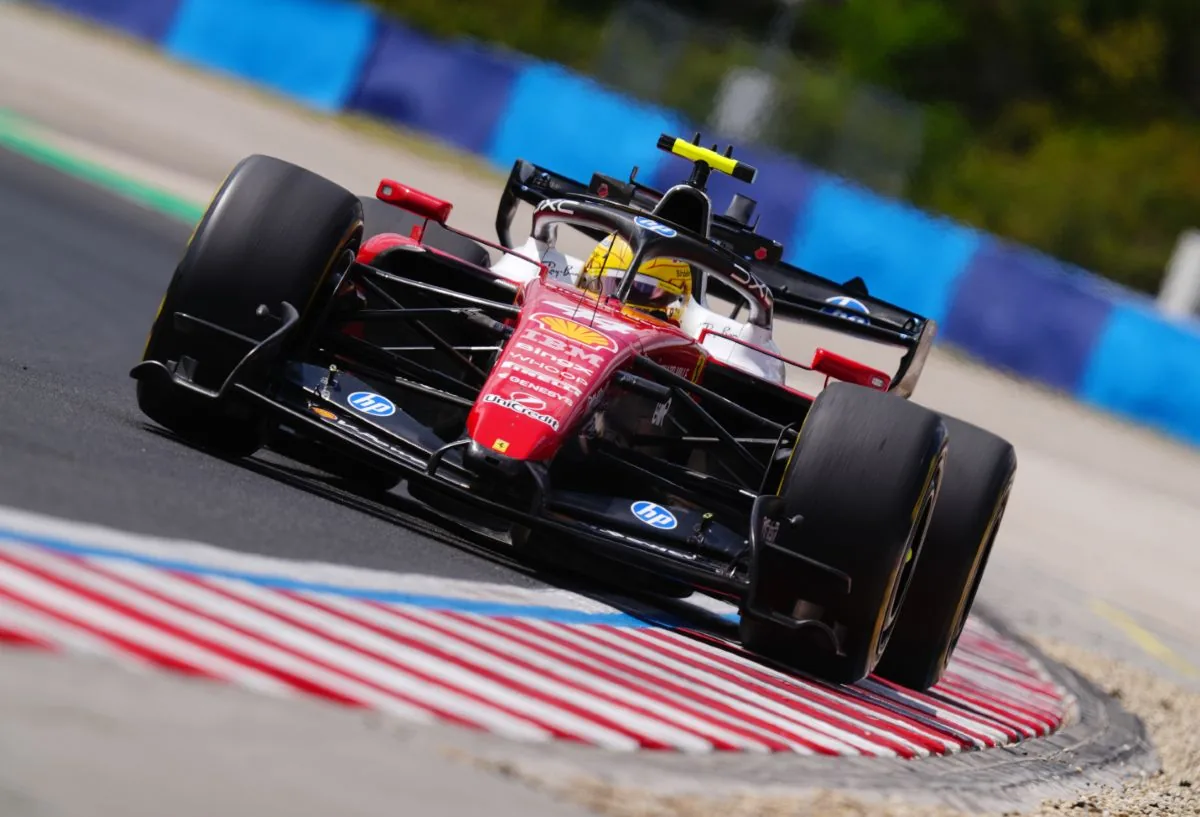
Certainly the first day of the Hungarian Grand Prix for Ferrari couldn’t have gone better. The Budapest track, winding, slow, and not challenging from an energy perspective, is much more suited to the SF-26 than the last tracks faced in the World Championship, and Ferrari proved to be decidedly prepared. With the car on the ground, the setup decided by simulations and factory analysis proved to be almost perfect from the start, with the work on the first day focused on a few substantial changes and a large number of refinements. Hamilton ultimately finished a few thousandths ahead of Leclerc, in a two-way battle for a single lap that showed very similar potential and was easy to extract for both red team drivers. A one-two that, although it’s only Friday, certainly also has some significance, considering that in both sessions the third place was always about half a second behind, an important gap that, although widely recoverable by the competition, underlines the perfect start for the Maranello team.
Read more Leclerc: “Usually on Friday we are behind… In qualifying we will have to be perfect”
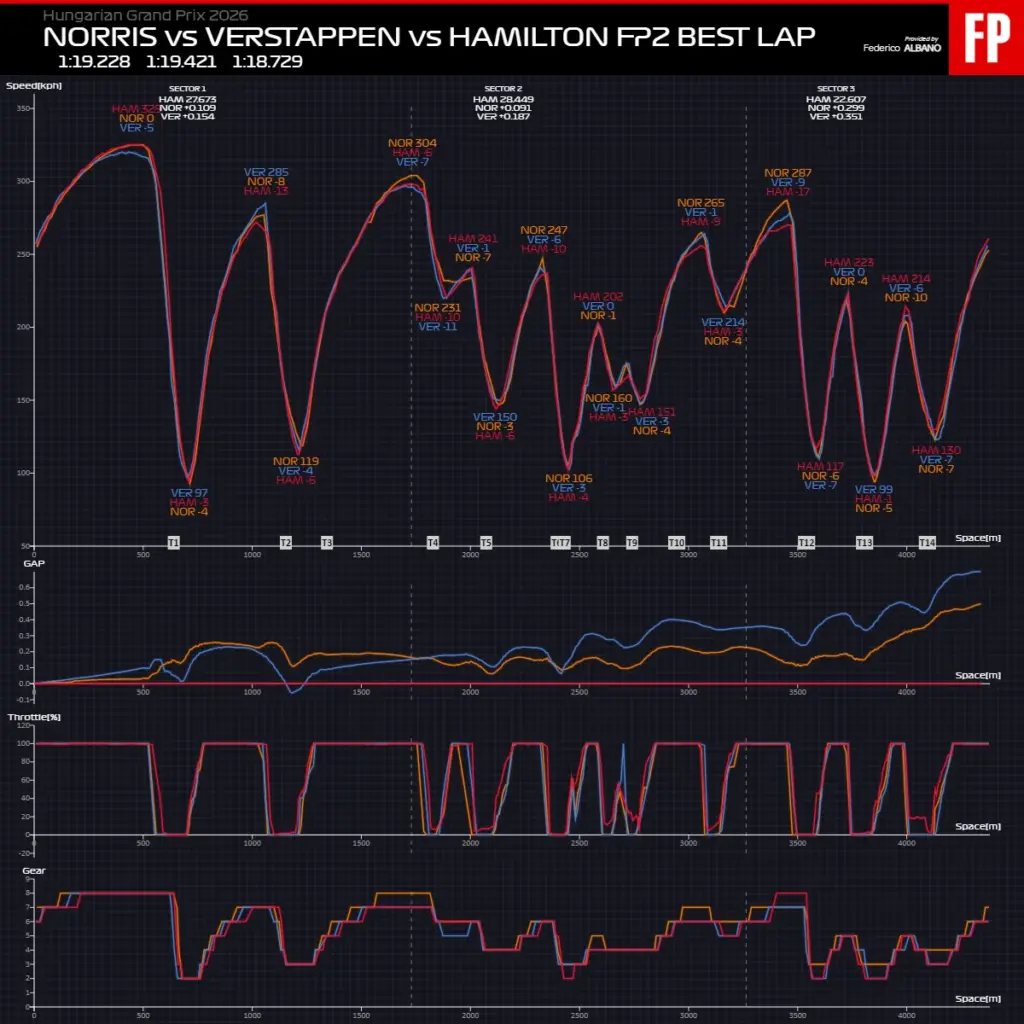
The single lap is the true hunting ground for the SF-26
Throughout the two free practice sessions, the constant impression was that Ferrari was truly far ahead of its rivals on a single lap rather than race pace. The Hungaroring is particularly selective on tires, especially the rears, and with the C5 compound, the softest, the difficulty for everyone is to reach the third sector with the tire still in a good temperature window, so as not to lose grip and thus a lot of time in the last three very long curves of the track. This will be one of the recurring themes of the weekend and is also evident from the graph: just look at the gap lines to notice how Hamilton, already ahead of Norris and Verstappen, gives them 3 tenths precisely in the last kilometer of the track.
Ferrari confirms the balance at the limit, very neutral between front and rear, with the need for drivers to be very careful not to overdo the push on corner exit, otherwise, wheelspin will cause temperatures to skyrocket and destroy performance. This was clearly seen, for example, on the very first lap of the second session, when Hamilton, clean on the accelerator pedal from the start, left Leclerc almost half a second behind. The Monegasque, initially impetuous on reopening the throttle, found his feeling the next lap, starting to use a style similar to his teammate’s, with times immediately aligning.
Ferrari’s setup base, perfected in the second free practice, is undoubtedly excellent, with plenty of downforce, a reactive front end in the central sector, where changes of direction are crucial, but at the same time not too pointed to allow drivers to protect the rear. A razor-edge balance that is not easy to manage, but which the red team can afford thanks to two talents like Hamilton and Leclerc who manage to make it perform at its best. The energy management is also well-studied, with Ferrari concentrating most of the power delivery on exiting slow corners, taking advantage of the good rear downforce, recharging at the end of the second sector to then have energy to deploy in the last three traction zones, thanks to the rear axle still being at temperature.
Read more Vasseur: “Qualifying will be another story. Fight for pole? Maybe”
Race pace with the same principle, but more critical for the red team: Antonelli very fast
The judgment on race pace is more complicated, however, as the simulation took place with a lot of track traffic, which prevented a truly reliable reading of times and performances. Ferrari’s degradation curve appeared good, but the performance over the laps seemed a step lower than Antonelli’s Mercedes, which in turn was not entirely on point for a single lap, but decidedly fast on race pace.
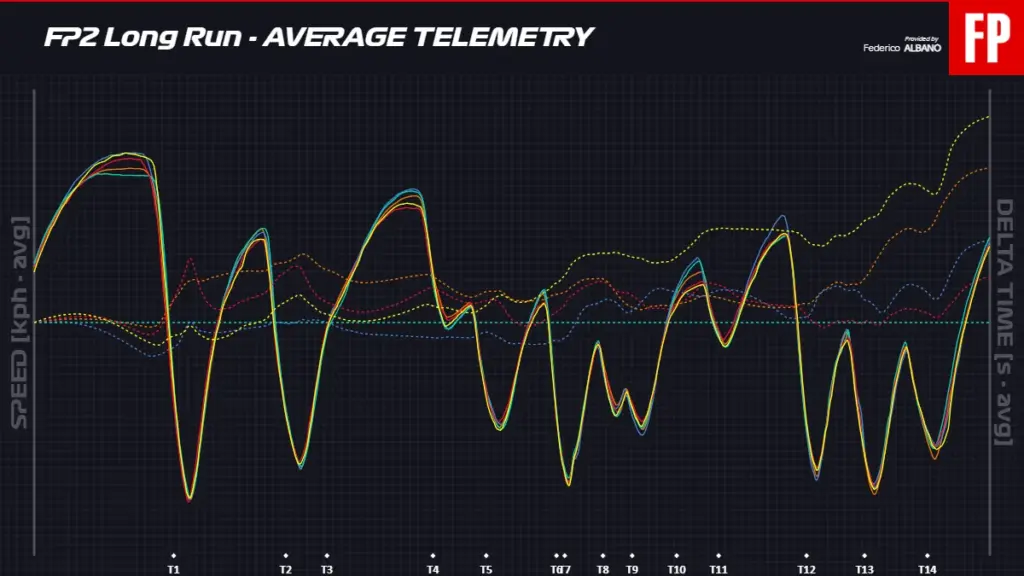
The average telemetry we calculated shows that, as with a single lap, race pace is also decided in the last sector, when those arriving with worn tires cannot push and must lose valuable time waiting to bring the tires back into the right window on the long main straight. On this, Mercedes seemed to confirm the effectiveness of the package introduced in Canada aimed precisely at keeping rear tire temperatures under control, with Antonelli always extending his lead in the last meters of the lap compared to his rivals, recording overall the best average of the race pace laps completed. On race pace, Lando Norris also seemed to have a decent degradation curve, although his last laps on soft tires gave the perception of McLaren’s dominance, which, while improved on degradation, was not yet perfect. The race pace results show Antonelli as the benchmark, followed by Leclerc just over a tenth behind, and Verstappen about 3 tenths behind.
Much can still change
Despite a decidedly encouraging Friday, much can still change, and the good starting base does not guarantee Ferrari will be at the same level when the sessions truly matter. Track evolution and the expected increase in temperatures will influence balance and tire management, with engineers and drivers needing to anticipate track changes by progressively adapting the setup. Ferrari’s delicate balance will require nothing less than mastery to maintain it throughout the entire weekend, an interesting challenge, with Antonelli and Mercedes ready to get ahead at the first opportunity, and with Verstappen and Norris who can take advantage of overnight work to improve their setup. In fact, Ferrari’s rivals seem to have, obviously, greater room for improvement, and the impression is that a certain convergence could already occur from qualifying, although there is no doubt that Leclerc and Hamilton should be considered in the fight for pole and, from there, for the race. We will see, starting from the third free practice, what the Budapest track, so complicated, selective, but at the same time interesting and revealing, will tell us.
Read more Newey dismisses Horner: “At Aston Martin, we are fine as we are”