




Brembo’s data paints a profoundly different picture from the past regarding braking. The new cars enjoy significantly less grip than previous ones, resulting in longer braking distances and a reduction in peak deceleration. Furthermore, battery charging is the dominant factor, so much so that in some points it is expected that drivers will only lift their foot off the accelerator, with repercussions for disc temperature management.
Read more Volvo, largest ever OTA software update
How braking changes
The most eloquent numbers on the new way of braking are those relating to Turn 11 in Melbourne, which last year Brembo indicated as the most demanding braking point on the Australian circuit. According to the Italian company’s simulations, with the new cars, maximum deceleration will drop from 4.8 g in 2025 to 3.3 g, a reduction of about 30%. The drop is a direct consequence of the lower aerodynamic downforce generated by the 2026 single-seaters, especially at high speeds, combined with the decrease in grip from the Pirelli tires, which are narrower than the previous ones.
All this leads to an extension of braking distances, an aspect that always helps with overtaking maneuvers. In detail, at Turn 11, the distance increases from 96 to 116 meters, while the time on the brakes lengthens from 1.80 to 2.16 seconds. Furthermore, the equivalent force exerted by the driver on the brake pedal drops from 153 to 88 kg, but the reason is not simply the lower deceleration. In fact, the new technical regulations allow the rear brake-by-wire system to amplify the force exerted by the driver by up to 20%, alleviating physical effort.
Fewer real braking events
The most surprising finding from Brembo’s simulations, however, concerns the number of braking events. The Italian company states that at Albert Park, drivers will only use the brakes at 4 points, whereas until last year, simulations spoke of 7 braking points. In the remaining ones, it is expected that drivers will simply lift their foot off the accelerator, particularly at Turns 4, 6 and 9, the entry to the very fast Waite chicane.
Read more Bagnaia: “A good coexistence with Marquez, he tried to help me”
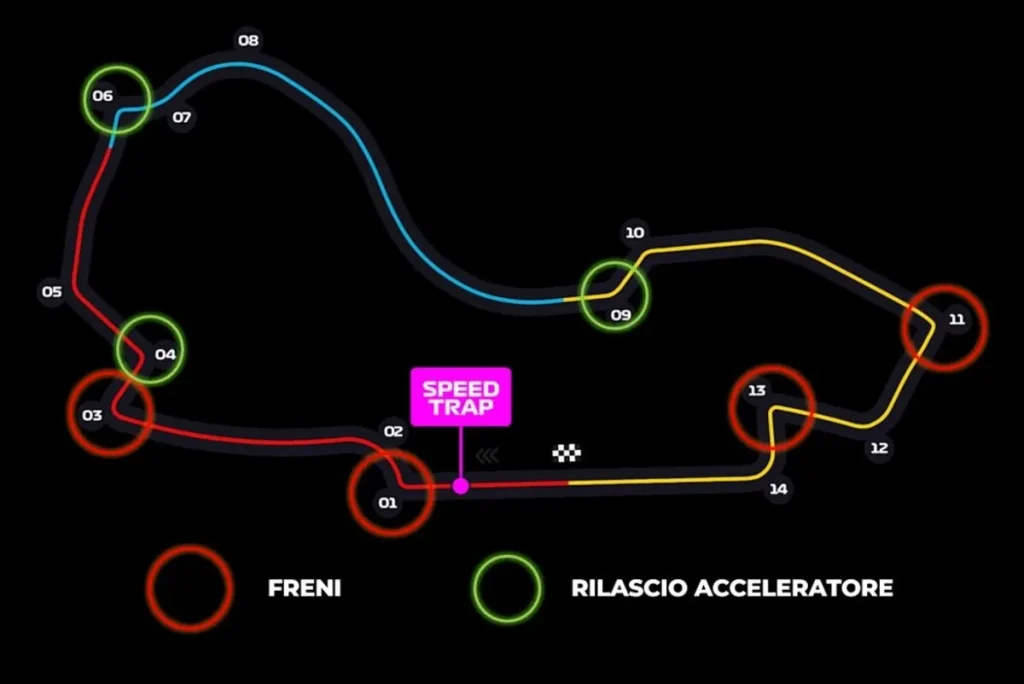
According to Brembo, the hydraulic system will therefore not be activated from Turn 3 to Turn 11, for a period of about 40 seconds during which calipers and discs will cool down significantly. However, it should be noted that there is still no consensus on what to expect, as the Italian company’s simulations differ, for example, from the data published by Mercedes. The Brackley-based team states that at Albert Park there will be 6 braking events where at least 2 g of deceleration will be reached, with peaks exceeding 4 g in at least 4 points. These are still numbers to be taken with a grain of salt, since every team has every intention of hiding its braking and charging strategies, not to mention that there could be wide differences in approach between the various teams.
The new brakes
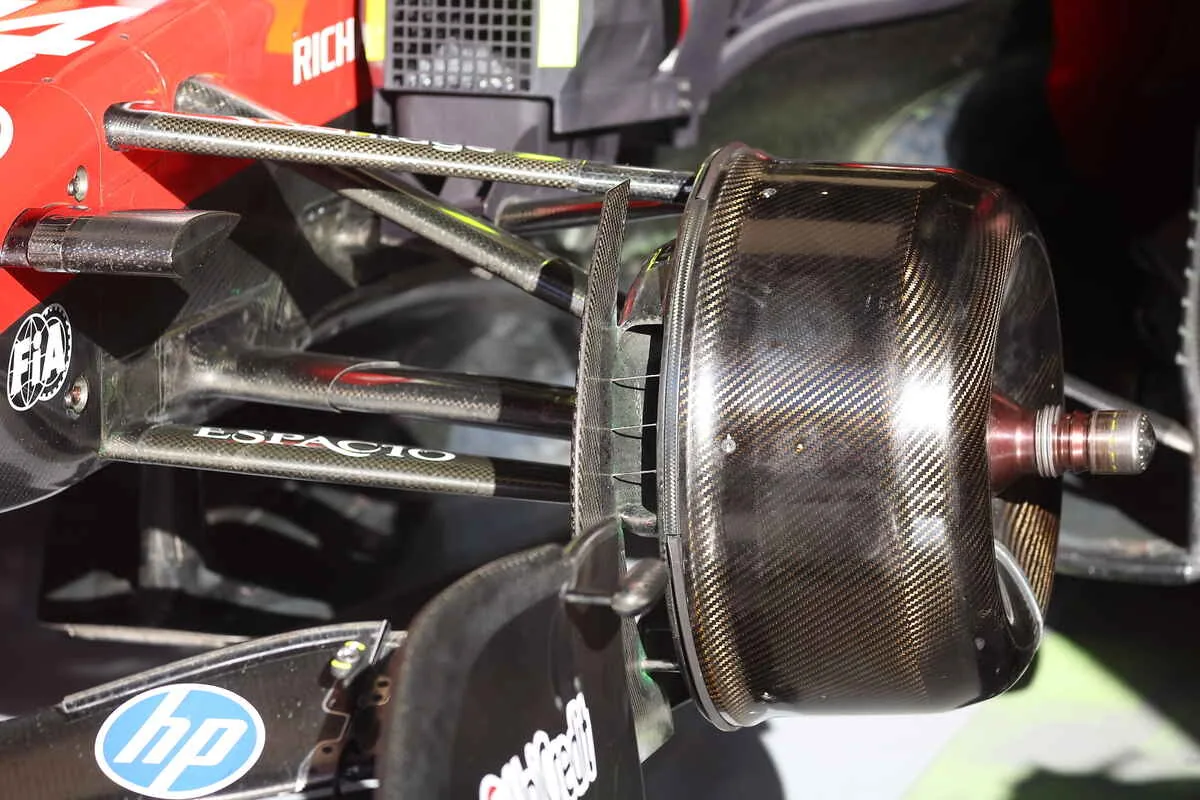
The reduced use of the hydraulic system, however, does not diminish its importance. The best witness is Brembo itself, whose group, which also includes AP Racing, supplies calipers to 11 teams and complete components to 5 teams. The lower braking intensity has facilitated weight reduction, which is of absolute importance in a season where teams have yet to all reach the minimum value. In particular, the master cylinder has gone from 400 to 350 g, while the brake-by-wire system has dropped from 800 to 650 g.
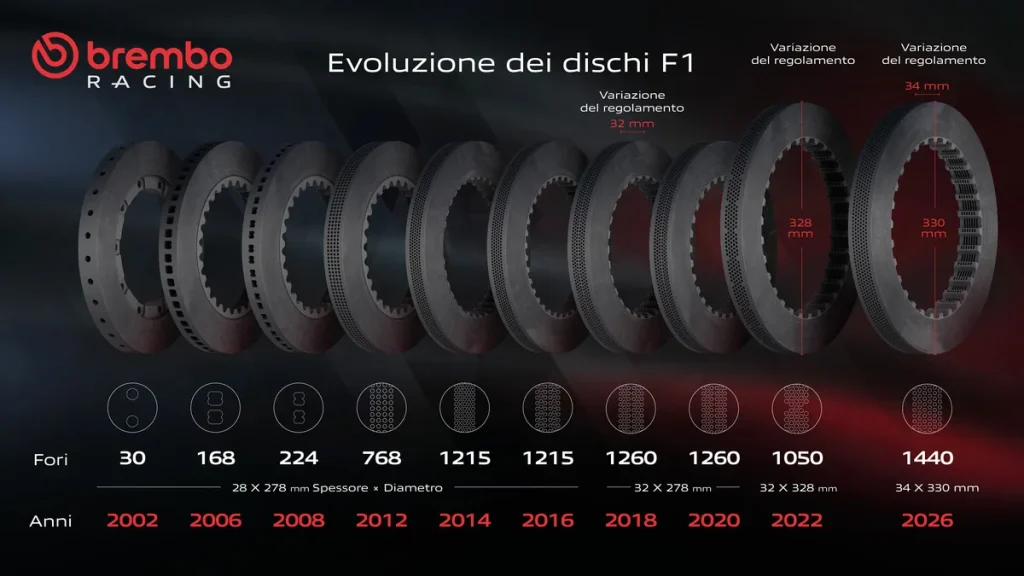
Regarding the front calipers, lightened on average from 2.5 to 2.0 kg, there is a diversification between those who chose the new 8-piston configuration and those who stayed with the classic 6-piston one, as well as a duality in the 4- or 2-pad architecture. The front discs are the only components slightly heavier than last year, with an increase from 1.75 to 2.0 kg, mainly due to the increase in external diameter and, for some, thickness. There is no data, however, for the rear axle, where a great diversity of solutions is recorded among the teams depending on the strategies for using the electric brake for battery charging.