



The pole position achieved by Andrea Kimi Antonelli at Suzuka is not just a prestigious result, but a real turning point within Mercedes. On a technical and selective track like the Japanese one, putting three tenths on George Russell takes on a meaning that goes far beyond a single qualifying session: it is a clear statement, in terms of hierarchy and also on a global scale.
Read more BMW recalls nearly 180.000 vehicles in China
If in China the comparison had been partly conditioned by Russell’s problems, in Japan the picture was much cleaner. Antonelli has appeared superior so far consistently throughout all the free practice sessions held, in addition to qualifying, where he was able to express his best driving quality. The most evident reference is the passage through the final chicane, where the Italian made the difference in practically all sessions and where even in qualifying he had the courage to attack, out-braking Russell, with superior courage on entry but also superior rotation ability. An important signal, because Suzuka is a track that rewards pure talent and confidence in the car.
Mercedes, the turning point in Q3
Mercedes, until Q2, had given the impression of being in relative difficulty, unable to fully express its potential. Always very slow on the pit straight, aligned with opponents on the rest of the track, with a power level that did not appear particularly superior. Then, at the decisive moment, something clearly changed.
In Q3, a change was observed in the management of the power unit, particularly in the torque curve in the middle sector. In the acceleration sections before the Degner, the hairpin, and the Spoon, the boost became “fatter”, fuller, allowing Antonelli to build his advantage precisely in the most sensitive points of the track.
It is a technical detail that is anything but secondary: Suzuka is not just a flow track, but a circuit where traction phases, often uphill or under lateral load, put the least efficient power units in difficulty. Mercedes found the key at the right moment, and the result was visible, evoking the party mode we already mentioned on these pages at the start of the season. The Brackley car also has an excellent level of downforce and a clearly optimal chassis setup, but when it fully exploits the potential of the power unit, it becomes unreachable.
McLaren, evident progress on the PU
Also interesting is McLaren’s work, which continues to make strides in understanding and exploiting the power unit supplied by Mercedes. We have seen throughout the sessions that the power curves are becoming increasingly similar to those of the parent company, a sign of growing maturity in the integration between the chassis and the hybrid system.
Read more 2026 Americas GP – Practice Standings: Marc Marquez ahead of Ogura, 4th Bezzecchi
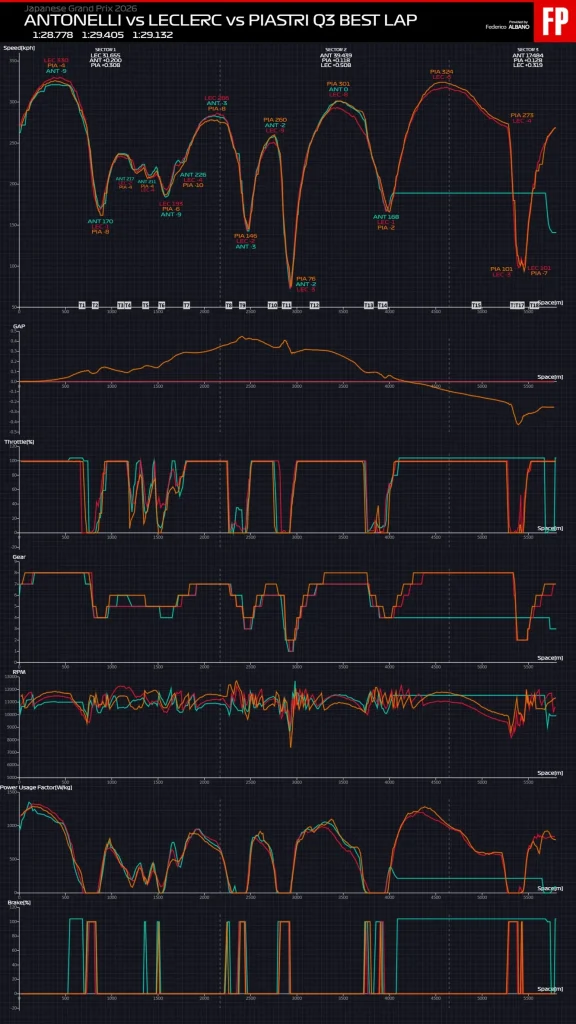
However, there is a detail that deserves attention: on the pit straight, McLaren always pushed, while Mercedes adopted a different, almost conservative approach, as if exploiting that downhill section to recharge energy. A strategic choice that could have implications in the race as well, especially in managing overtakes and defense. McLaren suffers from a chassis perspective in the first sector and the passage up to the Degners, but from there, it gains strength thanks to the power curve that indeed mirrors that of Mercedes. Note the excellent lap by Oscar Piastri, who has been particularly on form so far and will look to fight for the podium in the race.
Ferrari, balance rediscovered but power never so insufficient
Ferrari comes out of qualifying with discouraging feelings. On one hand, the progress compared to Friday is evident: the car appeared more balanced, the rear decidedly more stable and with a good ability to both switch on the soft compounds and then manage them at their best. In particular, Leclerc showed high-level traits, especially in the first sector, both in Q2 and Q3. His passages through turn 6, in preparation for the climb towards turn 7, were among the most impressive of the entire session, a sign of great sensitivity as well as rediscovered confidence in the car, in addition to being confirmation of the chassis quality of the Maranello car, evidenced by Leclerc’s absolute best time in that section in both Q2 and Q3. The problem, however, remains evident in the middle sector. In sections of pure power, Ferrari suffers markedly: when it comes to pushing uphill, under load, or exiting slow corners, the Maranello power unit cannot guarantee the same level of performance as its rivals, and in the upper part of the power spectrum, a high level of clipping comes into play, probably to recover energy for the next traction phase, and the time lost on the straights is significant. Among those held so far, the Japanese weekend is probably the one where the power limit emerges in a decidedly impactful way, even on a track where many other variables matter. The impression looking at the data is of an SF26 that “empties” itself of the necessary boost in many points where engine torque would be fundamental. An important aspect to highlight is that both drivers complained extensively about the hybrid energy deployment strategies during the Q3 lap, suggesting that one of the main reasons why Ferrari continues to fail to improve in the third part of the qualifying session is the inability of the Power Unit management software to adapt to the much tighter conditions of the final heart-pounding lap. Vasseur’s phrase “A new championship will start from Miami” seems to refer decisively to qualifying, with the probable reduction of electric power to return to a more “classic” flying lap, and therefore rewarding those who go all out in the final attempt.
Race: Mercedes favorite, but watch the balance
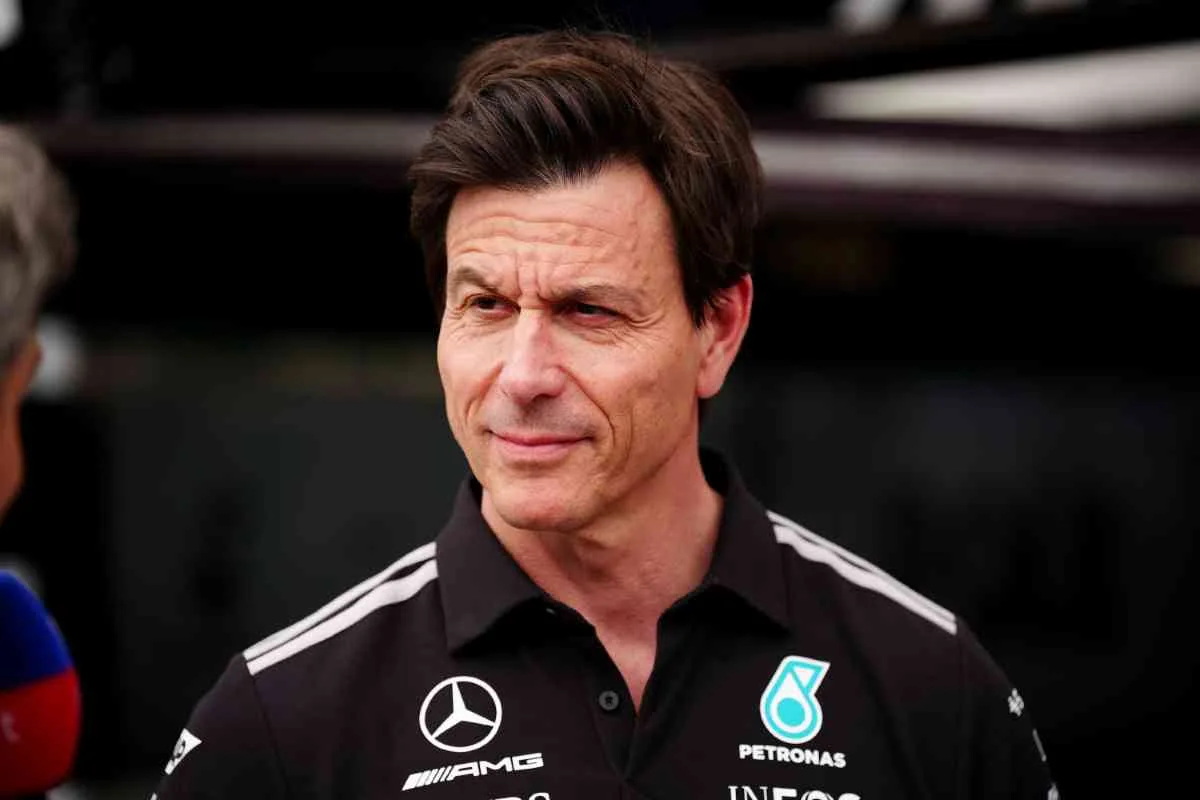
Looking at the race, it is difficult to imagine anyone capable of seriously challenging Mercedes on pure pace. However, the context adds an element of complexity: Antonelli and Russell are clearly not just racing for the stage win, but are starting to play for something much heavier in terms of the world championship, on a track so universally recognized as consecrating in terms of driving. An internal dynamic that could open up interesting scenarios, especially in the early stages or in the case of divergent strategies. If Wolff’s two standard-bearers are the only ones fighting for the win (as seems expected), whoever comes out on top will face the long break before Miami as the World Championship leader.
Behind them, the most concrete battle seems to be between Ferrari and McLaren for the podium. The reds seem to start as favorites compared to the Woking cars due to better tire management on long runs, but McLaren’s growth is tangible and it probably won’t be an easy battle for Vasseur’s men. The spectacle offered with the new rules on a wonderful track like the Japanese one was discouraging in qualifying. We will see if there are more entertaining situations in the race, while waiting for a break that, we hope, will be clarifying.
Note: the data provided by the Federation continues to be incredibly irregular and incomplete. Unfortunately, on the lap that earned Antonelli pole, from the exit of the Spoon onwards, his data control unit froze as seen in the graph. This is not just a problem for Mercedes but one that alternated across all teams throughout the entire session.