
There is a year in the history of Formula 1 that even today, fifty years later, still makes the heart beat faster. 1976. For the duel to the last point between Niki Lauda and James Hunt, of course, but also for everything that season represented: technical innovation, regulatory controversies, tragedy, resurrection, and a finale still debated today. Adriano Cisario, a journalist and blogger specialized in motorsport, tells it in the book “Formula 1976. The Revolution”, a month-by-month chronicle that goes beyond the results and delves into the behind-the-scenes, unpublished statements, and human tensions that transformed a championship into an epic.
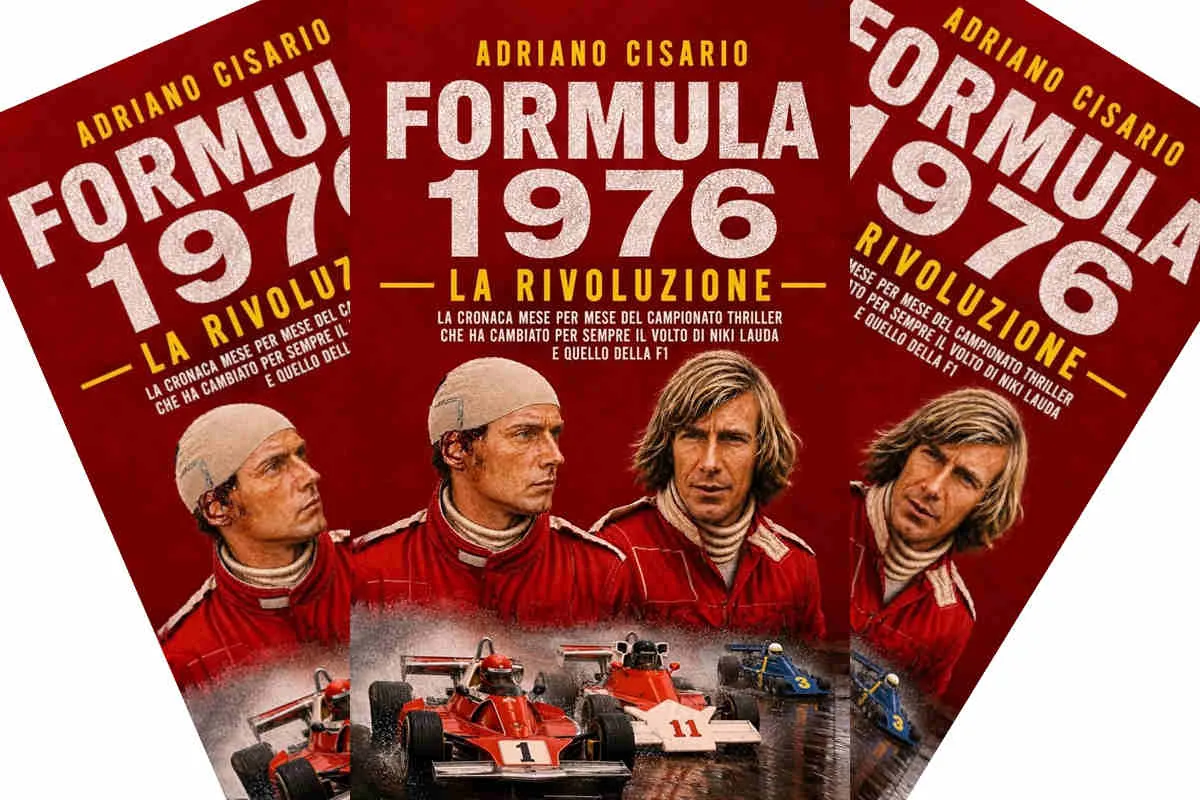
The cover says it immediately: on one side Lauda with white bandages, a sharp gaze; on the other Hunt with windblown hair and a playboy air. Below, the single-seaters in action on the wet track. The subtitle is eloquent: “The month-by-month chronicle of the thriller championship that forever changed the face of Niki Lauda and that of F1.”
A championship born already “succulent”
Cisario starts with the premises. After eleven years Ferrari returns to display the number 1. Lauda brought back to Maranello the title missing since 1964 with John Surtees. Mauro Forghieri’s 312 T, defined by the Austrian himself as “Forghieri’s astonishing monument, a jewel of a racing car,” dominated 1975. But 1976 brings new rules: away with the periscope air intakes (the airscopes), deformable structures to protect the driver’s feet, additional roll-bar. Maranello is ready: the 312 T2 was presented already on October 25, 1975, at Fiorano, under the sun, with Enzo Ferrari, the drivers, and even the Drake who escaped a kidnapping attempt.
The book follows every Grand Prix with the eyes of someone who was there (Cisario, then a boy, had his passion born precisely from that season) and of someone who interviewed the protagonists decades later.
The green hell and the resurrection
On August 1 at the Nürburgring, the so-called “green hell,” Lauda had the accident that disfigured his face and brought him close to death. Cisario reconstructs those minutes with emotional involvement, but without rhetoric. Then comes the miracle: at the end of August, at the Dutch Grand Prix, Lauda is back on track. “I’m ready,” he says. Hunt, on his birthday, wins. Ferrari, meanwhile, had its problems: double retirement in France due to a crankshaft defect that breaks the myth of red reliability. Hunt takes advantage and starts the comeback.
Read more “We need to understand”, “the potential”, “the execution”: the mantras of Ferrari’s chases
The other revolutions of the season are not missing: the first victory of the six-wheeled Tyrrell P34, the technical-legal disputes between Ferrari and McLaren, the internal quarrels in Maranello, Lauda’s quick marriage to model Marlene Knaus.
Fuji, the rain and the eternal doubt
The climax is the Japanese Grand Prix. Lauda leads the world championship by three points. It’s pouring rain. The Austrian retires after two laps. Hunt finishes third and wins the title by a single point. Even today that decision divides opinion. Cisario dedicates an entire chapter to the “Fuji bluff.” Lauda, in civilian clothes, watches from the box, then gets into a rented Rolls-Royce and leaves with Forghieri and his wife. Forghieri recounts: “Lauda was extremely strong in fully taking responsibility for the retirement.” But there are also those who speak of weakness shown to everyone. The book does not take a clear position, letting the facts and voices of the time speak.
The idea
Formula 1976. The Revolution is a feverish tale, made of pathos and thriller, of innovation and unbridled antagonism. Cisario, already author of Quasi ferraristi and Ferrari. Crisis and Redemption for Ultra Sport, mixes chronicle, curiosities, and interviews years later. The result is a volume that brings to life eight very intense months and explains why, from that season, Formula 1 took on the features of modernity: more spectacle, more business, more tension. VB
Read more Magny-Cours 2026, Race 1: Bulega returns immediately to the top