


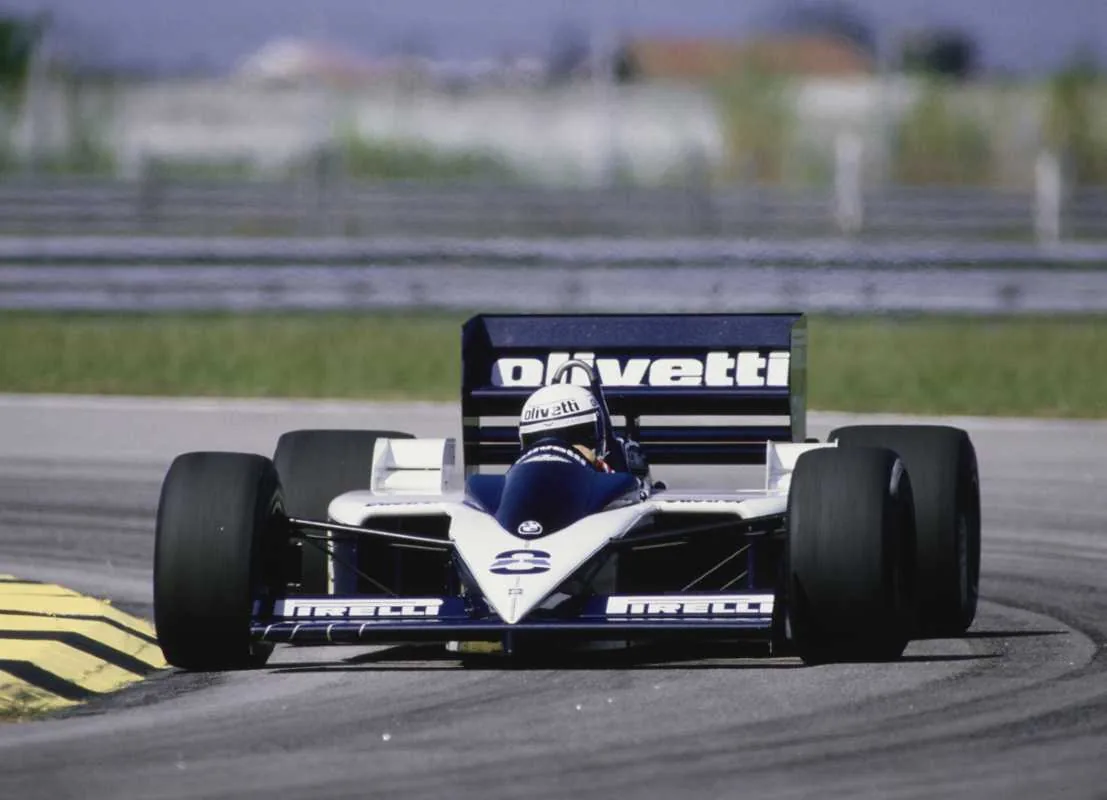
The 1986 Monaco Grand Prix was not particularly happy for the Brabham Bmw: Patrese broke the fuel pump, De Angelis was betrayed by the engine. So, Gordon Murray had decided to carry out, from May 13, a test session at Paul Ricard, the French track of Le Castellet.
Gordon Murray had designed a completely new car, very low, which forced the driver into an almost lying position and for this reason it was nicknamed “sole”. To this end, the Bmw technicians had designed a new engine by tilting it 72 degrees on one side, to be able to install it on the car. With this, Murray tried to make the air flows during movement “cleaner” and obtain greater downforce. For the first time on a Brabham, the chassis was all carbon fiber. That day in Monte Carlo, after the Grand Prix, Elio asked Patrese: “Riccardo I know Gordon has called you for tests at Paul Ricard, if you don’t mind let me go who am still very fresh from Brabham”. Patrese agreed without problems.
The tests began at Le Castellet, but on May 14 Elio was the victim of a very serious accident: while traveling along the long straight of Paul Ricard, the Brabham lost the rear wing, the single-seater went crazy spinning in the air, flipped six or seven times ending the run against the barriers, 250 meters ahead, catching fire. Several drivers, including Alan Jones and Nigel Mansell stopped to help and Alain Prost tried to extract De Angelis from the cockpit despite the flames, without success. Despite the hope for a miracle, the next day Elio de Angelis ceased to live, like a matador killed by a steel bull. And Riccardo Patrese, for weeks and weeks remained anguished at the thought that that accident, without that gear change, could have happened to him.
Elio de Angelis was 28 years old, he had raced with Shadow, Lotus and Brabham, he had won two Grand Prix (Austria and Imola), he had achieved three pole positions. He was certainly a great driver but, even more, a great character: a serious, calm boy, a «professional of great qualities – as Luca di Montezemolo had the opportunity to write then, on the Corriere della Sera – who paid with his life the lack of professionalism that often accompanies perhaps the most dangerous sport in the world».
Son of Giulio de Angelis, powerboat champion who rose to fame not only for his world victories but also because he was a victim of a kidnapping, Elio had immediately stood out with Formula 3. He traveled around Europe with his father’s jet, hosting on board his two great friends, Nelson Piquet and Piercarlo Ghinzani. Elio won the Lottery GP in Monza: he, a billionaire, had dispensed the billions of the national contest. A nice headline for the sports pages of the Corriere. He saw me one day, in Germany, and said to me: «You know I can’t forgive you for that headline? I don’t like being defined a billionaire because of my father’s money and not a driver. The family fortune can also help you, but to move forward you need qualities. And everything my father gave me, I have already returned to him». He had the modesty to be like all the other drivers: when he arrived in Formula 1, in 1977, he no longer used the personal jet and rarely traveled first class.
Elio was also an excellent pianist. Those who frequented Formula 1 in the early 80s cannot forget how he interpreted Gershwin’s music during a drivers’ strike, in Johannesburg, South Africa, because of a superlicense that no one wanted to accept. The drivers had gathered in a large hotel refusing to participate in the qualifying. Elio had found a piano in the large hall and had started playing. The notes carried in the air the sweetness of the nature of that young Roman who was completely exalted only behind the wheel of an F1 and by the feats of Roma: when the team, then coached by Liedholm, won the championship, Elio hoisted the great flag on his boat in Monte Carlo. He had a beautiful German girlfriend, Ute Kittelberger, and an intimate and fraternal friend, Louis Ruzzi, a young Argentine engineer who after Elio’s death disappeared from a world that perhaps only reminded him of pain.
In the years he raced, he had only one aversion, that for Ayrton Senna who was his teammate at Lotus, a favorite of the technicians and mechanics. I noticed this aversion in Montreal, in the qualifying of the 1985 Canadian GP where he took pole position. Elio got out of the Lotus and turned to Mansell saying: “Here Nigel, the answer from us old men to the presumptuous kid”. The kid was Ayrton Senna, his teammate at Lotus. Elio de Angelis is no longer here, and it seems like yesterday. Discreet and kind, he never bothered us in these decades arousing, inside us, secret reminiscences. He came back these days, suddenly: to make us understand that he is dead but not gone. From the heart of true Formula 1 enthusiasts.
Click here to add Formula Passion as a preferred source on Google Discover: you will find our content more easily!