





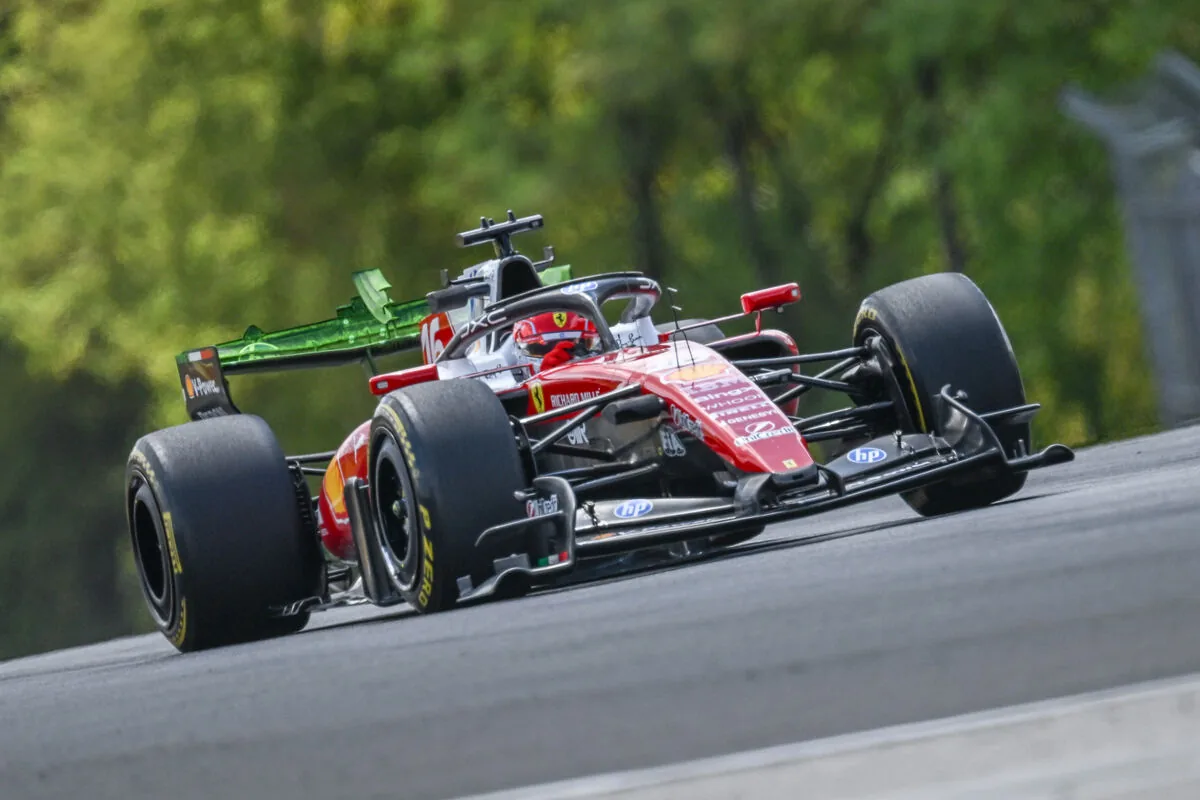
The first free practice session of the Hungarian Grand Prix yielded a particularly convincing Ferrari. On a track that was still very “green”, dirty and slippery, the SF-26 appeared to be the most refined car in terms of basic setup, allowing Charles Leclerc to immediately find speed and confidence. It’s only the first session of the weekend and the track conditions will change significantly as the sessions progress, but the start of the Maranello team still deserves to be highlighted. The car’s behavior seems to indicate excellent work done upstream, between the factory and the simulator, arriving at the Hungaroring with a configuration already very close to the circuit’s needs. An important advantage on a track where driver confidence and balance consistency make a significant difference.
Read more Here’s the Aston Martin 2.0: all-new aerodynamics, even higher suspension
Rear under special observation: for now it seems exactly on the limit
Leclerc was the driver who found the most confidence, exploiting a very neutral basic balance and an overall grip level that appeared, at least for the moment, truly high. Ferrari showed high cornering speed, also giving both drivers the possibility to manage rotation with the accelerator, something that, for example, we had seen Hamilton do little of in past races.
The rear of the SF26 is certainly under special observation in these sessions, as much of the Maranello team’s overall weekend performance will likely depend on its stability, and for now, the impression is that it is solid, albeit not far from the limit. The feeling is that the balance brought to the track has a very neutral longitudinal balance, which brings the rear of the red car to be exactly at the necessary limit, without yet seeking any form of understeer to protect the tires in view of the temperatures expected for Sunday. In his best lap, Leclerc clearly lost the rear on two occasions, at turn 5 and the last turn. Two visible moments, but part of a lap in which, for the rest of the track, Charles managed to use the throttle with great determination already in the cornering phases and especially in traction. The SF-26 did not simply appear stable, but capable of guaranteeing the driver a good level of predictability even when the rear approaches loss of grip. Leclerc was thus able to carry a lot of speed through the mid-corner on average, often using a significant percentage of throttle to sustain the car’s rotation.
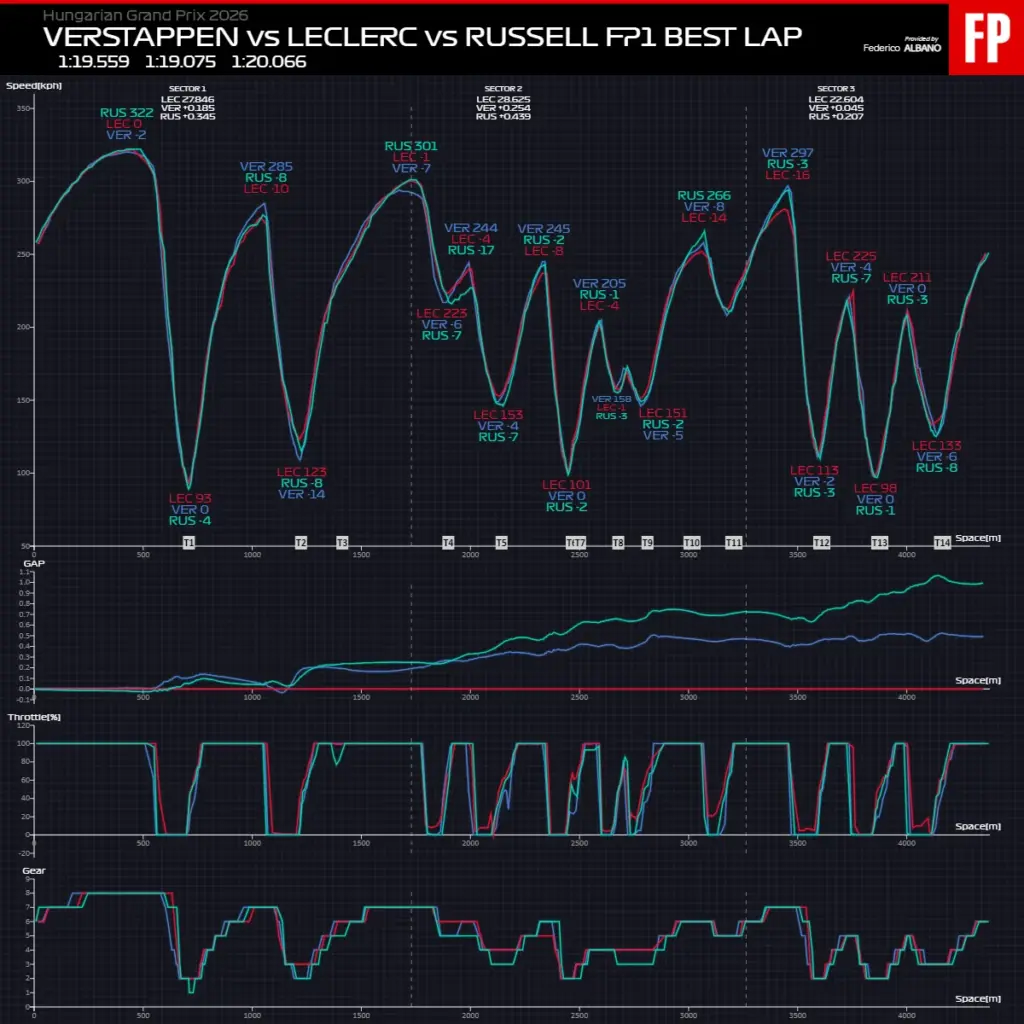
Ferrari manages energy based on traction
From an energy perspective, two recharge zones are evident from the data in Leclerc’s lap before turns 11 and 12. Ferrari evidently sacrifices a small part of the thrust in those sections (about 1 and a half tenths lost) with the aim of arriving in the immediately subsequent section, with accelerations from low speeds in the third sector, with energy to be concentrated low down to maximize the exit phase. A strategy consistent with the characteristics of the Hungaroring, where restarts constitute a fundamental part of the lap time. Even in very short race simulations, Ferrari appeared fast, with a good Hamilton in that case, given the breakdown suffered by Leclerc. However, it remains to be seen whether the very neutral balance seen in FP1 will remain so when the track rubbers in and temperatures rise as the weekend progresses.
Hamilton good with the old wing, but suffers from stiffness
Lewis Hamilton worked with the not fully updated rear wing, still showing a good overall performance. However, the Briton appeared slightly more challenged in managing the stiffness of the car, which had too pronounced bumps over curbs and dips. On an uneven track characterized by various load transfers, controlling the ride heights and aerodynamic platform will be one of the aspects to follow throughout the weekend. The Ferrari’s base still seems valid on both cars, despite some differences in configuration and confidence between the two drivers.
The others almost entirely to be discovered. FP2 crucial
Mercedes’ start was more complex. George Russell appeared to be in great difficulty on a single lap, while showing something better in the race pace simulation. The W17 still seems to need a lot of work to find the correct operating window, but FP2 will offer a much more significant reference with Kimi Antonelli’s entry onto the track. Verstappen, on the other hand, started the weekend positively, although it is not yet clear what Red Bull’s real margin is. It is even more difficult to evaluate McLaren, engaged with Norris and Fornaroli in a long update validation program that inevitably hid their potential over a single lap. FP2 will therefore be crucial. First of all, to understand if Ferrari will be able to confirm its excellent initial base with a more rubbered-in track. But also to discover the true level of Mercedes and the other rivals of the red car, who showed very little of their cards in the first session.
Read more Ferrari super with Leclerc, but there’s a thrill: a problem knocks out the SF-26 at the end of FP1