



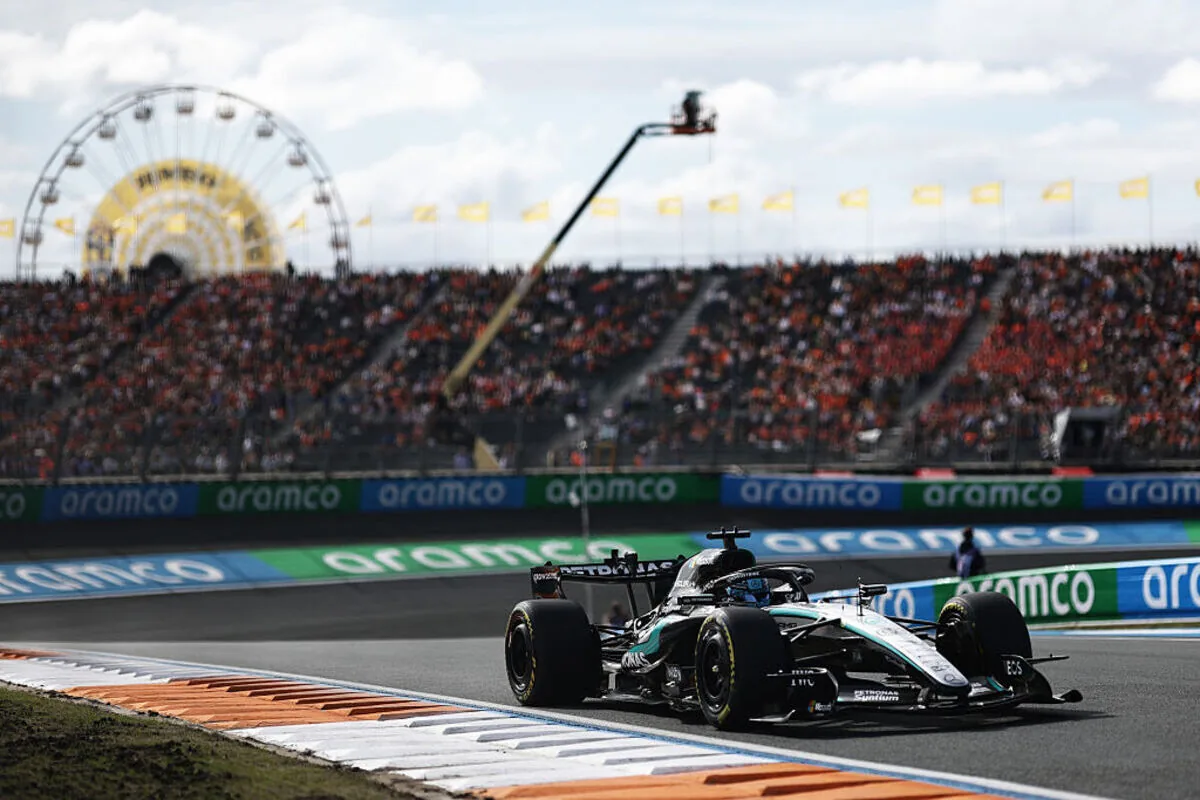
The Sprint Qualifying of the Dutch Grand Prix confirmed what was already hinted at in the free practice sessions: the balance at the front is really tight, with McLaren, Ferrari, and Mercedes placing the top 4 drivers in the standings within less than a tenth. The margins are small but looking at the data we notice that the 3 top teams build performance in very different ways. While the Woking and Maranello cars show quite similar characteristics, albeit with different strengths, the Mercedes almost represents an “outlier” in terms of the distribution of performance throughout the lap.
Read more Hamilton, misstep in Sprint Qualifying: “It was a total disaster”
Updated McLaren and Ferrari strong on fundamentals
The MCL40 and SF26 currently seem to be the two cars closest in general philosophy. The red car continues to show an excellent level of downforce and a good front end that brings great effectiveness in slow corners, where the car appears precise on entry and capable of rotating well without putting too much strain on the rear. The rear end appeared very stable both in free practice and qualifying, demonstrating what seems to be an evolution of the red car’s package in terms of controlling rear movement during exit and traction phases. The McLaren responds mainly in high-speed corners, where it manages to maintain a very stable platform and show excellent speed feedback in the central part of the circuit, the famous “toboggan” of the middle sector made entirely of fast corners. The differences over a lap between the red and papaya cars ultimately become minimal precisely because the two packages recover ground on each other in different parts of the track.
Mercedes is very different, both in energy and setup
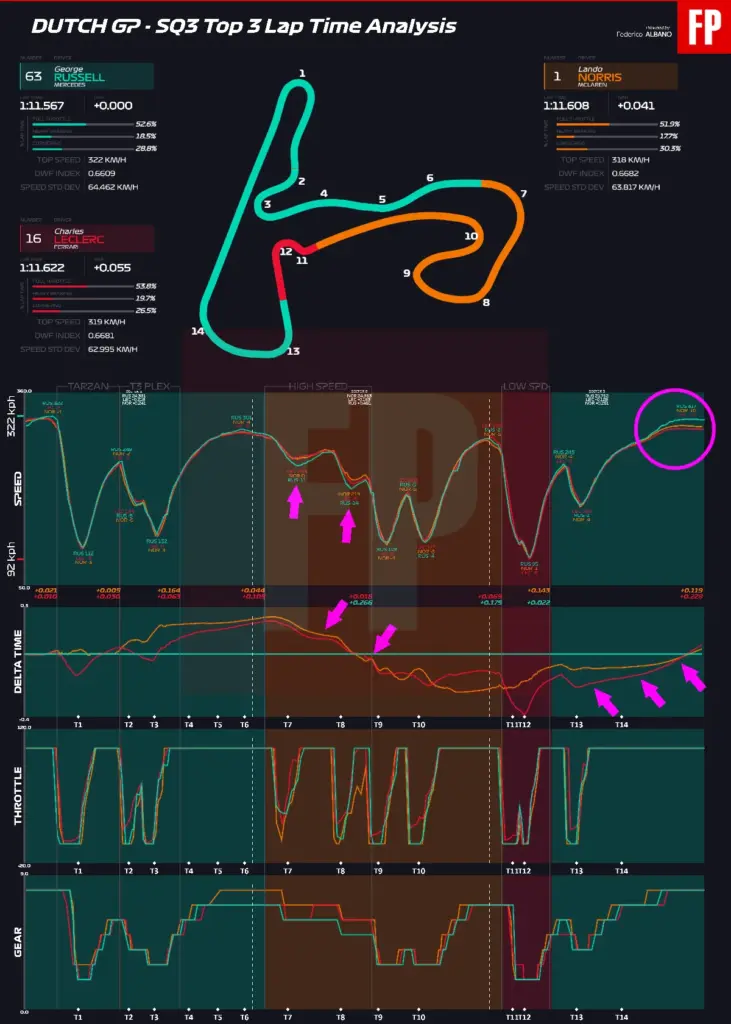
The story changes significantly when observing the Mercedes. From the data we see a very competitive Russell in the first sector, but who then suffered significantly in the fast corners, particularly between turn 7 and turn 8, a stretch that throughout the session represented one of the weakest points of the W17, with average speed readings about 10 km/h slower than McLaren and Ferrari in all conditions and with all compounds, betraying presumably lower aerodynamic downforce, as well as a less incisive front end, perhaps in an attempt to protect the rear for the long final traction. In the central sector the Englishman even lost almost half a second compared to the references of Norris and Leclerc, a situation very different from the battle for thousandths that took place precisely between the other two rivals throughout the lap.
The “monster” power delivery in the third sector however brought the situation back to substantial parity. According to our measurements, at turn 13 Russell was still virtually third, about two tenths behind Leclerc and one behind Norris, but starting from the entry of the parabolic corner the Mercedes PU of the Brackley team showed a margin significantly superior to the competition. On the main straight Russell reached a top speed of around 317 km/h, against about 307 of Norris’s McLaren and even 302 of Leclerc’s Ferrari.
Numbers that quite clearly tell both the usual energy surplus of Mercedes, but also how the W17’s setup today seems different compared to that of the two rivals. The feeling is that Brackley chose to sacrifice some aerodynamic downforce, especially in the fastest corners, balancing it with lower drag and greater energy availability in the final acceleration. A solution that could also be the result of aerodynamic progress made by Ferrari and McLaren with various update packages: if the rivals can now produce more efficient downforce, Mercedes seems forced to rely more on what continues to be one of its main strengths, namely the Power Unit. Antonelli also showed similar feedback to Russell in both free practice and qualifying, but the damage caused by the off-track excursion was felt especially in the slow corners: the lack of downforce at turn 12, the slowest part of the track, put Kimi in difficulty, with a loss of about two tenths just in that passage, roughly equal to his entire gap on the line.
Read more Leclerc 3rd with a smile: “My best qualifying lap this year”
Deserved Top 3, Hamilton doesn’t understand the soft. Sprint to be discovered
At the front, however, the result of the Sprint Qualifying appears deserved. Russell, Norris, and Leclerc all completed very high-level laps in not easy adaptation conditions. More curious is the very negative feedback from Lewis Hamilton. The seven-time World Champion indeed struggled in SQ3, but in the first two phases his Ferrari had not appeared so problematic. The impression is that the soft tire provided a really important grip gain, also changing the car’s behavior, and the Englishman did not find the key to maximize its performance, then letting himself go to some negativity in interviews more because of the result than the actual performance of the car. The Sprint now becomes particularly interesting. Ferrari and McLaren therefore seem to have a bit more aerodynamic downforce, Mercedes a clearly superior top speed. It remains to be seen how much the new regulations will actually allow these ingredients to be transformed into overtaking opportunities. The premises, at least, are the right ones.